
The Resurgence of Small Business Investment in U.S. Retail Markets
The Economic Multiplier Effect: Why Small Businesses Matter
Small Business Saturday's impact extends far beyond direct sales. In Michigan, a state where small businesses account for 99.6% of all firms, the event underscores the critical role of local enterprises in sustaining jobs and public services. Data from the Michigan Retailers Association reveals that every $100 spent at a local retailer generates over $5 in public services and $22 in new income for the state compared to out-of-state online retailers. This "multiplier effect" is particularly pronounced in rural and smaller communities, where small businesses form the backbone of economic resilience. For investors, this dynamic highlights the value of supporting sectors that prioritize localized value chains, such as grocery-anchored retail centers and urban retail hubs.
E-Commerce Fatigue and the Rise of Hybrid Models
While e-commerce continues to grow, its expansion is slowing. The 2025 U.S. Online Retail Report notes that digital sales now account for 23.5% of total retail, with a projected ceiling of 30% by decade's end. As consumers grow weary of the homogenization and logistical challenges of online shopping, demand is shifting toward hybrid models that blend physical and digital touchpoints. Retailers leveraging unified commerce platforms-enabling real-time inventory synchronization and personalized experiences-are seeing significant returns. For instance, AI-driven tools like chatbots and recommendation engines have boosted conversion rates by 20-30% and reduced returns by 12% in cases such as Urban Outfitters' virtual styling sessions. Investors should prioritize companies integrating AI and omnichannel strategies to meet evolving consumer expectations.
Strategic Investment Opportunities in Regional Retail
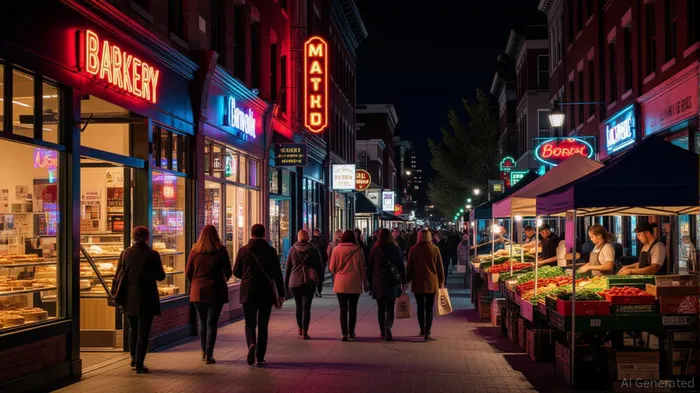
The 2025 retail investment market has demonstrated resilience, with Q1 transaction volumes reaching $9.8 billion-a 13% increase year-over-year. Grocery-anchored centers, in particular, have attracted 31% of total multi-tenant retail investment, driven by their stable tenant base and resistance to e-commerce disruption. Urban retail locations are also gaining traction, as evidenced by Uniqlo's $352.5 million acquisition of its New York City flagship and Apple's $88 million Boston store. These transactions reflect a broader trend: investors are favoring assets in prime locations that combine foot traffic with digital integration. The Mid-Atlantic region, which saw a 38% year-over-year growth in retail investment, exemplifies the potential of regional markets to deliver outsized returns.
Community-Driven Commerce: A New Frontier for Capital
Community-driven commerce is gaining momentum as consumers seek authenticity and localized value. In Dallas-Fort Worth, over 955,000 small businesses contribute to a diverse economic ecosystem spanning industries from healthcare to defense. Similarly, Nashville's economy thrives on its 365,487 small business employees in sectors like music and healthcare. For investors, opportunities lie in supporting platforms that empower small businesses to scale, such as e-commerce marketplaces (e.g., Etsy) and AI-powered tools that enhance customer engagement. Venture capitalists are increasingly optimistic about this space, with predictions of a reimagined digital shopping experience driven by the creator economy and AI.
Navigating the Future: Key Recommendations for Investors
- Prioritize Resilient Assets: Allocate capital to grocery-anchored centers, urban retail hubs, and big-box power centers, which have demonstrated resilience against e-commerce pressures.
- Leverage Technology: Invest in AI-driven personalization, unified commerce platforms, and localized fulfillment strategies to enhance operational efficiency and customer retention.
- Support Community-Driven Innovation: Back small businesses and platforms that foster local economic ecosystems, such as private-label brands and direct-to-consumer models.
- Adopt Hybrid Models: Focus on retailers integrating physical and digital experiences, as these are best positioned to capitalize on shifting consumer preferences.
As the retail sector evolves, the 2025 Small Business Saturday data and investment trends underscore a clear imperative: capital must flow to sectors that align with the values of authenticity, resilience, and community. For investors, the path forward lies in strategic, technology-enabled allocations that harness the enduring power of local commerce.





Comentarios
Aún no hay comentarios