
The Resurgence of Pro-Business Policy in AI and Tech
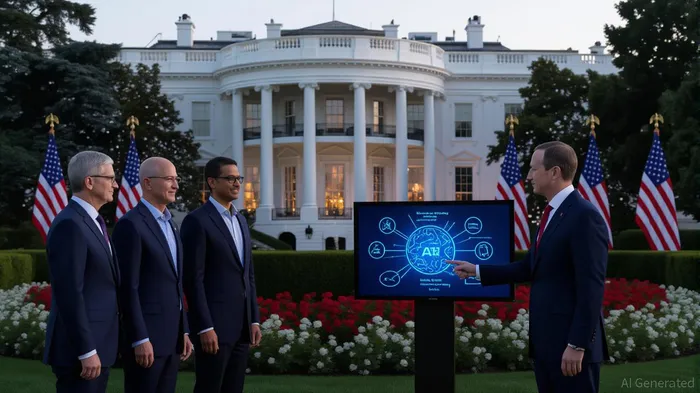
The U.S. artificial intelligence landscape is undergoing a seismic shift, driven by a strategic convergence between the Trump administration's deregulatory agenda and the ambitions of Silicon Valley's most influential players. With the release of the 90-point Winning the Race: America's AI Action Plan in July 2025 and the subsequent White House summit on September 5, 2025, the administration has signaled a clear intent to reassert American dominance in AI by dismantling regulatory barriers, accelerating infrastructure development, and fostering a unified front with tech giants. For investors, this alignment presents a rare window of opportunity in AI-driven tech stocks and innovation-linked ETFs, as policy tailwinds and corporate commitments collide.
Policy as a Catalyst: Deregulation and Infrastructure Prioritization
The Trump administration's AI Action Plan is a masterclass in strategic deregulation. By revoking Biden-era policies like Executive Order 14110 and introducing Executive Order 14318—which fast-tracks data center permitting and energy grid modernization—the administration is creating a regulatory environment that prioritizes speed and scale. The plan's three pillars—Accelerating Innovation, Building American AI Infrastructure, and Leading in International Diplomacy and Security—are not just aspirational; they are actionable.
For instance, the administration's push to streamline NEPA reviews for data centers and expand access to federal land for AI infrastructure has already spurred a $600 billion investment pledge from MetaMETA-- and a $100 billion domestic manufacturing commitment from AppleAAPL--. These moves are underpinned by a 60-day mandate for the Office of Management and Budget to revise OMB memoranda, ensuring alignment with the new policy framework.
The deregulatory approach extends to federal procurement, where the “Unbiased AI Principles” executive order mandates ideologically neutral AI systems for government use. This has direct implications for companies like MicrosoftMSFT-- and GoogleGOOGL--, which are now recalibrating their models to meet these criteria. The removal of DEI and climate change references from the NIST AI Risk Management Framework, for example, simplifies compliance for tech firms, reducing friction in federal contracts.
Tech Giants as Policy Partners: A New Era of Collaboration
The September 2025 White House summit marked a turning point in the relationship between the administration and Silicon Valley. For years, tech leaders had criticized Trump's regulatory skepticism, but the event showcased a unified front. Sam Altman of OpenAI praised the administration for “bringing the power of the industry back to the United States,” while Sergey Brin of Google called it an “incredible inflection point.”
This alignment is not merely symbolic. The administration's AI Action Plan includes a 180-day timeline for agencies to review and revise Biden-era FTC investigations deemed “burdensome” to AI innovation. This creates a favorable environment for companies like NVIDIANVDA-- and AMDAMD--, whose semiconductor technologies are critical to AI development. Additionally, the proposed AI Information Sharing and Analysis Center (AI-ISAC) will enhance cybersecurity collaboration, a sector where firms like PalantirPLTR-- and CrowdStrikeCRWD-- are poised to benefit.
Investment Implications: Infrastructure, ETFs, and Market Leadership
The administration's focus on AI infrastructure—data centers, energy grids, and cybersecurity—points to a multi-trillion-dollar investment opportunity. The modernization of the power grid to support AI's energy demands, for instance, could accelerate adoption of clean energy technologies, benefiting companies like NextEra Energy and BrookfieldBN--. Meanwhile, the push for “minimum data quality standards” positions firms like SnowflakeSNOW-- and Databricks as key players in data management.
For investors, innovation-linked ETFs such as the XLK (Technology Select Sector SPDR Fund) and VGT (Vanguard Information Technology ETF) offer diversified exposure to the AI boom. These funds include heavyweights like Microsoft, Apple, and AmazonAMZN--, which are directly aligned with the administration's infrastructure and export strategies.
The administration's emphasis on international diplomacy also opens avenues for export-driven tech firms. By promoting the “American AI Technology Stack” to allied nations, companies like IBMIBM-- and SalesforceCRM-- are likely to see increased demand for cloud and enterprise AI solutions. Furthermore, the administration's resistance to state-level AI regulations—advocating for a single federal standard—reduces compliance complexity, making large-cap tech stocks more attractive.
Positioning for the AI-Driven Future
The Trump administration's AI agenda is a calculated blend of deregulation, infrastructure investment, and global competition. For investors, the key takeaway is clear: the U.S. is pivoting toward a pro-business, innovation-first AI ecosystem. This creates near-term tailwinds for tech stocks in infrastructure, semiconductors, and cybersecurity, as well as long-term opportunities in AI-driven exports and workforce development.
However, risks remain. The administration's push for federal preemption of state AI laws could face legal challenges, and privacy concerns—unaddressed in the AI Action Plan—may resurface. Yet, given the current momentum, the strategic alignment between policy and industry is a powerful force.
Actionable Advice:
1. Overweight AI Infrastructure Stocks: Prioritize companies like Meta, Apple, and NVIDIA, which are directly benefiting from deregulation and infrastructure spending.
2. Allocate to Innovation ETFs: Diversify with XLK and VGT to capture broad-based AI growth.
3. Monitor Export-Driven Sectors: Watch for opportunities in cloud computing and enterprise AI as the administration's international strategy unfolds.
The AI race is no longer a distant horizon—it is here, and the U.S. is accelerating. For investors, the time to act is now.





Comentarios
Aún no hay comentarios