
The Resurgence of the Mining Sector and Its Strategic Implications for Canadian Equities
The global mining sector is experiencing a renaissance, driven by a confluence of macroeconomic tailwinds and the accelerating energy transition. For Canadian equities, this resurgence presents both opportunities and challenges, as the country's mining industry navigates shifting demand dynamics, regulatory reforms, and geopolitical uncertainties.
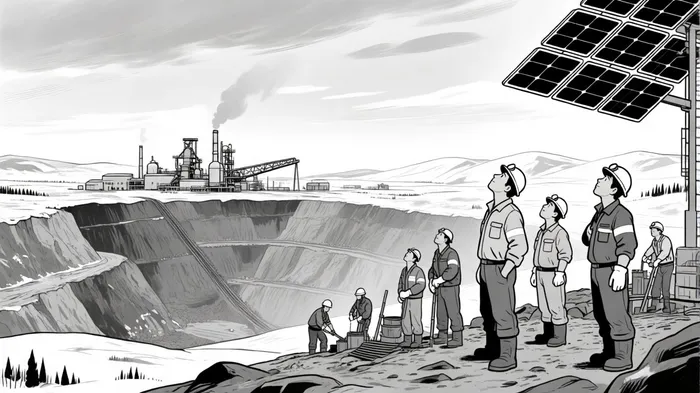
Macroeconomic Tailwinds: Energy Transition and Dollar Weakness
The energy transition has become the sector's most powerful catalyst. Demand for critical minerals such as copper, lithium, and uranium is surging; an AvantisAI analysis projects copper demand for clean energy technologies to more than double by 2030. This has directly benefited Canadian producers, as the S&P/TSX Global Mining Index (TXGM) rose 6% in Q2 2025 amid macroeconomic volatility, according to a Daily Miner report. A weaker U.S. dollar, which typically supports commodity prices, has further bolstered the sector, while trade tensions-such as U.S. tariffs on steel and aluminum-have created short-term uncertainties, the Daily Miner report noted.
Canada's strategic position as a top-tier mining jurisdiction is also gaining traction. The country hosts 40% of the world's public mining companies and is home to 41 initial public offerings (IPOs) in 2024 alone, raising $10 billion in capital, as the Daily Miner reported. This influx reflects investor confidence in Canada's mineral endowment and its alignment with global decarbonization goals.
Canadian Sector Momentum: Policy and Capital Alignment
Government initiatives are amplifying the sector's momentum. The $4-billion Critical Minerals Strategy, launched in 2025, aims to establish Canada as a global supplier of essential resources like battery-grade nickel and cobalt, according to an EDC article. Complementing this, the Critical Minerals Infrastructure Fund (CMIF) has allocated up to $500 million to support infrastructure projects, addressing a key bottleneck in the value chain, per a Natural Resources Canada announcement.
Canadian companies are already capitalizing on these trends. Gold producers such as Barrick Gold and Agnico Eagle have seen record prices, with gold exceeding $2,400 per ounce in early 2025 due to its safe-haven appeal, as noted in the AvantisAI analysis. Copper, meanwhile, is emerging as a cornerstone of the green economy, with EDC facilitating $8.9 billion in mining-related business in 2024.
The sector's resilience is further underscored by strategic mergers and acquisitions. The June 2025 merger of Equinox Gold and Calibre Mining created a leading gold producer with significant Canadian operations, reflecting a broader trend of consolidation to strengthen balance sheets and secure assets, according to a KPMG press release.
Challenges and Regulatory Hurdles
Despite these positives, challenges persist. Regulatory complexity remains a drag on investment, with Canada's average mining project taking over 17 years to progress from discovery to production, per a Resource World analysis. Permitting delays and the need for decarbonization are top concerns for industry leaders, with 98% of mining executives surveyed by KPMG calling for more government support.
Moreover, Canada's lack of smelting and refining capacity for critical minerals-such as lithium and rare earth elements-poses a risk to long-term competitiveness. Addressing this requires not only capital but also policy reforms to streamline approvals and reduce duplication across jurisdictions, as highlighted in the Resource World analysis.
Investment Strategies: Navigating the New Normal
For investors, the key lies in balancing exposure to high-growth critical minerals with ESG-aligned strategies. The surge in the S&P/TSX Battery Metals Index (+29.8% in 2024) highlights the potential of electrification-driven demand, as the Daily Miner reported. However, companies must also demonstrate robust environmental and social governance (ESG) practices to retain capital, as stakeholders increasingly tie investment to measurable sustainability outcomes, the AvantisAI analysis observes.
Tax incentives like the Critical Mineral Exploration Tax Credit (CMETC) are proving effective, with 76% of respondents in a KPMG survey indicating it has attracted capital for exploration. Yet, the CMETC's current scope-covering only 15 of 31 critical minerals-limits its impact, prompting calls for expansion.
Conclusion: A Sector at a Crossroads
The mining sector's resurgence is a testament to its adaptability in the face of macroeconomic and geopolitical headwinds. For Canadian equities, the path forward hinges on aligning with global energy transition goals while addressing domestic regulatory and infrastructural bottlenecks. As demand for critical minerals accelerates, companies and investors that prioritize innovation, sustainability, and strategic partnerships will be best positioned to capitalize on this transformative era.







Comentarios
Aún no hay comentarios