
The Resurgence of Local Retail: Analyzing the Impact of Small Business Saturday on Small-Cap Retail Stocks
Consumer Behavior: A Shift Toward Local Identity
The 2023 Small Business Saturday underscored a generational shift in consumer preferences. According to a report by the Seattle Office of Economic Development, , . households by 2025. This trend is not merely about price but about identity. For every $100 spent at a local business, , . In Seattle, where minimum wage pressures and rising operational costs have strained small retailers, this loyalty has become a lifeline.
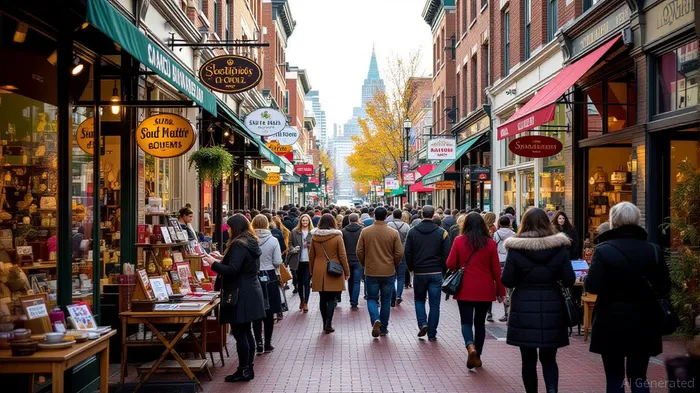
The data is even more striking in rural areas. in such regions, serving as engines of employment and economic resilience. The rise of e-commerce has further amplified their reach, allowing rural entrepreneurs to bypass geographic limitations. Platforms like EtsyETSY-- and TikTok have enabled niche brands to scale nationally, creating a hybrid model of local authenticity and digital accessibility.
Regional Resilience: Casper and Seattle as Case Studies
While national chains struggle with homogenization and e-commerce competition, cities like Casper, Wyoming, and Seattle, Washington, have leveraged Small Business Saturday to reinforce their unique economic identities. In Casper, local retailers such as The Cadillac Cowgirl and Wind City Books offered discounts and community events, drawing foot traffic that "felt like a holiday parade". Similarly, Seattle's Pioneer Square and West Seattle Junction saw surges in activity, 's "Magic in the Market" and pop-up markets in creating a sense of urgency and community.
Seattle's data highlights the symbiotic relationship between office occupancy and retail success. As downtown workers returned post-pandemic, . This correlation suggests that local retail is not just a seasonal event but a barometer of broader economic health. For investors, the lesson is clear: regions that foster localized consumer ecosystems are better positioned to weather macroeconomic volatility.
Small-Cap Stocks: A New Frontier for Investors?
The resurgence of local retail has not gone unnoticed by . While direct links between Small Business Saturday and small-cap stock performance remain elusive, broader trends suggest a growing alignment. For instance, for 2025, . Though the company continues to post losses, its modest growth reflects the resilience of niche brands in a fragmented market.
Investor sentiment is also shifting. view the holiday season as critical to annual profitability, . This optimism is mirrored in the stock market, where sectors tied to local commerce-such as and e-commerce-have shown volatility but also strong rebounds in Q4. The key for investors lies in identifying companies that balance local authenticity with scalable digital strategies.
Challenges and Opportunities
Despite the positive momentum, challenges persist. and inflation have squeezed margins, particularly in apparel and electronics, forcing small businesses to pass costs to consumers. In Seattle, adds further pressure. Yet these headwinds have also spurred innovation. For example, 83% of small businesses now use social media for marketing, . Such adaptability is a hallmark of the sector's long-term viability.
Conclusion: A Symbiotic Future
Small Business Saturday is more than a retail event; it is a microcosm of the American economy's evolving priorities. By prioritizing local spending, consumers are not only sustaining small businesses but also reinforcing the economic resilience of their communities. For investors, the challenge is to identify small-cap stocks that align with these values-companies that thrive on hyperlocal engagement while leveraging digital tools for growth.
As the 2025 holiday season approaches, the lessons from Casper and Seattle are clear: the future of retail lies in the intersection of community and commerce. Those who recognize this shift early may find themselves positioned to capitalize on a trend that is here to stay.





Comentarios
Aún no hay comentarios