
The Resurgence of Institutional Ethereum Demand: Whale Activity, Corporate Staking, and the Fusaka Upgrade
The EthereumETH-- ecosystem is undergoing a seismic shift in 2025, driven by a confluence of institutional adoption, whale accumulation, and corporate staking, all amplified by the technical advancements of the Fusaka Upgrade. These factors are not only reshaping Ethereum's supply dynamics but also positioning it for a supply-side breakout in 2026.
Institutional Adoption: A New Era of Capital Inflows
Institutional demand for Ethereum has surged, with U.S. spot Ethereum ETFs attracting record inflows. By September 2025, total inflows reached $10.75 billion, including a single-day influx of $35.49 million according to market analysis. BlackRock's proposed staked ETH ETF, which plans to allocate Ethereum assets to custodians like Coinbase Custody and Anchorage Digital, has further solidified institutional confidence according to reports. This trend reflects a broader shift toward Ethereum as a yield-generating asset, with staking now accounting for over 36.15 million ETH in total staked supply.
Whale Accumulation and Corporate Staking: Supply Tightening in Action
Large whale wallets-those holding 10,000 to 100,000 ETH-have accumulated over 20 million ETH, signaling long-term bullish sentiment. 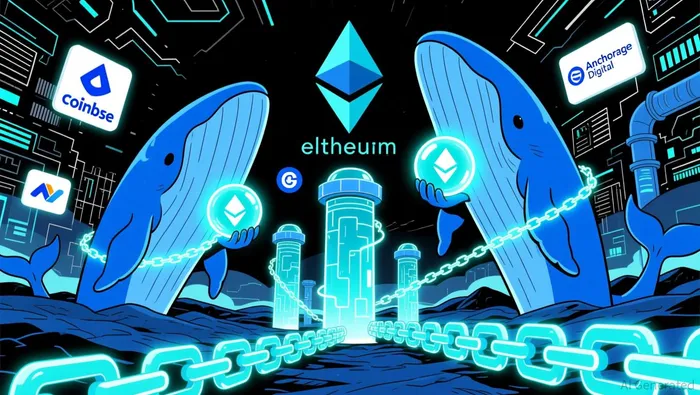 Simultaneously, corporate staking has gained momentum, with firms like BitMine Immersion Technologies amassing 2 million ETH in treasury holdings and staking a significant portion for yield according to industry analysis. These activities have drastically reduced the liquid supply of ETH on exchanges, with current exchange-held reserves at 8.7% of total supply (16.6 million ETH)-a historic low according to data. This tightening of liquidity underscores a structural shift in how Ethereum is being utilized, favoring staking and long-term custody over speculative trading.
The Fusaka Upgrade: Scaling for the Future
Ethereum's Fusaka Upgrade, activated on December 3, 2025, marks a pivotal step in its roadmap to scalability and efficiency. Key innovations include PeerDAS, which allows validators to verify rollup data via sampling, reducing bandwidth and storage requirements according to technical analysis. This upgrade also introduces Blob Parameter Only (BPO) forks, enabling incremental increases in blob capacity without disruptive hard forks according to industry experts. The block gas limit has been raised from 36 million to 60 million units, enhancing throughput and supporting complex smart contracts according to Ethereum documentation. Collectively, these changes position Ethereum to process over 100,000 transactions per second by 2026, slashing L2 data fees by 40–60% according to technical reports.
Supply-Side Dynamics: Burning Rates and Exchange Reserves
The Fusaka Upgrade's impact extends to Ethereum's supply-side mechanics. By optimizing blob fee mechanisms and increasing Layer 1 activity, the upgrade is expected to supercharge ETH burning rates under EIP-1559 according to market analysis. This deflationary pressure is compounded by the record-low exchange-held reserves, as highlighted by Binance's December 2025 Proof of Reserves (PoR), which reported a 1.32% monthly decline in Ethereum holdings to 4.04 million ETH according to Binance's official report. With excess reserves at zero, the network's liquidity is further constrained, creating a self-reinforcing cycle of scarcity and demand.
The 2026 Breakout Thesis
Ethereum's 2026 breakout is underpinned by three pillars:
1. Institutional and Whale-Driven Supply Tightening: Staking and accumulation have reduced liquid supply, creating upward price pressure.
2. Fusaka-Enabled Scalability: Enhanced throughput and lower fees will attract broader adoption, driving network activity and fee burns.
3. Exchange Reserve Compression: Historically low exchange balances indicate a shift from speculative trading to long-term value accrual.
As Ethereum transitions from a speculative asset to a foundational infrastructure layer, its supply-side dynamics-coupled with institutional and corporate adoption-position it as a prime candidate for sustained appreciation in 2026.





Comentarios
Aún no hay comentarios