
The Resurgence of Grocery-Anchored Retail in Suburban Texas: A Strategic Opportunity in Fate's Lafayette Crossing Development
The resurgence of grocery-anchored retail in suburban Texas has emerged as a defining trend in real estate and retail investment, driven by demographic shifts, population growth, and evolving consumer behavior. Nowhere is this trend more evident than in the Dallas-Fort Worth (DFW) metro area, where grocery-anchored centers have dominated leasing activity and delivered robust financial performance. As of Q3 2025, DFW's retail market , , underscoring the sector's resilience amid broader economic volatility. This momentum is particularly pronounced in Collin County, , KrogerKR--, and CostcoCOST-- according to local market analysis.
At the heart of this growth lies Fate, Texas, a fast-developing suburb poised to capitalize on these dynamics through the Lafayette Crossing mixed-use development. This 267-acre project, anchored by a Fortune 100 grocery store and a major department store, represents a strategic convergence of real estate innovation, public-private partnerships, and consumer demand. With projected infrastructure support, tax incentives, and a focus on mixed-use amenities, Lafayette Crossing exemplifies how grocery-anchored retail can catalyze economic growth in high-potential suburban markets.
The Grocery-Anchored Retail Renaissance in DFW
The DFW market has become a bellwether for grocery-anchored retail's resurgence. According to a Q3 2025 report by Matthews Real Estate Investment Services, , driven by their ability to generate consistent foot traffic and stabilize retail ecosystems. This trend is fueled by grocers' strategic expansion into high-growth suburbs like Frisco, McKinney, and Prosper, where population booms have outpaced supply. For instance, H-E-B's entry into Prosper in 2024 marked its first store in the area, . Similarly, .
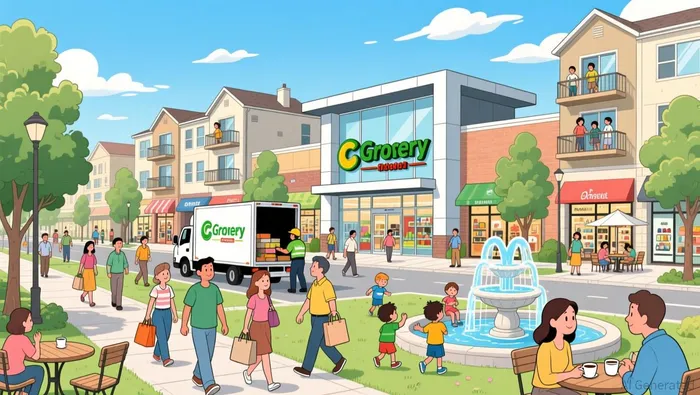
The financial metrics further validate this trend. in Q3 2025, reflecting strong investor confidence despite softer sales. Meanwhile, , aligning with national shifts toward value-driven brands and essential spending. These dynamics position grocery-anchored retail as a low-risk, high-reward asset class, particularly in suburban markets where demand for convenience and community-centric amenities is surging.
Lafayette Crossing: A Model for Suburban Retail Development
Fate's Lafayette Crossing development, known as "Project Cactus," embodies the strategic alignment of real estate, retail, and public policy. , , anchored by a Fortune 100 grocery store and department store, . The City of Fate has structured a performance-based sales tax incentive to support infrastructure costs, . This model not only reduces upfront financial burdens for developers but also ensures long-term fiscal alignment between public and private stakeholders.
The project's phased approach underscores its scalability and adaptability. Phase I, which began in late 2024, , . Upon completion, , directly contributing to the city's goal of diversifying its tax base. Additionally, the development will incorporate residential formats (single-family homes, apartments, condos), a 120-room hotel, and public recreational spaces, creating a mixed-use ecosystem that enhances community appeal and tenant retention.
Benchmarking Lafayette Crossing Against Collin County Trends
Lafayette Crossing's projected performance aligns with broader trends in Collin County, where grocery-anchored retail has demonstrated exceptional ROI. For example, the Central Market District in Texas . Similarly, Prosper's Costco and H-E-B locations have driven occupancy rates to record levels, . These case studies highlight the sector's ability to sustain high occupancy and rental growth even in competitive markets.
Financial benchmarks further reinforce Lafayette Crossing's potential. In Q4 2025, cap rates for grocery-anchored retail , . Given Fate's proximity to Frisco and McKinney-two of North Texas's fastest-growing cities-the development is well-positioned to capture cross-shopping traffic and benefit from spillover demand. The inclusion of experiential retail, dining, and entertainment options also aligns with consumer preferences for "destination" retail environments, .
Strategic Implications for Investors
For investors, Lafayette Crossing represents a rare confluence of macroeconomic tailwinds and localized execution. The project's infrastructure incentives, anchored by Fortune 100 tenants, mitigate risks associated with tenant turnover and supply chain volatility. Moreover, its mixed-use design-combining retail, residential, and hospitality-creates a diversified revenue stream that enhances long-term stability.
The broader grocery-anchored retail sector also offers defensive characteristics. During the pandemic and subsequent economic downturns, , outperforming other retail formats. This resilience is attributed to the inelastic demand for groceries and the cross-shopping effect, . For Lafayette Crossing, this dynamic is amplified by its strategic location in a high-growth corridor and its alignment with national trends toward suburbanization and e-commerce fulfillment.
Conclusion
The resurgence of grocery-anchored retail in suburban Texas is not a fleeting trend but a structural shift driven by demographic, economic, and consumer forces. Fate's Lafayette Crossing development epitomizes this shift, leveraging strategic location, public-private partnerships, and mixed-use innovation to create a high-yield investment opportunity. As DFW's retail market continues to outperform national averages, projects like Lafayette Crossing will play a pivotal role in shaping the future of suburban real estate. For investors, the message is clear: grocery-anchored retail in high-growth Texas suburbs is a strategic asset class that combines resilience, scalability, and long-term value creation.





Comentarios
Aún no hay comentarios