
The Resurgence of Ethereum's Early Adopters: A Staking Move Worth $656M and Its Implications for ETH’s Future
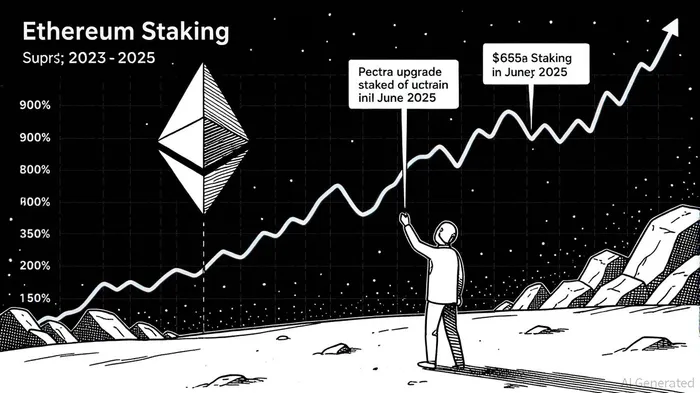
The EthereumETH-- blockchain has long been a crucible for innovation, but 2025 marks a pivotal year in its evolution. A recent on-chain event—a $656 million staking move by an early Ethereum ICO participant—has reignited discussions about the network’s long-term value proposition. This activity, executed in six batches of 730 ETH each, not only reactivates a dormant whale’s holdings but also serves as a compelling case study in how on-chain behavior can act as a leading indicator of bullish market sentiment.
The Pectra Upgrade: A Catalyst for Staking Efficiency
The Ethereum Pectra upgrade, activated on May 7, 2025, fundamentally reshaped the staking landscape. By increasing the maximum effective balance of a validator from 32 ETH to 2,048 ETH via EIP-7251, the upgrade enabled large-scale stakers to consolidate their operations. This change reduced the total number of validators on the network while streamlining management for institutional participants [4]. For example, a validator holding 2,048 ETH now earns rewards with a single node, cutting operational overhead by over 60% compared to managing 64 separate 32-ETH validators [5].
Complementary upgrades like EIP-7002 and EIP-6110 further enhanced staking flexibility. EIP-7002 allows validators to trigger withdrawals directly from the execution layer, reducing reliance on node operators and mitigating security risks [3]. EIP-6110 slashed the activation time for new deposits from 12 hours to 13 minutes, enabling faster capital deployment [5]. These improvements collectively lowered barriers to entry for both retail and institutional stakers, contributing to Ethereum’s record-high staking participation.
Staking Trends: A Network Secured by Capital Inflows
By Q2 2025, Ethereum’s staked ETH had surged to 35.7 million, representing 29.6% of the circulating supply and a USD value of $89.25 billion [4]. This growth was fueled by a dual force: protocol upgrades and strategic capital allocation by digital assetDAAQ-- treasuries. Entities like SharpLink GamingSBET-- and BitMine ImmersionBMNR-- staked over 95% of their ETH holdings, leveraging liquid staking protocols to maintain liquidity while earning 3.2% APY [6].
The role of digital treasuries cannot be overstated. Between April and June 2025, these entities accumulated 2.2 million ETH (1.8% of supply), creating a supply-demand imbalance that temporarily inflated staking yields [5]. If a significant portion of these holdings were staked at the current 2.95% nominal yield, they could generate over $650 million in annual income for these firms [5]. This dynamic underscores Ethereum’s transformation into a dual-income asset, offering both yield and price appreciation.
On-Chain Behavior as a Bullish Signal
The $656 million staking event by an early Ethereum ICO participant—worth $4.3 billion in total holdings—epitomizes the network’s gravitational pull. This whale, inactive for eight years, staked 150,000 ETH in June 2025, signaling confidence in Ethereum’s post-Pectra ecosystem [1]. Such on-chain activity is not merely a transaction; it is a vote of faith in the network’s security, scalability, and economic model.
Historically, dormant wallets reactivating to stake large sums have correlated with price rallies. For instance, the 2023 staking boom preceded a 60% ETH price surge. In 2025, the combination of protocol upgrades, institutional adoption, and whale participation creates a self-reinforcing cycle: higher staking yields attract more capital, which strengthens network security, which in turn attracts further investment [4].
Implications for ETH’s Future
The convergence of these factors positions Ethereum as a cornerstone of the digital asset ecosystem. The Pectra upgrade’s focus on scalability—doubling blob capacity and reducing block sizes—ensures the network remains competitive with Layer-2 solutions [1]. Meanwhile, the rise of liquid staking derivatives (e.g., stETH) has democratized access to staking rewards, enabling retail investors to participate without sacrificing liquidity [6].
For investors, the $656 million staking event is a microcosm of broader trends. It demonstrates that even long-dormant capital is now incentivized to engage with Ethereum’s ecosystem, driven by attractive yields and protocol-driven efficiency. As staking participation continues to rise, the network’s security and decentralization will strengthen, creating a flywheel effect that could drive ETH’s price higher.
Conclusion
Ethereum’s 2025 resurgence is not a coincidence but a result of deliberate protocol upgrades and strategic capital allocation. The Pectra upgrade, combined with institutional staking adoption and the reactivation of early adopters, has created a robust foundation for sustained growth. On-chain behavior—particularly large-scale staking moves—now serves as a leading indicator of bullish sentiment, suggesting that Ethereum’s best days may still lie ahead.
Source:
[1] Dormant Ethereum ICO Whale Stakes 150000 ETH Worth $656M [https://www.xt.com/en/blog/post/dormant-ethereum-ico-whale-stakes-150000-eth-worth-656-million]
[2] Ethereum's Pectra Upgrade: Smarter Accounts, Scalable Staking [https://www.elementus.io/blog-post/ethereums-pectra-upgrade-smarter-accounts-scalable-staking-and-higher-throughput]
[3] Ethereum Pectra Upgrade Benefits [https://cash2bitcoin.com/blog/ethereum-pectra-upgrade-benefits]
[4] State of Ethereum Q2 2025 [https://messari.io/report/state-of-ethereum-q2-2025]
[5] Ethereum Staking Insights & Protocol Analysis [https://everstake.one/crypto-reports/ethereum-staking-insights-and-analysis-first-half-of-2025]
[6] Ethereum's Institutional Adoption and Network Dominance [https://www.bitget.com/asia/news/detail/12560604947531]






Comentarios
Aún no hay comentarios