
The Resurgence of Dormant Casascius Bitcoins: Implications for Crypto Collectibles and Investment Strategies
In late 2025, the crypto world witnessed a quiet but significant event: the activation of dormant Casascius BitcoinsBTC-- after over a decade of inactivity. On October 22, nine of these physical coins-each containing 1 BTC or 5 BTC-were moved, totaling 9.5 BTC and valued at approximately $640,000 at the time according to reports. This movement, alongside the activation of two 1,000 BTC Casascius coins in December 2025 unlocking over $179 million in value, underscores a broader shift in how investors and collectors view these historical artifacts. Once dismissed as novelty items, Casascius coins are now emerging as hybrid assets-blending digital value with tangible scarcity-and reflecting the maturing dynamics of the crypto market.
The Historical and Scarcity Premium of Casascius Coins
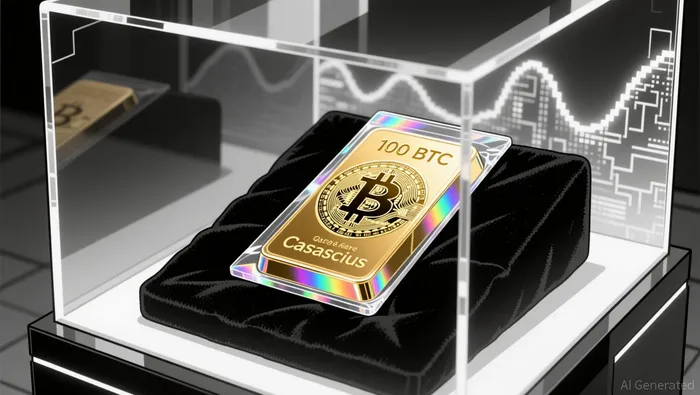
Created between 2011 and 2013 by Mike Caldwell, Casascius coins are physical representations of BitcoinBTC--, with private keys embedded under tamper-resistant holograms as per official documentation. Their value lies not only in the BTC they contain but also in their historical significance as early Bitcoin artifacts. For instance, a 1 BTC brass Casascius coin, worth around $68,000 in BTC at the time of writing, can command prices between $80,000 and $120,000-a 1.2–2x premium. Rarer variants, such as 5 BTC gold-plated coins or 100 BTC gold bars, now sell for up to twice their "peel value" due to limited production runs and high demand according to market analysis.
This collector's premium is driven by scarcity and nostalgia. As of January 2025, Casascius coins collectively held 38,216.2 BTC in active balances according to market data, but many remain dormant, creating a sense of urgency among collectors to acquire intact, unredeemed coins before they are activated. The recent movement of 46 BTC from dormant Casascius coins in November 2025-after 13–14 years of inactivity according to financial reports-further highlights their dual role as both functional Bitcoin assets and sought-after collectibles.
Broader Trends in Crypto Collectibles and Investor Behavior
The Casascius phenomenon is part of a larger trend in the crypto collectibles market, where scarcity and provenance drive valuations. In 2025, the global memorabilia market, including crypto collectibles, reached $60 billion, with 54% of Millennials purchasing collectibles as investments according to industry statistics. Blockchain technology has amplified this trend by enabling transparent provenance tracking, a feature 70% of collectors now demand according to market research. For example, innovations like tamper-evident NFC verification and blockchain authentication have boosted confidence in physical Bitcoin markets, contributing to a 74% growth in 2024 to $1.2 billion according to industry analysis.
Investor behavior is also evolving. Where early adopters viewed physical Bitcoin as a novelty, today's investors treat it as a strategic asset. A 100-BTC Casascius bar, purchased for $500 in 2012, was recently redeemed to unlock $10 million in value according to market reports. This shift reflects a growing recognition of the need for advanced security measures as Bitcoin's price surpasses $100,000 according to investment trends. Meanwhile, institutional adoption of Bitcoin has surged, with 59% of institutional portfolios allocating at least 10% to crypto in 2025 according to market data. The launch of Spot Bitcoin ETFs, such as BlackRock's iShares Bitcoin Trust (IBIT), has further legitimized Bitcoin as an investment vehicle, attracting $18 billion in assets under management by Q1 2025 according to financial reports.
Implications for Investment Strategies
The resurgence of Casascius coins and the broader crypto collectibles market suggest that investors should consider diversifying their portfolios beyond digital assets. Physical Bitcoin, with its blend of historical narrative and scarcity-driven value, offers a unique hedge against the volatility of traditional crypto markets. For instance, the 1,000 BTC Casascius coins activated in December 2025 were minted when Bitcoin traded at $3.88 and $11.69 according to market data, illustrating the astronomical returns possible when holding early artifacts.
Moreover, the integration of AI in crypto trading strategies is reshaping how investors approach these assets. AI-driven tools now optimize yield maximization and autonomous portfolio management in DeFi according to expert analysis, enabling investors to balance exposure between liquid digital assets and illiquid collectibles like Casascius coins. Regulatory clarity around stablecoins and tokenization has also expanded the narrative for crypto collectibles, allowing investors to tokenize physical assets and trade them on decentralized platforms according to market insights.
Conclusion
The activation of dormant Casascius Bitcoins in 2025 is more than a technical curiosity-it is a barometer of the maturing crypto market. These coins, once seen as novelties, now embody the intersection of digital value, historical significance, and scarcity-driven investment. As institutional adoption grows and blockchain technology enhances provenance transparency, the market for crypto collectibles will likely continue to expand. For investors, the lesson is clear: in a world where Bitcoin's price volatility is increasingly tempered by institutional demand, physical artifacts like Casascius coins offer a compelling way to diversify and preserve value.






Comentarios
Aún no hay comentarios