
The Resurgence of DEXs: ASTER's Pivotal Role in the 2025 Perpetual Derivatives Revolution
The DEX Market's Structural Turnaround
The DEX boom in 2025 is underpinned by two critical factors: architectural innovation and user-driven demand. Central Limit Order Book (CLOB) architectures and Layer-1 scalability solutions have bridged the gap between decentralized and centralized trading experiences, enabling platforms like SunPerp to achieve $1.8 billion in cumulative trading volume within five weeks of its public beta launch-without token incentives or aggressive marketing, according to an HTX report. Meanwhile, the perpetual derivatives segment alone has surged to $1.8 trillion in Q3 2025, with DEXs now handling over $1 trillion in monthly trading volume, as noted in the Markets.com analysis.
This growth reflects a broader disillusionment with CEXs, which have faced liquidity challenges and regulatory scrutiny. Traders are increasingly prioritizing platforms that offer transparency (e.g., visible order books) and self-custody (e.g., non-custodial wallets), even if it means navigating a steeper learning curve. The DEX-to-CEX derivatives trading ratio has steadily risen, signaling a durable shift in market infrastructure preferences, according to the Markets.com analysis.
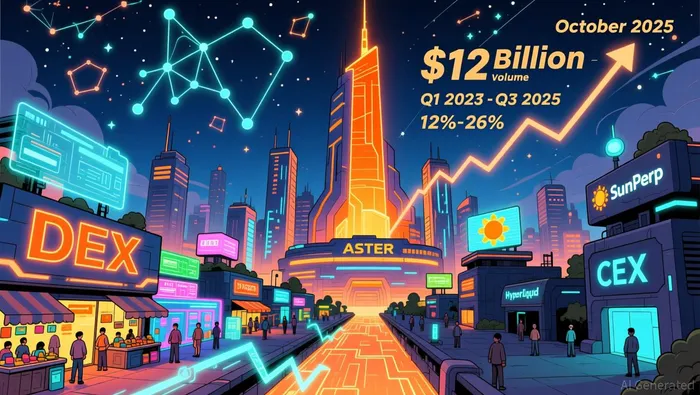
ASTER: A Case Study in DEX Innovation
Aster's meteoric rise in 2025 underscores the DEX market's capacity to scale while maintaining its core principles. As of September 2025, the platform reported $137 billion in cumulative perpetual trading volume and $413 million in total value locked (TVL), capturing nearly 10% of the perpPERP-- DEX market share, according to a TokenMetrics deep dive. Its daily trading volumes average $1 billion, a figure that has grown 300% year-to-date.
Aster's success stems from a combination of technical differentiation and strategic execution. The platform's multi-chain deployment across BNBBNB-- Chain, EthereumETH--, ArbitrumARB--, and SolanaSOL-- eliminates the need for cross-chain bridges, reducing friction for global traders, according to a Wu Blockchain article. Its dual trading modes-Pro Mode for advanced order book trading and 1001x Mode for MEV-resistant one-click trades-cater to both retail and institutional users. Additionally, Aster's "Earn and Trade" system allows users to leverage yield-bearing assets like USDF and asBNB as collateral, blending DeFi's composability with derivatives trading, as described in the Wu Blockchain article.
The platform's Phase 4-Aster Harvest-has further accelerated growth. A token buyback program and the allocation of 1.5% of the total ASTER supply over six weeks have driven a 12% price surge in 24 hours, despite the token still trading 53% below its all-time high, according to the HTX report. Coinbase's inclusion of ASTER in its listing roadmap is expected to catalyze institutional adoption, while technical analysis suggests a potential breakout above $1.29 if key resistance levels are breached, as noted in the HTX report.
Competitive Advantages and Market Positioning
Aster's competitive moat is fortified by three pillars: liquidity, partnerships, and fee structure. The platform's 0.01% MakerMKR-- and 0.035% Taker fees are among the lowest in the perp DEX space, attracting high-frequency traders and large institutional players, according to the Wu Blockchain article. Strategic alliances with market makers and projects like Four.MemeMEME-- have enhanced liquidity depth, while endorsements from Binance founder CZ and backing by YZi Labs (formerly Binance Labs) have amplified brand credibility, as described in the Wu Blockchain article.
On-chain data reveals Aster's dominance in user growth, with over 1.8 million total addresses and $500 billion in cumulative trading volume, as noted in the Wu Blockchain article. This scale positions it to challenge incumbents like Hyperliquid and SunPerp, particularly as it expands its product suite to include options and spot trading.
The Road Ahead: Risks and Opportunities
While Aster's trajectory is compelling, investors must remain cognizant of risks. Regulatory uncertainty, particularly around tokenized derivatives, could disrupt growth. Additionally, the platform's reliance on BNB Chain and Ethereum exposes it to network congestion and gas volatility. However, Aster's multi-chain strategy and partnerships with Layer-2 solutions mitigate these risks.
The broader DEX market, meanwhile, faces competition from hybrid models that blend CEX-like convenience with decentralized governance. Yet, as long as transparency and self-custody remain premium features, DEXs like Aster will continue to attract capital.
Conclusion
The 2025 DEX renaissance is not a speculative bubble but a structural reordering of the crypto ecosystem. Platforms like Aster are proving that decentralized infrastructure can scale without compromising user autonomy or performance. With a robust product roadmap, strategic partnerships, and a bullish technical outlook, Aster is well-positioned to capture a significant share of the $1.8 trillion perp DEX market. For investors, this represents a rare opportunity to align with a platform that is not only riding the DEX wave but helping to define its next phase.







Comentarios
Aún no hay comentarios