
The Resurgence of Corn Futures: A Strategic Play on Strong Export Demand and Production Trends
The corn futures market has entered a period of strategic intrigue, marked by a fragile balance between short-term export-driven gains and long-term bearish fundamentals. While recent export sales have spurred modest price rallies, the broader narrative remains dominated by global oversupply and declining price projections. For commodity investors, understanding this duality is critical to navigating the market's volatility and identifying positioning opportunities.
Export Demand: A Temporary Tailwind
Strong export sales have provided a temporary boost to corn futures. In the week ending October 16, 2025, U.S. corn export sales surged by 112%, surpassing market expectations and pushing December and March 2026 contracts higher by 0.8% and 0.5%, respectively. This surge reflects robust demand from key markets such as Mexico, Japan, and South Korea, which have driven a four-year high in corn shipments. Such demand has created a short-term bullish bias, particularly for near-month contracts, as traders anticipate improved cash flow for U.S. producers.
However, this optimism is tempered by structural challenges. The U.S. 2024/25 corn crop is projected to yield a record 16.752 billion bushels, while Brazil's production is expected to reach 136 million metric tons for the same period according to market analysis. These figures, combined with the USDA's projection of a 2.208 billion bushel global surplus in 2025-26, underscore a persistent oversupply that will likely weigh on prices in the medium term.
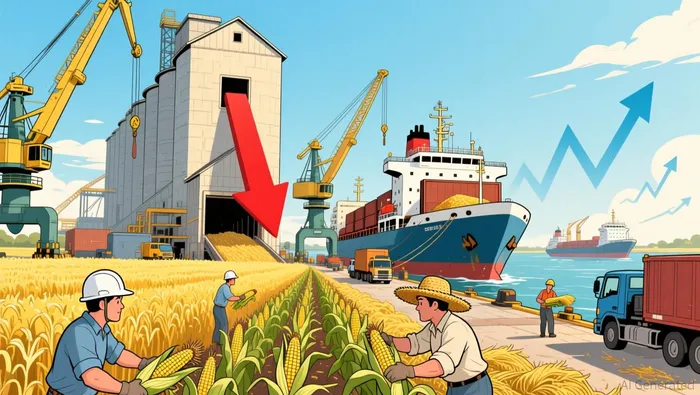
Investor Positioning: A Bearish Undercurrent
Despite the recent export-driven rally, speculative positioning in corn futures reveals a bearish undercurrent. As of November 2025, managed money traders held a net short position of 160,985 contracts, having trimmed their net short by 30,070 contracts during the week of October 21. This shift, while modest, reflects growing caution among institutional investors.
Data from the CFTC further highlights this trend. Managed money long positions in CBOT Corn Futures have declined by 5.49% week-over-week and 20.90% year-over-year, while short positions have increased by 4.29% to 354,831.0. The divergence between long and short positioning suggests that investors are increasingly hedging against price declines, particularly as the USDA's $3.90 per bushel price projection for 2025-26 looms according to research. This projection is already below current futures prices, with March 2026 contracts trading at $4.38¾ per bushel according to market data, indicating potential downward pressure as the marketing year progresses.
Strategic Implications for Investors
For investors, the corn market presents a nuanced opportunity. The short-term strength in export demand offers a tactical entry point for those betting on near-term rallies, particularly in December and March contracts. However, the long-term bearish outlook-driven by global oversupply and declining price projections-suggests that these gains may be ephemeral.
Positioning strategies should account for this duality. Short-term traders might capitalize on export-driven volatility, while longer-term investors may consider hedging with short positions or options to mitigate downside risk. The current environment also favors a focus on cash-flow-positive producers, as the cost-price squeeze continues to pressure farm incomes according to market analysis. Historically, corn prices have exhibited cyclical plateaus, with periods of higher prices often driven by temporary imbalances according to agricultural research. Investors must weigh whether the current export surge represents a meaningful shift or a fleeting reprieve.
Conclusion
The corn futures market is at a crossroads. While strong export sales have injected short-term optimism, the broader narrative of oversupply and declining prices remains intact. For commodity investors, the key lies in aligning positioning with both immediate demand signals and long-term fundamentals. As the USDA's bearish projections take hold and global production trends continue to evolve, strategic agility will be essential to navigating this complex landscape.







Comentarios
Aún no hay comentarios