
The Resurgence of Bitcoin as a Decoupled Safe-Haven Asset
Gold's Q3 2025 Resurgence: A Traditional Safe-Haven in Turbulent Times
Global gold ETFs shattered records in Q3 2025, amassing , with North American investors contributing -the largest Q3 inflow on record, according to a BlackRock analysis. European funds added , nearing their Q1 2020 peak, while Asia saw in inflows, led by India's September surge, the BlackRockBLK-- analysis found. By quarter-end, gold ETFs' total AUM hit , a 23% jump from Q2, the analysis reported.
This surge was fueled by geopolitical tensions, dollar weakness, and expectations of further Fed rate cuts. Gold prices soared above , with daily trading volumes averaging in September-a 34% MoM increase, the same analysis noted. Central banks and pension funds, wary of stagflation and inflationary pressures, increased gold holdings, reinforcing its role as a hedge against economic uncertainty.
Bitcoin's Surge: A New Era of Institutional Adoption
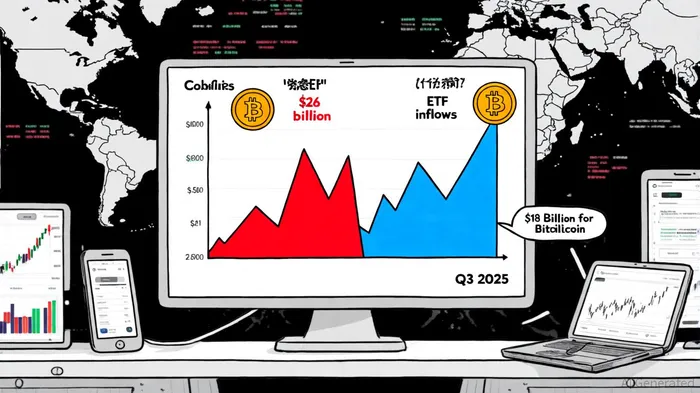
While gold dominated headlines, Bitcoin ETFs quietly captured , propelling their AUM to by early September. BlackRock's IBIT led the charge, with institutional demand surging amid regulatory clarity from the SEC. By October, Bitcoin ETFs had amassed , outpacing gold ETFs' in just two years of trading.
Bitcoin's safe-haven credentials were further validated in October 2025, when gold lost over two days-a loss exceeding Bitcoin's total market cap of at the time. During the same period, Bitcoin consolidated above , showcasing resilience amid macroeconomic volatility. This divergence highlighted a critical shift: Bitcoin is no longer merely a speculative asset but a decoupled safe-haven with asymmetric upside potential.
Portfolio Rebalancing: Generational and Philosophical Shifts
The rebalancing of portfolios between gold and Bitcoin in Q3 2025 reflects stark generational and philosophical divides. Younger, tech-native investors increasingly favor Bitcoin for its high-growth narrative and , allocating up to 1–5% of their portfolios to the asset. Conversely, older investors and institutions still prioritize gold's , with recommended allocations of 5–15%.
However, crossover strategies are rising. Institutions now integrate both assets into diversified portfolios, leveraging gold's low-correlation stability and Bitcoin's inflation-hedging potential. For example, EthereumETH-- (ETH) emerged as a key beneficiary of Q3 rebalancing, with its portfolio weight increasing by 20% since May. Meanwhile, altcoins like XRPXRP-- and SolanaSOL-- (SOL) gained traction as investors sought exposure to DeFi and ETF speculation.
Decoupling Factors: Why Bitcoin Is Reshaping Safe-Haven Dynamics
Bitcoin's decoupling from gold is underpinned by three key factors:
1. : The SEC's approval of spot Bitcoin ETFs in 2024 provided institutional legitimacy, attracting $7.8 billion in Q3 inflows.
2. : Younger investors view Bitcoin as a modern hedge, with 70% of gold ETF inflows in 2025 captured by Bitcoin ETFs.
3. Asymmetric Upside: Unlike gold, Bitcoin's price action is less correlated with equities, offering a unique risk profile. In Q3, it outperformed the Nasdaq by 6%, despite underperforming gold.
The Road Ahead: Strategic Allocation in a Dual-Asset World
As 2025 progresses, the coexistence of gold and Bitcoin in diversified portfolios is likely to deepen. While gold remains a cornerstone for hedging against geopolitical and inflationary risks, Bitcoin's role as a is cementing itself. Investors must now navigate this duality, balancing gold's time-tested stability with Bitcoin's innovation-driven potential.
For institutions, the key lies in strategic allocation: a 1–5% Bitcoin exposure paired with 5–15% gold can optimize risk-adjusted returns. Retail investors, meanwhile, should monitor macroeconomic signals-such as Fed policy shifts and geopolitical tensions-to time rebalancing decisions.
In this new era, the safe-haven asset landscape is no longer a zero-sum game. Gold and Bitcoin are not rivals but complementary tools in a well-structured portfolio, each addressing distinct facets of global uncertainty.





Comentarios
Aún no hay comentarios