
The Resurgence of ARMs in 2025: Are They a Safe Bet or a Repeat of 2008?
The adjustable-rate mortgage (ARM) is back. In 2025, as fixed-rate mortgages hover near historic highs, borrowers and lenders alike are turning to ARMs as a tool to navigate the current economic landscape. But as these instruments gain traction, a critical question looms: Are today's ARMs a calculated financial strategy or a dangerous echo of the subprime lending practices that precipitated the 2008 financial crisis?
To answer this, we must dissect the structural and regulatory evolution of ARMs since 2008. Pre-2008 subprime lending was a house of cards built on teaser rates, balloon payments, and a lack of borrower safeguards. These loans often targeted individuals with no income, no job, or no assets (NINJA loans), according to research, relying on a housing bubble to keep defaults at bay. When the bubble burst, the reset clauses in these hybrid ARMs triggered a cascade of defaults, foreclosures, and systemic collapse as data shows.
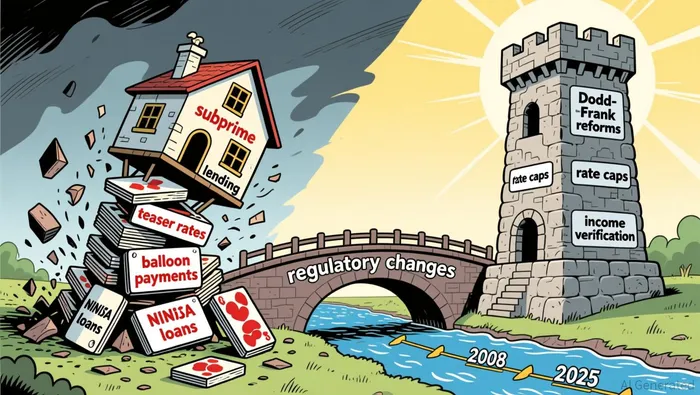 Modern ARMs, by contrast, operate under a vastly different framework. Post-2008 reforms-most notably the Dodd-Frank Act-have imposed stringent underwriting standards, requiring lenders to verify a borrower's ability to repay based on actual income and expenses. Legal caps on rate adjustments and longer initial fixed periods (often five to 10 years) have been introduced to mitigate the shock of sudden resets. These changes aim to prevent the kind of payment shocks that destabilized households in the mid-2000s.
The key distinction lies in the regulatory guardrails. Pre-2008 subprime lending operated in a vacuum, with little oversight and a culture of predatory practices as research indicates. Today's ARMs are embedded in a system of borrower protections, including caps on rate increases and mandatory disclosures. As stated by the Federal Deposit Insurance Corporation (FDIC), these measures reduce the likelihood of unaffordable payment shocks. However, the Federal Reserve's monetary policy remains a wildcard. If inflationary pressures or geopolitical shocks force aggressive rate hikes, even well-structured ARMs could strain household budgets.
The parallels to 2008 are not perfect. The 2025 ARM market is not driven by speculative excess or lax underwriting. Instead, it reflects a pragmatic response to high fixed rates and a desire for short-term affordability. Yet the lessons of history are clear: financial instruments that appear benign in stable markets can become volatile when conditions shift.
For investors and policymakers, the challenge is to balance innovation with caution. ARMs, when used strategically-by borrowers who anticipate rate declines or who can absorb future payment increases-are a calculated tool. But they remain a gamble if deployed recklessly or in a climate of economic fragility.
In the end, the resurgence of ARMs is not a repeat of 2008, but it is a reminder of the cyclical nature of financial risk. The question is not whether ARMs are inherently dangerous, but whether the safeguards in place today will hold when the next storm arrives.







Comentarios
Aún no hay comentarios