
The Resurgence of U.S. Airlines: Why Southwest and Delta Are Set for 2026 Gains
The U.S. airline industry is entering a pivotal phase in 2026, driven by strategic repositioning, improving demand dynamics, and a wave of analyst upgrades that signal renewed investor confidence. Two of the sector's most prominent players-Southwest Airlines (LUV) and Delta Air LinesDAL-- (DAL)-are at the forefront of this resurgence, each leveraging distinct strategies to capitalize on evolving market conditions. This analysis examines the factors underpinning their growth potential, focusing on recent analyst upgrades and the shifting demand landscape that positions both carriers for outperformance in the coming year.
Southwest's Strategic Transformation and Analyst Optimism
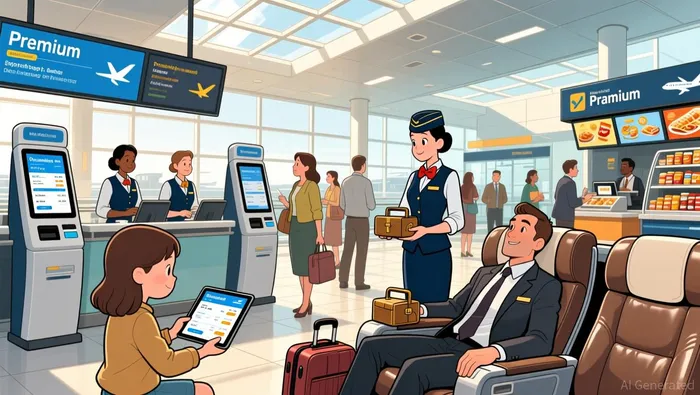
Southwest Airlines has emerged as a standout performer in 2025, defying broader industry challenges through a bold strategic overhaul. JPMorgan's rare "double upgrade" of the stock-from "Underweight" to "Overweight"-and a price target increase to $60 underscores the firm's conviction in Southwest's transformation. This shift is anchored in the airline's pivot to assigned seating and the introduction of a premium cabin offering, which analysts project will generate $1 billion in pretax earnings in 2026 and $1.5 billion in 2027.
The monetization of seat selection and extra legroom is reshaping Southwest's revenue model, moving it away from its traditional low-cost carrier (LCC) identity toward a hybrid approach that balances affordability with premiumization. According to JPMorgan's Jamie Baker, this strategy could drive earnings per share (EPS) to $5 in 2026, far exceeding the current market consensus of $2.98. Such optimism is reflected in Southwest's stock performance, which has outpaced peers like Delta and United in 2025 despite a temporary dip in profitability.
 However, not all analysts share this bullish view. Bank of America's Andrew Didora has rated Southwest as "Underperform," citing execution risks tied to its network model and operational complexity. This divergence highlights the airline's balancing act: executing a disruptive transformation while maintaining its cost discipline and customer appeal.
Delta's Premiumization and Operational Discipline
Delta Air Lines, meanwhile, is leveraging its strengths in premium services and operational efficiency to secure a leading position in 2026. The airline's Q3 2025 results revealed a 10% year-over-year surge in premium revenue to $5.796 billion, with high-margin segments (premium, corporate, and loyalty) now accounting for 60% of total revenue. This focus on premiumization has propelled Delta's operating margin to 11.2% in the quarter, reflecting disciplined cost management and a strategic emphasis on high-value travelers.
Analysts are equally enthusiastic. Bank of America's Andrew Didora forecasts FY26 EPS of $7.30, supported by Delta's capacity discipline and resilient demand. Morgan Stanley has rated Delta as a top pick, assigning a $90 price target and highlighting its potential to demonstrate normalized earnings power in a stable operating environment. These projections are bolstered by Delta's extensive network, which carried 12 million passengers in December 2025 alone, leveraging hubs in Atlanta, Detroit, and Minneapolis to serve both domestic and international markets.
Delta's success also stems from its ability to balance premium offerings with operational reliability. Enhanced airport lounges, improved in-flight experiences, and a robust loyalty program have solidified its appeal to business and leisure travelers alike. As the U.S. airline market remains highly concentrated-with the top four carriers controlling 74% of the market-Delta's strategic focus on premiumization positions it to capture a growing share of high-margin demand.
Demand Dynamics: A Tale of Two Strategies
The divergent strategies of SouthwestLUV-- and DeltaDAL-- are being amplified by broader demand trends in the U.S. airline sector. In December 2025, Southwest carried nearly 10 million passengers, driven by its "Bags Fly Free" program and competitive pricing. This success underscores the enduring appeal of LCCs in a price-sensitive market, even as the industry shifts toward premiumization.
Conversely, Delta's ability to attract premium travelers is evident in its December 2025 performance, where its international and domestic networks catered to a diverse passenger base. Analysts predict that this trend will accelerate in 2026, with premium services and improved customer experiences becoming central to competitive differentiation.
The U.S. airline market's high concentration-dominated by American, Delta, Southwest, and United-means that strategic innovations by these carriers will have outsized impacts on industry-wide performance. Southwest's pivot to premium cabins and Delta's refinement of its premium offerings are not just competitive moves but necessary adaptations to a market increasingly defined by traveler expectations for comfort and value.
Conclusion: A Dual-Track Path to 2026 Gains
The 2026 outlook for Southwest and Delta hinges on their ability to execute distinct but complementary strategies. Southwest's transformation into a premium-focused LCC, backed by JPMorgan's rare double upgrade, positions it to capture both affordability-driven and premium segments of the market. Meanwhile, Delta's disciplined capacity growth and premiumization efforts, supported by top analyst ratings, reinforce its status as a leader in normalized earnings power.
For investors, the key takeaway is clear: both airlines are well-positioned to benefit from improving demand dynamics and strategic repositioning. While Southwest's disruptive model carries execution risks, its potential rewards-reflected in a $5 EPS target-make it a compelling long-term play. Delta, on the other hand, offers a more stable, premium-driven growth trajectory, supported by its operational excellence and market leadership. Together, they exemplify the resilience and adaptability driving the U.S. airline industry's resurgence.







Comentarios
Aún no hay comentarios