
The Resurgence of AI Hype and Its Implications for Tech Equity Valuations
Tim Cook's Strategic Vision: Caution and Commitment
Apple's approach to AI, as outlined by CEO Tim Cook in the Q4 2025 earnings call, reflects a measured yet ambitious strategy. Cook emphasized a three-pronged roadmap: developing in-house foundation models, forming partnerships with third-party (LLM) providers, and pursuing targeted M&A opportunities. This approach underscores Apple's intent to balance innovation with control, ensuring alignment with its privacy-first ethos. Notably, Cook confirmed the company's openness to M&A if it accelerates its AI roadmap, a signal that Apple is prepared to act decisively in a competitive landscape.
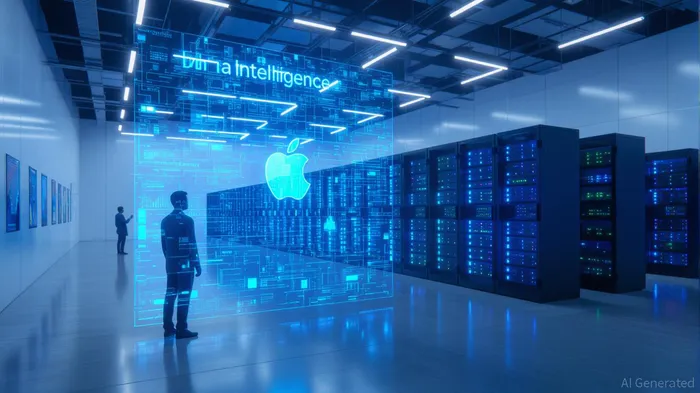 The CEO also highlighted progress on Apple Intelligence, including the next-generation AI-powered Siri slated for 2026 and the construction of AI-specific servers in Houston to support data center operations. These moves suggest Apple is positioning itself to capitalize on AI-driven consumer demand, particularly for smartphones, while mitigating risks through infrastructure investments. Such strategic clarity may bolster investor confidence, contrasting with the volatility observed in pure-play AI stocks.
Nvidia's Stock Underperformance: A Barometer of Investor Anxiety
Despite record-breaking financials, Nvidia's stock has underperformed in Q3 2025, . This decline, , signals growing skepticism about AI valuations according to market analysis. .
CEO 's assertion of a "virtuous cycle of AI" and through 2026 has not fully assuaged concerns. Analysts like Evercore and Raymond James have upgraded their price targets, but the stock's underperformance reflects a tug-of-war between optimism over AI's transformative potential and fears of overvaluation. With , Nvidia's multiples remain elevated, prompting questions about whether the market is pricing in unrealistic growth scenarios.
Investor Psychology and Valuation Trends: A Sector in Flux
The AI sector's valuation dynamics are shaped by divergent investor behaviors. On one hand, venture capital firms are pouring capital into AI, . This capital influx suggests institutional confidence in AI's long-term potential, even as public markets exhibit caution.
On the other hand, companies like C3.ai and BigBear.ai illustrate the sector's volatility. C3.ai's , while BigBear.ai's reliance on government contracts and low forward P/S ratio position it as a value play in a fragmented market according to market analysis. Meanwhile, Palantir's and strategic partnership with Nvidia demonstrate how firms leveraging AI for enterprise solutions can outperform, even in a correctionary environment.
The AI Bubble Debate: Innovation vs. Speculation
The tension between AI's transformative promise and its valuation risks has reignited debates about a potential bubble. Proponents argue that AI's integration into industries-from healthcare to defense-justifies high multiples, and zero debt as evidence of resilience. Conversely, critics point to the sector's reliance on speculative bets, such as , which alone accounted for 29% of Q3 AI funding.
Tim Cook's emphasis on infrastructure and partnerships contrasts with hyper-speculative strategies of some AI startups, suggesting a more sustainable path for Apple. However, the broader market's shift toward defensive sectors like healthcare indicates investor hedging against overvaluation risks.
Conclusion: Navigating the AI Valuation Crossroads
The AI sector in 2025 stands at a crossroads. Tim Cook's strategic pragmatism and Apple's infrastructure investments offer a counterpoint to the speculative frenzy seen in pure-play AI stocks. Meanwhile, Nvidia's underperformance underscores the market's demand for earnings to justify lofty valuations. As venture capital continues to flow into AI, the key question remains: Will the sector deliver on its transformative promises, or will overvaluation lead to a painful correction? For investors, the answer lies in distinguishing between foundational innovation and speculative hype-a task that requires both technical insight and psychological discipline.







Comentarios
Aún no hay comentarios