
Restored Federal Grants and Their Impact on Education and Innovation-Driven Sectors
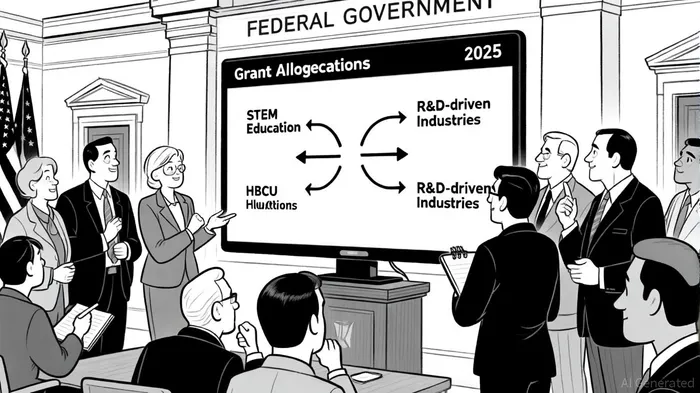
The 2025 fiscal year has marked a pivotal shift in U.S. federal education funding, with restored and redirected grants reshaping the landscape for education-dependent industries and R&D-driven equities. After a contentious period of freezes and reallocations under the Trump administration, bipartisan pressure led to the restoration of critical programs, while new priorities—such as literacy innovation, STEM expansion, and support for historically marginalized institutions—have emerged as focal points for strategic investment.
Strategic Investment in Education Innovation
The Education Innovation and Research (EIR) program remains a cornerstone of federal efforts to drive evidence-based educational advancements. With a FY2025 funding request of $259 million, the EIR prioritizes literacy instruction aligned with the science of reading, aiming to address persistent gaps in K-12 outcomes [1]. This focus has catalyzed demand for R&D-driven equities in edtech and curriculum development, particularly among companies offering AI-powered literacy tools and data analytics platforms. For instance, the Accelerate, Transform, and Scale (ATS) Initiative—backed by a $160 million allocation—explicitly targets AI integration in classrooms, signaling a long-term commitment to leveraging emerging technologies for educational equity [2].
Investors should note that the EIR's Expansion Grants, which provide up to $15 million over five years for scalable projects, are attracting applications from consortia of schools, nonprofits, and tech firms. These grants emphasize partnerships with STEM-focused industries, creating opportunities for firms specializing in robotics, cybersecurity, and biotechnology to align their R&D pipelines with federal priorities [3].
Equity-Driven Funding and Its Ripple Effects
The Trump administration's reallocation of $500 million to historically Black colleges and universities (HBCUs) and Tribally Controlled Colleges and Universities (TCCUs)—a 48.4% and 109.3% increase, respectively—has drawn both praise and criticism [4]. While this infusion of capital supports infrastructure upgrades and STEM scholarships at these institutions, it also reflects a broader policy shift toward education choice and merit-based funding models. For investors, this signals growing demand for equities tied to HBCU and TCCU ecosystems, including edtech platforms that cater to underserved student populations and research institutions collaborating with these colleges on workforce development programs.
However, the termination of $350 million in grants for minority-serving institutions (MSIs)—including Hispanic-serving institutions—has created uncertainty. Secretary Linda McMahon's rationale—that these programs “perpetuated racial stereotyping”—has sparked legal and political challenges, with critics warning of long-term equity risks [5]. This tension underscores the importance of monitoring legislative developments, as the Senate's push to maintain Title I and IDEA funding contrasts with the House's proposed cuts [6].
STEM and AI: The New Frontiers of Federal R&D
Federal grants in 2025 are increasingly channeling resources into STEM education and AI research, positioning these sectors as high-growth opportunities. The Institute of Education Sciences (IES) has requested $815.5 million for FY2025, with a focus on modernizing data systems and fostering AI-driven educational tools [7]. This aligns with the National Science Foundation's (NSF) parallel investments in STEM curriculum innovation, which are expected to boost demand for R&D-driven equities in fields like quantum computing and biotechnology [8].
A key indicator of this trend is the Statewide Longitudinal Data Systems (SLDS) program, which is being expanded to track student outcomes across K-12 and higher education. By providing granular data on learning gaps and workforce readiness, SLDS supports evidence-based policymaking and creates opportunities for data analytics firms to monetize their expertise in education R&D [9].
Challenges and Controversies
Despite these advancements, the 2025 funding landscape is not without risks. The DOGE Initiative's consolidation of 12,000 grants and the Continuing Resolution's administrative flexibility have introduced operational uncertainty for grantees [10]. Additionally, heightened compliance requirements under Executive Order 14151 and OMB Memo M-25-13 may increase overhead costs for institutions, potentially dampening returns on R&D investments [11].
Investors must also weigh the political volatility surrounding education funding. The House's emphasis on “merit-based” programs contrasts sharply with the Senate's defense of equity-focused initiatives, creating a regulatory tug-of-war that could destabilize long-term funding commitments [12].
Conclusion
The 2025 federal grant landscape presents a dual opportunity: innovation-driven R&D sectors are gaining traction through STEM and AI-focused funding, while equity-oriented programs offer long-term growth potential in underserved markets. However, investors must navigate a complex web of policy shifts, legal challenges, and operational uncertainties. For those who can align their portfolios with the EIR's emphasis on scalability, the IES's AI ambitions, and the HBCU/TCCU funding surge, the rewards could be substantial—but only for those who act with strategic foresight.






Comentarios
Aún no hay comentarios