
Restoration Hardware's RH Manhasset: Redefining Experiential Retail and Unlocking Shareholder Value
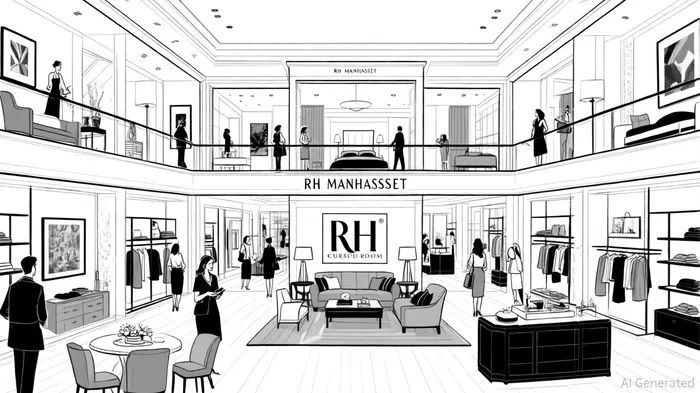
Restoration Hardware (RH) has long been a polarizing name in retail, but its recent transformation under CEO Gary Friedman is redefining what it means to be a luxury home brand. The opening of RH Manhasset, a 19,400-square-foot "immersive gallery," marks a pivotal moment in the company's evolution. This flagship location, part of a broader global expansion strategy, is not just a store-it's a calculated move to position RHRH-- as a lifestyle brand that competes with the likes of LVMH and Chanel, as reported at Americana ManhassetAmericana Manhasset. By blending retail with art, hospitality, and design, RH is betting that experiential shopping can drive both revenue growth and brand differentiation in a sector struggling with macroeconomic headwinds, a trend highlighted in a recent lifestyle profile lifestyle profile.
The Strategic Shift: From Hardware to High-End Lifestyle
RH's pivot from quirky, nostalgia-driven hardware to a curated luxury brand has been nothing short of radical. A.E. Marketing reports that the company's new Design Galleries-featuring curated room settings, rare antiques, and integrated dining experiences-reflect a deliberate effort to elevate the customer journeyA.E. Marketing. The Manhasset location, Morningstar notes, includes a full-service restaurant and event spaces, transforming the act of buying furniture into a multi-sensory experienceMorningstar. This approach mirrors the strategies of luxury fashion houses, which use physical spaces to build emotional connections with customers.
Financially, the strategy is paying off. In Q2 2025, RH reported a 13% increase in core segment revenue to $765 million, driven by product innovation and hospitality revenue, according to RH's Q2 2025 reportRH's Q2 2025 report. The company's adjusted EBITDA margin hit 20.8%, up from 12.4% in the same period the prior year. These metrics suggest that RH's immersive model is not only attracting affluent customers but also converting them into high-value buyers.
Brand Differentiation: A Niche for the Affluent
RH's differentiation lies in its ability to cater to a hyper-specific demographic: high-net-worth individuals who prioritize exclusivity and design. According to an Advan Research LinkedIn post, 80% of RH's sales come from households earning $150K+, compared to 60% for competitors like Pottery BarnAdvan Research post. This affluent base allows RH to maintain premium pricing and limited availability, creating a sense of scarcity that drives demand, consistent with RH's stated missionRH's mission.
The numbers back this up. In August 2025, RH's online platform reported an average order value (AOV) of $1,100–$1,125, nearly four times Pottery Barn's AOV of $275–$300, per Grips Intelligence dataGrips Intelligence. While RH's conversion rate (0.50–1.00%) lags behind the industry average of 1.4%, its ability to monetize high-intent customers offsets this gap. The Manhasset gallery, with its curated, room-like displays, likely amplifies this effect by reducing decision fatigue and showcasing products in aspirational contexts, as suggested by customer engagement metricscustomer engagement metrics.
Challenges and Mitigations: Tariffs, Margins, and Expansion
RH's strategy is not without risks. Tariffs and supply chain disruptions have pressured gross margins, which fell by 730 basis points from pre-pandemic levels as of Q3 2023, according to Bristlemoon ResearchBristlemoon Research. To counter this, the company is shifting production of 52% of its upholstered furniture to the U.S. by year-end 2025, a move documented by HF BusinessHF Business. This move, while costly, aligns with its brand positioning and reduces exposure to geopolitical risks.
Expansion also carries costs. The Manhasset location, part of a 2025 plan to open seven new galleries globally, requires significant capital investment. However, early results from international locations like RH Paris-where foot traffic exceeded New York's in the first six days-suggest the strategy is resonating, Interior Daily reportsInterior Daily. Analysts project RH's global revenue could reach $20–$25 billion by 2027, fueled by its real estate-driven expansion and digital integration, per SWOT AnalysisSWOT Analysis.
The Road Ahead: Shareholder Value and Long-Term Growth
RH's stock has underperformed in recent years, down 59% from its 2021 peak, according to MarketBeat dataMarketBeat data. Yet, the company's 26% annualized shareholder value creation over 11 years indicates a resilient business model. With its immersive retail concept now fully baked, RH is poised to capitalize on the growing demand for experiential luxury. The key will be maintaining margins while scaling-a challenge it's addressing through domestic production and AI-driven virtual design tools to reduce online checkout abandonment, as explored in a Nasdaq analysisNasdaq analysis.
For investors, the question is whether RH can sustain its premium positioning in a softening housing market. The answer lies in its ability to treat retail as a platform for lifestyle curation rather than mere transactions. As Friedman has emphasized, "The gallery is not just a store-it's a destination." If RH can keep customers coming back for the experience, not just the products, its shareholders may find themselves in a position to reap the rewards of a redefined luxury retail model.





Comentarios
Aún no hay comentarios