
Restaurant Industry Consolidation and Its Impact on Fast Food Stocks: Operational Efficiency and Margin Pressures Take Center Stage
The Cost of Underperformance: Brand Value and Investor Sentiment
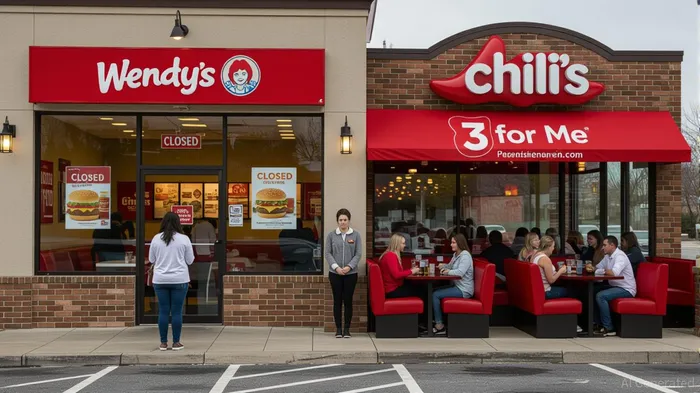
Underperforming units act as a drag on brand value and investor confidence. Wendy's closures, for instance, signal a strategic pivot toward high-potential locations but also highlight systemic challenges. The chain's same-store traffic declined by as much as -9.9% in September 2025, exacerbated by rising food costs (4.1% inflation in food-away-from-home) and aggressive value campaigns from rivals, according to the Indian Express report. Such closures often trigger skepticism among investors, who interpret them as a failure to adapt to market dynamics.
Starbucks, meanwhile, faces a different but equally damaging issue: labor disputes. Despite reporting a 1% global same-store sales rebound in Q4 2025, the company's adjusted operating margin plummeted by 900 basis points to 9.4%, driven by restructuring costs and union-related tensions, according to a GuruFocus report. Over 80 U.S. lawmakers have criticized StarbucksSBUX-- for alleged union-busting, leading to over 100 unfair labor practice charges, as reported by Common Dreams. These controversies not only erode brand trust but also create volatility in stock multiples, as seen in its 10% share price drop following Q4 earnings.
Operational Efficiency: Who's Winning the Margin Battle?
Operational efficiency has become a critical differentiator in a sector where profit margins are razor-thin. Chili's, a subsidiary of Brinker International, exemplifies this. In Q3 2025, the brand reported a 31.6% same-store sales increase and an EBITDA margin of 18.9%, up from 14.2% in the prior year, according to a Brinker International news release. These gains stem from cost-cutting measures, value-driven promotions (e.g., its "3 for Me" deal), and a focus on high-traffic urban locations. By contrast, Wendy's struggles with a 300-store closure plan and stagnant innovation, while Starbucks grapples with margin compression despite international growth.
McDonald's, though absent from specific 2025 EBITDA data in this analysis, remains a benchmark for operational resilience. Its global supply chain optimization and digital ordering systems have historically insulated it from margin pressures. However, its Q4 2024 same-store sales dip of 1.4%-linked to an E. coli outbreak-reveals vulnerabilities, according to a Yahoo Finance report. The company's $100 million recovery initiative underscores the cost of reputational damage, even for industry leaders.
Navigating Consolidation: Strategic Positioning for Survival
The companies best positioned to weather industry consolidation are those that balance cost discipline with customer retention. Chili's, with its robust EBITDA margins and value-focused strategy, stands out. Its ability to attract budget-conscious diners while maintaining profitability contrasts sharply with Wendy's defensive closures and Starbucks' labor-driven headwinds.
Starbucks, despite its challenges, retains a loyal customer base and strong international growth potential, particularly in China. However, its margin pressures and union-related costs could weigh on long-term investor sentiment. Wendy's, meanwhile, faces an uphill battle to regain market share without a clear innovation roadmap.
Conclusion: Investing Through the Noise
For investors, the key takeaway is clear: operational efficiency and margin resilience are non-negotiable in a consolidating fast-food sector. Chili's demonstrates that aggressive cost management and value-driven marketing can outperform peers, while brands like Starbucks and Wendy's must address structural weaknesses to avoid further erosion of brand equity. As the industry evolves, those that adapt to inflationary pressures and shifting consumer behavior-without sacrificing profitability-will emerge as the true winners.





Comentarios
Aún no hay comentarios