
The Resilient Investor: How Founders' Mental Models Shape Market-Beating Outcomes
In an era of market volatility and rapid technological disruption, the most successful investors are not those who chase trends but those who emulate the decision-making frameworks of legendary founders. These frameworks—rooted in first principles, adaptability, and long-term vision—offer a blueprint for constructing investment theses that withstand uncertainty and outperform conventional strategies. By dissecting the mental models that have propelled icons like Elon Musk, Sam Altman, and Steve Blank to success, we uncover how investors can replicate their resilience in unpredictable markets.
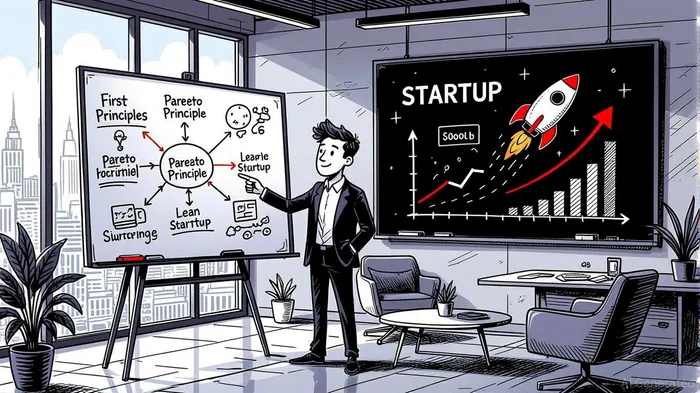
First Principles Thinking: Deconstructing Value, Not Assumptions
Legendary founders like Elon Musk have mastered the art of first principles thinking. By stripping away industry dogma and rebuilding problems from their core truths, they identify undervalued opportunities. For investors, this means avoiding herd mentality and instead analyzing a company's fundamentals: What is the true cost of production? What barriers to entry exist? How does the business model scale? Tesla's rise from a niche EV startup to a $1 trillion market cap exemplifies this approach.
Lean Startup Methodology: Iterative Experimentation as a Competitive Edge
The lean startup framework, popularized by Eric Ries, emphasizes rapid prototyping and customer feedback. Founders like Steve Blank used this to pivot from failed assumptions to market-validated solutions. Investors should prioritize companies that demonstrate agility—those that launch minimum viable products (MVPs), iterate based on data, and avoid overcommitting to unproven ideas. Look for startups with a history of pivoting successfully, such as Slack's evolution from a gaming platform to a workplace communication tool.
The Pareto Principle: Focus on High-Impact Levers
The 80/20 rule reminds us that 20% of efforts often yield 80% of results. Founders and investors must identify these high-impact levers. For example, a SaaS company might discover that 80% of its revenue comes from 20% of its features. By allocating capital and time to these critical areas, investors can amplify returns while minimizing distractions. This principle also applies to portfolio diversification: a concentrated bet on a few high-conviction, high-impact assets often outperforms a broad, diluted approach.
Long-Term Resilience and Strategic Adaptability
Market-beating outcomes require a balance between long-term vision and short-term flexibility. Founders like Sam Altman have navigated AI's shifting landscape by pivoting strategies while maintaining a focus on transformative potential. Investors should seek companies with leaders who demonstrate this duality—those who can weather macroeconomic shocks (e.g., interest rate hikes, supply chain disruptions) without abandoning their core mission.
Pattern Recognition and Intuition: The Art of the Unspoken
Decades of deliberate practice hone a founder's intuition. Robert Greene's Mastery highlights how experts internalize patterns, enabling split-second decisions. Investors can cultivate this skill by studying case studies of past successes and failures. For instance, recognizing the early signs of a "10x team" (high-performing, culturally aligned talent) or spotting a founder's ability to pivot during crises can signal future outperformance.
Mental Model Integration: The Power of Interdisciplinary Thinking
The most durable investment theses emerge from integrating diverse mental models. A founder might combine first principles (to deconstruct a problem), the Pareto principle (to prioritize solutions), and lean startup methods (to test hypotheses). Investors should favor companies that draw from multiple disciplines—such as biotech startups leveraging AI for drug discovery or fintech firms applying behavioral economics to user engagement.
Risk Underwriting and Future-Oriented Planning
Startups are inherently "default-dead," as Kevin Mahaffey notes. Legendary founders underwrite risk by focusing on future potential rather than present metrics. Investors must evaluate companies through this lens: Does the business have a defensible moat? Can it scale cash flows in a decade? For example, early-stage biotech investments often hinge on the promise of a breakthrough, not current profitability.
Team and Talent: The Human Element
A company's team is its most critical asset. Founders like Elon Musk and Steve Jobs built empires by assembling "10x teams"—individuals with exceptional skills and cultural alignment. Investors should scrutinize leadership dynamics: Are key hires domain experts? Do they exhibit a growth mindset? A strong team can execute even in the face of market headwinds.
Emotional and Psychological Resilience
The ability to endure failure and maintain focus is a hallmark of resilient founders. Investors must mirror this mindset, avoiding panic during downturns and maintaining conviction in long-term theses. For instance, during the 2020 market crash, investors who stayed committed to companies like AmazonAMZN-- and MicrosoftMSFT-- reaped outsized rewards as these firms capitalized on remote work and cloud computing trends.
Investment Strategy Alignment: Building Defensible Cash Flows
Ultimately, market-beating outcomes require aligning with foundational business principles. Founders who generate large, growing, and defensible cash flows attract capital. Investors should prioritize companies with sustainable revenue models, such as recurring SaaS subscriptions or high-margin hardware-software ecosystems.
Conclusion: Synthesizing the Frameworks
The resilient investor is not a passive observer but an active participant in the mental models that shape market outcomes. By adopting first principles thinking, lean experimentation, and interdisciplinary frameworks, investors can construct theses that thrive in uncertainty. The next step is to identify companies where these models are already in action—those led by founders who treat decision-making as a science and art. In a world of noise, the most durable returns belong to those who think like builders.





Comentarios
Aún no hay comentarios