
Resilient Investment Opportunities Amid Volatile Market Corrections in Hardware and Services Sectors
The global hardware and services sectors in 2025 are navigating a landscape marked by volatility, driven by geopolitical tensions, inflationary pressures, and rapid technological shifts. Yet, within this turbulence lie opportunities for investors who can identify resilient strategies and companies poised to thrive. This analysis examines the challenges and innovations shaping these sectors, with actionable insights for capitalizing on their evolving dynamics.
Hardware Sector: Navigating Tariffs and AI-Driven Growth
The hardware market, projected to grow at a 7% CAGR to $232.51 billion by 2033, according to a Business Research Insights report, faces dual pressures: escalating tariffs and supply chain disruptions. U.S. tariffs on steel and aluminum, coupled with retaliatory measures from China, are expected to increase costs of goods sold by 7% across the sector, according to an AlixPartners analysis. However, companies leveraging AI and edge computing are mitigating these risks. For instance, NVIDIA's H100-16 and Google's TPU-V4 dominate AI throughput, while AMD's MI300 gains traction for energy efficiency, as noted by AI 2 Work.
Strategic supply chain diversification is another key resilience factor. CiscoCSCO--, for example, reduced tariff exposure by 80% through manufacturing shifts to India, as AlixPartners reports, while AppleAAPL-- and QualcommQCOM-- are embedding AI into edge devices to meet demand for real-time processing, according to a TechTarget roundup. Investors should prioritize firms with hybrid cloud architectures (e.g., Azure HSA, AWS Hopper) and open-source GPU ecosystems, which reduce vendor lock-in and accelerate innovation, as AI 2 Work notes.
Services Sector: Defensive Strength in Essential Industries
The services sector, particularly healthcare, utilities, and consumer staples, has demonstrated resilience during 2025's market corrections. Healthcare providers, for instance, are addressing cost pressures through automation and partnerships. Allina Health outsourced IT operations to Optum to focus on innovation, according to Healthcare Dive, while Civica Rx and Mark Cuban Cost Plus Drugs are lowering medication costs, as discussed in an AJHCS podcast. Similarly, utilities and consumer staples benefit from inelastic demand and stable dividend yields, making them attractive during downturns, as a resilient sectors analysis shows.
AI integration is also reshaping services. In professional services, firms are adopting AI-driven platforms to streamline accounting, legal, and consulting workflows, according to a USITC report. Meanwhile, healthcare systems are using AI for administrative efficiency and clinical decision-making, as the AJHCS podcast discusses. These adaptations underscore the sector's ability to balance cost containment with technological advancement.
Balancing Hardware and Services: A Strategic Approach
To capitalize on sector-specific opportunities, investors must adopt a dual strategy:
1. Hardware: Target companies with diversified supply chains, AI integration, and tariff mitigation tactics. NVIDIANVDA--, AMDAMD--, and Cisco exemplify this profile, as AI 2 Work notes.
2. Services: Prioritize defensive sectors like healthcare and utilities, while investing in AI-enhanced platforms. Firms like Optum and Civica Rx highlight the potential for innovation-driven resilience, as Healthcare Dive reports.
Infrastructure investments further bridge these sectors. As demand for data centers and fiber networks grows, hardware firms reliant on cloud computing will benefit from expanded connectivity, as Forbes notes. Similarly, services sectors adopting AI and automation will require robust hardware ecosystems, creating symbiotic growth opportunities, as AlixPartners explains.
Conclusion: Positioning for Long-Term Resilience
The 2025 market environment demands agility and foresight. While hardware faces headwinds from tariffs and geopolitical risks, AI and supply chain innovations are unlocking growth. Meanwhile, services sectors rooted in essential goods and AI-driven efficiency offer stability. By aligning portfolios with these resilient strategies, investors can navigate volatility while positioning for long-term gains. 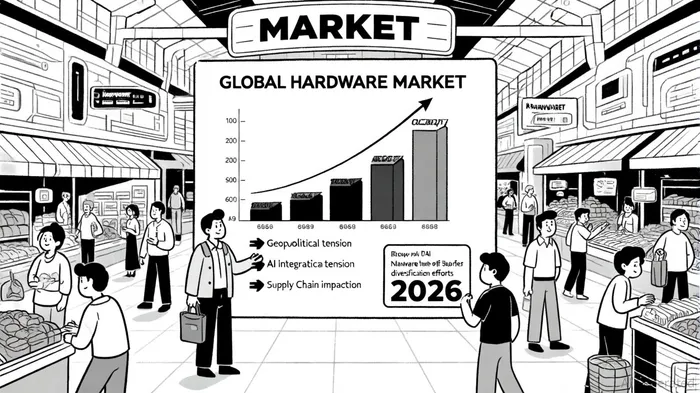





Comentarios
Aún no hay comentarios