
The Resilient Expansion of Chinese EV Giants in Europe: A Contrarian Opportunity Amid Tariffs
The European EV market has long been seen as a battleground for global automakers, but recent data reveals a seismic shift: Chinese EV giants are not just surviving-they're thriving-despite the EU's aggressive 2024 tariffs on Chinese-made battery-electric vehicles (BEVs). In November 2025, Chinese automakers captured a record 12.8% of Europe's EV market, with hybrid exports surging past 13% in the same period. This growth, driven by strategic adaptability and relentless innovation, underscores a contrarian opportunity for investors.
Strategic Adaptability: Pivoting to PHEVs to Bypass Tariffs
The EU's 45.3% tariffs on Chinese BEVs were designed to shield domestic automakers like Volkswagen and BMW. However, Chinese manufacturers have outmaneuvered these barriers by pivoting to plug-in hybrid electric vehicles (PHEVs), which remain untariffed. This shift has been led by BYDBYD--, whose PHEVs now account for 40.1% of its total EV sales in Europe. By focusing on hybrids, Chinese automakers have not only avoided tariffs but also tapped into European demand for fuel-efficient vehicles amid high energy prices.
BYD's Seal U DM-i and Dolphin Surf models exemplify this strategy. The Seal U DM-i, priced competitively against the Volkswagen Tiguan and Toyota C-HR, became the top-selling PHEV in Europe in September 2025, with 45,837 units sold. Meanwhile, the Dolphin Surf starts at £18,650 in the UK-less than half the price of a TeslaTSLA-- Model 3-making it a hit with budget-conscious buyers. This pricing advantage, combined with BYD's vertical integration, has allowed it to undercut European rivals while maintaining profitability.
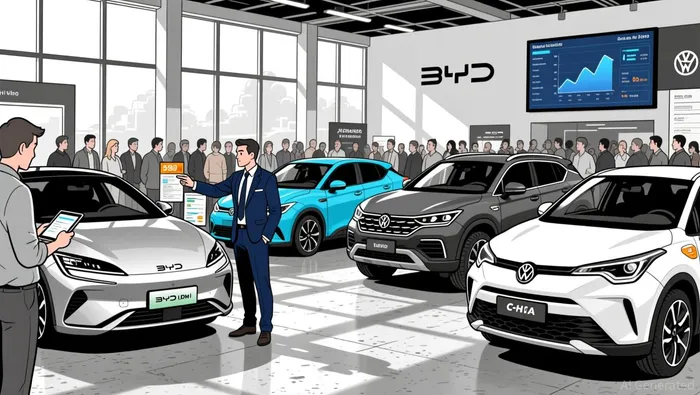
BYD's success stems from three core advantages:
1. Vertical Integration: BYD produces critical components like batteries and semiconductors in-house, reducing costs by up to €10 per kWh compared to competitors. Its Blade Battery technology, for instance, offers superior safety and cost efficiency.
2. Localization: New factories in Hungary and Türkiye will enable local production of both BEVs and PHEVs, sidestepping tariffs and enhancing brand perception as a "European" manufacturer.
3. Dual-Platform Flexibility: Unlike EU automakers, which have over-invested in BEVs, BYD's hybrid-first approach caters to markets with underdeveloped charging infrastructure. This adaptability has driven 302.6% sales growth in the first nine months of 2025.
In contrast, EU automakers face rising costs and supply chain bottlenecks. Volkswagen's EV market share grew to 11.2% in Q3 2025, but BYD's share rose to 4.4% in the same period. Meanwhile, Tesla's European sales-once dominant-slumped as BYD's surged 272% year-over-year.
EU Automakers: Struggling to Keep Up
The EU's protectionist policies have backfired. While tariffs were meant to shield domestic automakers, they've accelerated the shift to hybrids-a segment Chinese manufacturers dominate. European brands like BMW and Mercedes-Benz, which focused heavily on BEVs, now face declining market shares. For example, BYD's September 2025 sales (13,221 units) outpaced Tesla's (25,656 units) in the UK, a market where Tesla once held a monopoly.
Moreover, Chinese automakers are leveraging Europe's fragmented regulatory landscape. With 42,000 EVs exported in November 2025 alone, and total 2025 exports exceeding 600,000 units, Chinese brands are capitalizing on gaps in EU infrastructure and consumer preferences.
The Investment Thesis: Long-Term Exposure to Export-Driven Leaders
For investors, the case for Chinese EV leaders is compelling. Despite short-term headwinds like tariffs, these companies are demonstrating strategic resilience and operational agility. BYD's planned European factories, coupled with its hybrid-first strategy, position it to dominate the next phase of the EV transition. Similarly, broader Chinese automakers like SAIC Motor Corp. are expanding their hybrid portfolios to maintain growth.
The data is clear: Chinese EVs are not just a passing trend. They represent a structural shift in global automotive dynamics. As one analyst notes, "The EU's tariffs have failed to curb Chinese competition-they've only forced it to innovate faster." For long-term investors, this is a rare opportunity to bet on a sector where adaptability and scale are rewriting the rules.





Comentarios
Aún no hay comentarios