
The Resilience of USDf: How Reserve-Backed Stability is Fueling Institutional Adoption in 2025
The Foundation of Trust: USDf's Reserve Composition and Audit Rigor
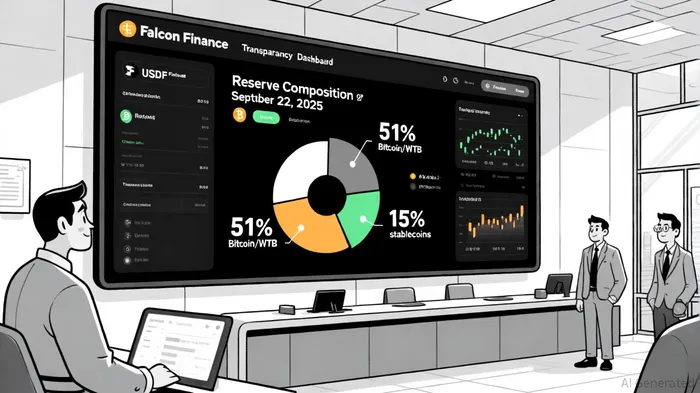
USDf's credibility begins with its reserves. According to an independent audit by Harris & Trotter LLP, USDf tokens are fully backed by reserves exceeding liabilities, with a collateralization ratio of 103.87% as of September 22, 2025. The audit, conducted under the International Standard on Assurance Engagements (ISAE 3000), verified that reserves-held in segregated, unencumbered accounts-include $1.96 billion in total assets, with $1.002 billion allocated to BitcoinBTC-- and wrapped BitcoinWBTC-- (WBTC) and $666.599 million in stablecoins, according to a Cryptorank report. This diversified approach contrasts with traditional stablecoins like USDCUSDC--, which rely heavily on U.S. Treasuries, and USDTUSDT--, which includes opaque corporate bonds, as a StablecoinInsider analysis explains.
The transparency is further reinforced by Falcon Finance's Transparency Dashboard, which allows real-time verification of reserves and issuance. This level of accountability is critical in an era where the collapse of undercollateralized stablecoins has eroded trust. As one analyst noted in Incrypted, "USDf's blend of crypto and fiat assets offers a hedge against both liquidity risks and regulatory shifts."
Institutional Adoption: From Custody to Real-World Assets
Falcon Finance's roadmap for USDf is not merely about stability-it's about utility. The platform has secured partnerships with BitGo to provide institutional-grade custody solutions, enabling features like staking and fiat settlement, as announced in Falcon Finance's June update. This infrastructure is critical for attracting banks and asset managers, who require secure, auditable systems to integrate stablecoins into their operations.
Geographically, USDf is expanding access through fiat on- and off-ramps in Latin America, Turkey, the MENA region, and the U.S., with UAE-specific gold redemption options (see Falcon Finance's Transparency Dashboard). These moves align with a broader trend: institutions are increasingly using stablecoins for cross-border payments, where speed and transparency outweigh the inertia of legacy systems. For example, a Visa pilot program with USDC and EURC highlights the demand for pre-funded, real-time settlements. USDf's synthetic dollar model-pegged to the U.S. dollar but minted via collateralized assets-positions it as a hybrid solution for both decentralized and traditional finance.
The project's 2026 RWA engine, which will tokenize bonds and credit instruments, further underscores its ambition to bridge crypto and traditional markets, as described by Incrypted. By securitizing USDf through a special purpose vehicle (SPV), Falcon Finance aims to offer institutional investors a regulated, yield-generating alternative to cash equivalents, according to the same analysis.
Regulatory Tailwinds and Market Dynamics
The U.S. and EU regulatory environments have become fertile ground for USDf's growth. The GENIUS Act, passed in June 2025, mandates full reserve backing for stablecoins, primarily in Treasuries, and enforces regular audits, per an OnChain Standard overview. While USDf's current reserve mix includes significant crypto exposure, its collateral ratio of 116% (as reported by DWF Labs in July 2025) exceeds the minimum requirements. This flexibility allows USDf to navigate regulatory shifts without sacrificing yield potential-a key advantage over centralized peers like TetherUSDT--, whose reserve practices have been critiqued in a StablecoinInsider analysis.
Meanwhile, the EU's Markets in Crypto-Assets (MiCA) regulation, effective January 2025, has set a global standard for stablecoin transparency (OnChain Standard's overview also covers MiCA). USDf's compliance with these frameworks not only reduces legal risk but also enhances its appeal to multinational corporations seeking to tokenize treasuries. Hedge funds and venture capital firms, for instance, are allocating 5–20% of their portfolios to stablecoin yield strategies, with USDf's sUSDf variant-its yield-bearing counterpart-offering returns through funding rate arbitrage and liquidity provision, according to an AlphaStake analysis.
The Path Forward: Growth in a Fragmented Market
Despite its strengths, USDf faces competition from established players like USDC and USDT, which dominate market share. However, its synthetic dollar model-combining decentralized minting with institutional features-addresses a critical gap. As McKinsey notes, stablecoins now handle $27 trillion in annual transactions, with cross-border B2B payments in Southeast Asia growing to 43% via stablecoins. USDf's expansion into these corridors, coupled with its RWA engine, could position it as a preferred vehicle for tokenized assets.
Moreover, the rise of "digital treasuries"-where companies hold stablecoins for liquidity management-has created a $11.2 billion market, per AlphaStake. USDf's ability to generate yield through its Falcon engine, while maintaining a 1:1 peg, makes it an attractive option for corporations seeking to optimize cash balances.
Conclusion: A Stablecoin for the Institutional Age
USDf's journey reflects a broader shift in the stablecoin ecosystem: from speculative experiments to institutional-grade infrastructure. Its reserve-backed stability, audited transparency, and strategic partnerships have created a foundation for sustained adoption. As regulators tighten requirements and corporations seek digital efficiency, USDf's hybrid model-balancing crypto innovation with traditional safeguards-may well define the next phase of stablecoin evolution. For investors, the question is no longer whether stablecoins matter, but which ones will endure. USDf, with its blend of resilience and ambition, is a compelling candidate.







Comentarios
Aún no hay comentarios