
The Resilience and Risks in German Industry: Is a Cyclical Rebound Within Reach?
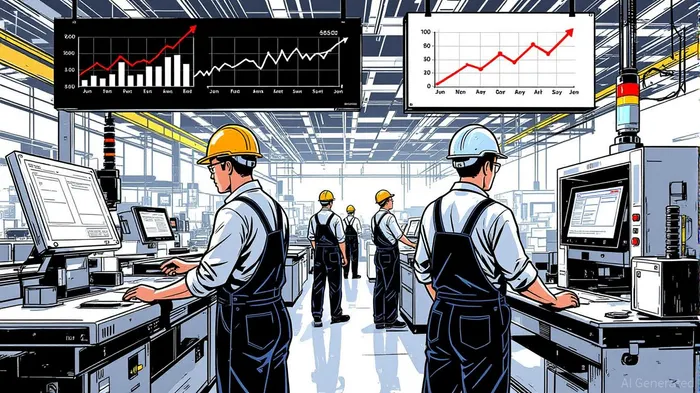
Germany’s industrial sector stands at a crossroads in 2025, balancing fleeting signs of cyclical recovery with entrenched structural headwinds. While recent data hints at a potential rebound in manufacturing and exports, the broader economic landscape remains clouded by energy transition costs, geopolitical trade tensions, and weak domestic demand. For investors, the question is whether these short-term gains can evolve into a sustainable upturn—or if they merely mask deeper vulnerabilities.
Cyclical Recovery: A Glimmer of Hope
July 2025 brought a rare bright spot: industrial production surged 1.3% month-on-month, driven by the automotive and machinery sectors [2]. This rebound followed a 0.1% quarterly GDP contraction in Q2, largely attributed to a sharp decline in exports to the U.S. as companies front-loaded transactions ahead of new tariffs [1]. The July data suggests that global trade activity—particularly in machinery and automotive components—remains resilient, with Germany’s manufacturing sector accounting for 17% of total exports in 2024 [3].
However, this recovery is fragile. The S&P Global PMI for German manufacturing fell below 50 in May 2025, signaling contraction [5], and industrial output remains over 10% below pre-pandemic levels [2]. The U.S. remains a critical market, absorbing 10% of Germany’s exports in H1 2025, but expanding tariffs on steel and aluminum have already prompted some European firms to halt U.S. shipments [2].
Structural Challenges: The Heavy Hand of Transition
The energy transition, or Energiewende, looms large as both a long-term opportunity and an immediate burden. According to the German Chambers of Industry and Commerce (DIHK), the transition could cost up to 5.4 trillion euros by 2049, straining businesses and households alike [1]. Industrial electricity prices in Germany—0.19 USD/kWh—remain nearly double those in the U.S. (0.08 USD/kWh) [6], eroding cost competitiveness in energy-intensive sectors like automotive and machinery.
The International Energy Agency (IEA) has urged Germany to clarify its energy mix, particularly the role of natural gas, as the country phases out coal and nuclear power [4]. Despite growing renewable capacity, reliance on LNG imports—90% from the U.S.—has exposed industries to volatile pricing [6]. Meanwhile, the government’s plan to subsidize electricity for energy-intensive sectors with 11.3 billion euros by 2030 lacks a clear decarbonization roadmap, leaving investors uncertain [4].
Sector-Specific Pressures: Automotive and Machinery in the Crosshairs
The automotive sector, a pillar of German exports, faces a dual crisis. Production in 2024 fell 12% below 2019 levels, with 4.1 million passenger cars manufactured [2]. The BDI forecasts a further 0.5% decline in 2025 as global competition intensifies and energy costs persist [1]. Similarly, the machinery sector, which contributes 17% of total exports, is grappling with weak demand in China and the U.S., two of its largest markets [2].
Investment Implications: Navigating Uncertainty
For investors, the German industrial sector presents a paradox. Short-term pull-forward effects from U.S. tariff hikes may temporarily boost exports, but these gains are unlikely to offset structural weaknesses. The services sector has shown resilience, growing across business and consumer services [4], but manufacturing and construction remain in contraction.
Key risks include:
- Tariff escalation: The U.S.-China trade war and U.S. steel/aluminum tariffs could further dampen demand.
- Currency headwinds: A stronger euro makes German exports less competitive.
- Domestic investment lag: Faster depreciation policies have only just begun to take effect, with uncertain long-term impact [2].
Conversely, the Mittelstand—the backbone of Germany’s export machine—could benefit from a stabilization in global trade flows. However, this depends on policy clarity around energy subsidies and decarbonization.
Conclusion: A Delicate Balance
Germany’s industrial sector is neither in freefall nor on a clear path to recovery. The July 2025 rebound offers hope, but it is a narrow window against a backdrop of energy costs, geopolitical tensions, and structural underperformance. For investors, the path forward hinges on two questions: Can policymakers align the Energiewende with industrial competitiveness? And will global trade tensions ease enough to sustain export growth? Until these uncertainties resolve, caution remains warranted.
Source:
[1] Industry Report April 2025 [https://issuu.com/bdi-berlin/docs/industry_report_april_2025]
[2] July Data Keeps Hope Alive For Cyclical Rebound In German Industry [https://menafn.com/1110029646/July-Data-Keeps-Hope-Alive-For-Cyclical-Rebound-In-German-Industry]
[3] Germany's industry: the most important facts and figures [https://www.deutschland.de/en/topic/business/germanys-industry-the-most-important-facts-and-figures]
[4] International Energy Agency recommends Germany to use energy transition as a driver of energy security and economic competitiveness [https://www.bundeswirtschaftsministerium.de/Redaktion/EN/Pressemitteilungen/2025/04/20250328-international-energy-agency-recommends-germany-to-use-energy-transition-as-a-driver-of-energy-security-and-economic-competitiveness.html]
[5] BMWE - The economic situation in Germany in June 2025 [https://www.bundeswirtschaftsministerium.de/Redaktion/EN/Pressemitteilungen/Wirtschaftliche-Lage/2025/20250613-the-economic-situation-in-germany-in-june.html]
[6] Germany - Energy [https://www.trade.gov/country-commercial-guides/germany-energy]







Comentarios
Aún no hay comentarios