
The Resilience and Future Growth of the Bitcoin ATM Network in 2026
The BitcoinBTC-- ATMATM-- (BTM) network has emerged as a cornerstone of retail crypto infrastructure, offering a tangible bridge between traditional finance and digital assets. By 2026, this sector is poised to demonstrate remarkable resilience and growth, driven by technological innovation, regulatory clarity, and sector-specific adoption. For investors, the maturing crypto market has not diminished the appeal of BTMs but rather highlighted their enduring value in democratizing access to digital assets.
A Network in Exponential Expansion
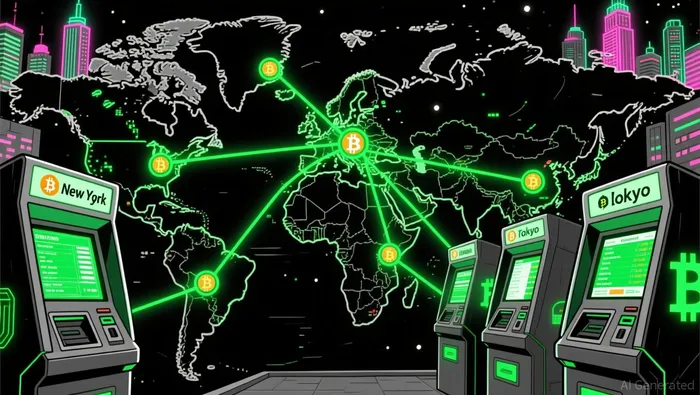
The global BTM market has already achieved staggering growth, with over 37,700 installations worldwide by 2024, up from just 500 in 2015. The U.S. alone accounts for 81% of global installations, with 31,500 machines deployed by 2024. Projections indicate this trend will accelerate: the U.S. market alone is expected to grow from $267.4 million in 2025 to $7,679.6 million by 2034, reflecting a 45.22% compound annual growth rate (CAGR). By 2026, the global BTM market is forecasted to surpass $2 billion, with North America, Europe, and Asia-Pacific leading adoption. This growth is underpinned by macroeconomic factors such as inflationary pressures and currency devaluations, which drive demand for alternative assets.
Technological and Regulatory Tailwinds
Innovation in BTM technology has been a critical driver of adoption. Modern machines now feature biometric authentication, AI-driven fraud detection, and real-time compliance checks, addressing security concerns and enhancing user trust. These advancements align with evolving regulatory frameworks, which are increasingly clarifying compliance pathways for operators. For instance, the U.S. and Europe have implemented robust anti-money laundering (AML) and know-your-customer (KYC) standards, legitimizing BTMs as part of mainstream financial infrastructure. The approval of spot Bitcoin and EthereumETH-- ETFs in 2025 further institutionalized crypto, creating a regulatory environment conducive to BTM expansion.
Sector-Specific Adoption: Retail and Hospitality Lead the Charge
The retail and hospitality sectors have become pivotal in BTM adoption. By 2026, over 63 U.S. retail stores have integrated BTMs, including partnerships between Bitcoin Depot Inc.BTM-- and major chains, to cater to tech-savvy consumers. Hotels, restaurants, and transportation hubs are leveraging these machines to enhance payment flexibility and attract a broader customer base. This trend is particularly pronounced in underserved communities, where BTMs provide a critical on-ramp to crypto for individuals excluded from traditional banking systems.
Institutionalization and Government Initiatives
The maturation of the crypto market has also spurred institutional investment in BTM infrastructure. Over 172 publicly traded companies held Bitcoin by Q3 2025, a 40% increase from the prior quarter, signaling growing corporate confidence. Financial giants like JPMorgan and Morgan Stanley have expanded into crypto services, while bipartisan legislation in the U.S. is set to integrate blockchain-based finance into traditional capital markets. Government initiatives, such as Europe's MiCA framework, further reinforce institutional confidence by establishing clear regulatory boundaries.
Why Retail Crypto Infrastructure Remains a Compelling Investment
Despite the market's maturation, BTMs retain their investment appeal due to their role in financial inclusion, technological adaptability, and regulatory alignment. The U.S. South and Midwest, for example, are witnessing rapid BTM deployment, reflecting untapped regional potential. Additionally, strategic partnerships demonstrate scalability of BTM networks in retail environments. For investors, the confluence of exponential growth projections, institutional adoption, and macroeconomic tailwinds makes BTMs a resilient asset class in an evolving crypto ecosystem.
Conclusion
The Bitcoin ATM network's trajectory in 2026 underscores its resilience and growth potential. As a hybrid of physical and digital finance, BTMs address accessibility, security, and regulatory challenges while capitalizing on mainstream adoption trends. For investors, this sector represents not just a bet on crypto's future but a strategic play on the infrastructure enabling its integration into everyday life.







Comentarios
Aún no hay comentarios