
The Resilience Factor in Global Manufacturing: Lessons from Hyundai's Chung Ju-Yung for Today's Trade Turbulence
In an era of geopolitical tensions, supply chain fragility, and rapid technological shifts, the ability of global manufacturers to endure and thrive hinges on a rare combination of leadership, operational rigor, and long-term vision. Hyundai Motor Company's journey—from a postwar construction firm to a global industrial titan—offers a masterclass in resilience. The strategies forged by its founder, Chung Ju-Yung, during crises like the 1997 Asian Financial Crisis remain strikingly relevant today, as companies navigate trade wars, inflation, and the energy transition. For investors, the lessons from Hyundai's playbook are not just historical curiosities but actionable frameworks for identifying equities poised to outperform in volatile markets.
The Chung Ju-Yung Blueprint: Frugality, Discipline, and Vision
Chung Ju-Yung's leadership was defined by a philosophy of “diligence, frugality, and affection.” His frugality was not mere cost-cutting but a strategic lever to compound value. In 1965, he invested $8 million in 2,000 heavy machines—a bold move for a fledgling South Korean firm—to accelerate infrastructure projects like the Soyang Dam. This ethos of resourcefulness translated into operational efficiency, enabling Hyundai to dominate markets with lower costs and faster execution.
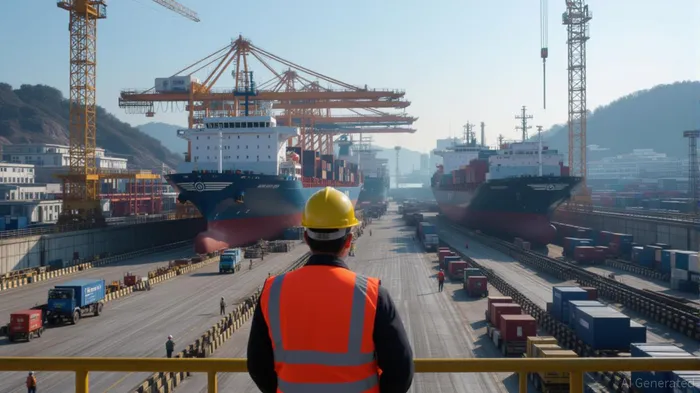
Execution discipline was another cornerstone. During the 1997 crisis, while rivals collapsed, Hyundai survived by prioritizing project timelines, cutting costs without sacrificing quality, and fostering employee loyalty through shared hardship. A case in point: the Ulsan shipyard, where Chung's team built the facility and the first ship simultaneously, shaving two years off the timeline. This “no-wasted-motion” approach became a hallmark of Hyundai's operations, a trait that resonates with value investors seeking businesses that deliver measurable results under pressure.
Hyundai's Modern Resilience: Navigating 2020–2025 Trade Turbulence
The past five years have tested Hyundai's legacy. The 2020 pandemic and 2022 supply chain crisis disrupted global manufacturing, yet Hyundai's recent performance underscores the enduring relevance of Chung's principles. In Q2 2025, the company reported a 7.3% year-on-year revenue increase to KRW 48.29 trillion, despite a 15.8% drop in operating profit. This resilience stems from strategic investments in localized production and electrification.
Hyundai's $21-billion U.S. manufacturing initiative, centered on the Georgia Metaplant America, is a direct response to the 25% U.S. tariff on imported vehicles. By aiming to produce 70% of U.S.-bound vehicles domestically by 2028, the company is not only bypassing tariffs but also aligning with U.S. tax credits for green technology. This mirrors Chung's strategic boldness, as the company balances short-term cost absorption with long-term positioning.
Electrification is another pillar of Hyundai's resilience. Hybrid sales surged 45.3% in Q2 2025, with the company planning to expand its hybrid lineup to 14 models by 2028. Extended-range electric vehicles (EREVs) are being introduced to cater to EV-skeptical consumers, blending innovation with pragmatism. Meanwhile, Hyundai's hydrogen division, HTWO, is scaling fuel cell systems for both passenger and commercial vehicles, positioning the company as a leader in the $2.5 trillion hydrogen economy by 2050.
Comparative Resilience: Hyundai vs. Peers
Hyundai's approach contrasts sharply with peers like TeslaTSLA-- and General MotorsGM--. While Tesla's margins have declined 12% in Q2 2025 due to supply chain disruptions, Hyundai's disciplined cost management has allowed it to maintain a 7.5% operating margin. Similarly, General Motors and Ford face projected EBIT declines of 31.6% and 16.5%, respectively, under the same tariff regime. Hyundai's ability to absorb costs while investing in localized production and hybrid technology highlights its competitive edge.
Actionable Insights for Investors
For investors, Hyundai's story underscores three critical metrics to evaluate global industrial and automotive equities:
1. Operational Discipline: Look for companies that prioritize execution efficiency, even in downturns. Hyundai's ability to maintain project timelines and employee morale during crises is a testament to this.
2. Strategic Localization: Firms investing in localized production to mitigate trade risks—like Hyundai's U.S. initiative—are better positioned to navigate geopolitical uncertainties.
3. Long-Term Innovation: Companies that treat innovation as a perpetual cycle, rather than a one-time event, will outperform. Hyundai's hydrogen and EV investments, rooted in Chung's ethos of continuous improvement, exemplify this.
Conclusion: Building a Resilient Portfolio
Chung Ju-Yung's legacy is not just a historical footnote but a blueprint for modern manufacturing. As global trade turbulence persists, investors should seek companies that blend frugality with strategic boldness, operational discipline with innovation, and employee-centric leadership with long-term vision. Hyundai's journey—from a postwar startup to a hydrogen-powered mobility leader—proves that resilience is not a passive trait but a cultivated strategy. For those willing to look beyond short-term volatility, the rewards are substantial.







Comentarios
Aún no hay comentarios