
The Resilience of Ethereum in the 2025 Market Selloff: Why ETH Outperformed BTC in a Bitcoin-Dominated Panic
On-Chain Metrics: Stress, but Not Collapse
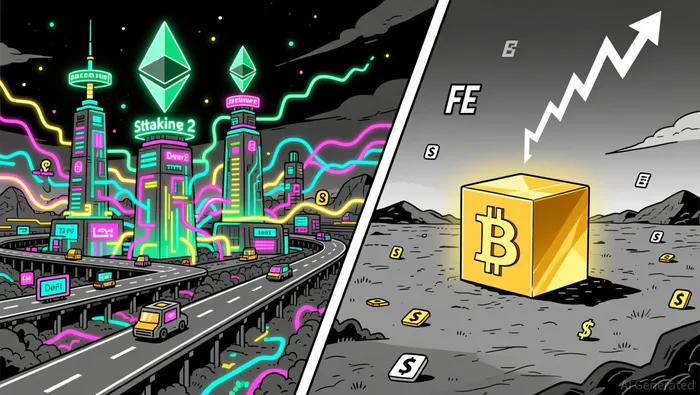 During the selloff, Ethereum's network activity showed signs of stress but retained critical functionality. Monthly active addresses fell to 8.2 million from 9 million in September, and transaction fees collapsed by 42% to $27 million. However, Ethereum's Layer 2 solutions surged in activity, growing 18% quarter-over-quarter. This growth underscores Ethereum's role as a foundational blockchain for decentralized finance (DeFi) and Web3 innovation, with projects like Aztec Network's Ignition Chain and RISE's global on-chain markets gaining traction according to market reports.
Bitcoin's on-chain metrics told a different story. While transaction counts and active addresses remained stable, the network saw fewer but higher-value transactions, signaling institutional activity. Centralized exchange inflows also spiked, hinting at selling pressure. Yet, core metrics like transaction volume and user growth stagnated, suggesting the selloff was driven by short-term capital movements rather than organic demand.
Structural Advantages: Staking Yields and Institutional Adoption
Ethereum's staking ecosystem emerged as a key differentiator. With 35.7 million ETH staked (25% of the supply), the network generated $89.25 billion in annualized yield, attracting institutional capital in a low-interest-rate environment. Staking yields of 4.5–5.2% contrasted sharply with Bitcoin's zero-yield model, making ETH a more attractive asset for capital preservation during macroeconomic uncertainty. This structural advantage was further amplified by Ethereum ETFs, which managed $27.66 billion in assets under management, including a $600 million influx for BlackRock's ETHA ETF within two days.
Meanwhile, Bitcoin's appeal remained tied to its store-of-value narrative. However, the selloff exposed vulnerabilities in its utility. With no native staking mechanism, Bitcoin holders lacked yield-generating opportunities, leaving them more exposed to liquidity crunches according to market analysis.
Layer 2 and Dencun: The Road to Scalability
Ethereum's Layer 2 solutions, bolstered by the Dencun and Pectra upgrades, reduced gas fees by 90%, enabling 10,000 transactions per second at $0.08 per transaction. This scalability positioned Ethereum as an institutional-grade platform, even as broader market sentiment soured. DeFi's total value locked (TVL) reached $223 billion, with 53% tied to tokenized real-world assets-a testament to Ethereum's expanding role in bridging traditional and digital finance according to market reports.
Bitcoin, by contrast, faced limitations in transaction efficiency. While its network handled large-value transfers, the lack of scalable Layer 2 infrastructure constrained its ability to adapt to rising demand for programmable money.
The Paradox of Underperformance
Despite Ethereum's fundamentals, the ETH/BTC ratio hit a seven-month low during the selloff. This paradox can be explained by Bitcoin's dominance in the panic-driven flight to liquidity. As investors sought defensive assets, Bitcoin's brand recognition and perceived scarcity made it a default safe haven. However, Ethereum's underlying metrics-such as steady staking inflows and Layer 2 growth-suggest its ecosystem weathered the storm better than its price action implied.
Conclusion: A New Era for Ethereum
The 2025 selloff highlighted Ethereum's structural strengths: yield generation, scalability, and institutional adoption. While Bitcoin's role as digital gold endured, Ethereum's transition to a programmable, scalable platform positioned it to outperform in the long term. The Dencun upgrade, expected to further reduce fees and enhance throughput, and the rise of tokenized real-world assets on Ethereum's network signal a shift toward utility-driven value accrual. For investors, this means Ethereum's resilience is not just a function of price but of its evolving infrastructure-a foundation built to withstand macroeconomic turbulence.






Comentarios
Aún no hay comentarios