
Resilience of Emerging Market Traders in Geopolitical Crises: How Adversity Shapes Long-Term Investment Behavior and Market Stability
In 2025, emerging market traders have proven that adversity is not a barrier but a catalyst for innovation and resilience. Amid escalating geopolitical crises-from U.S.-China trade wars to renewed Middle East conflicts-these markets have demonstrated a unique ability to adapt, rebuild, and even thrive. The key lies in understanding how loss and volatility shape long-term investment behavior, fostering strategies that prioritize agility, localization, and systemic preparedness.
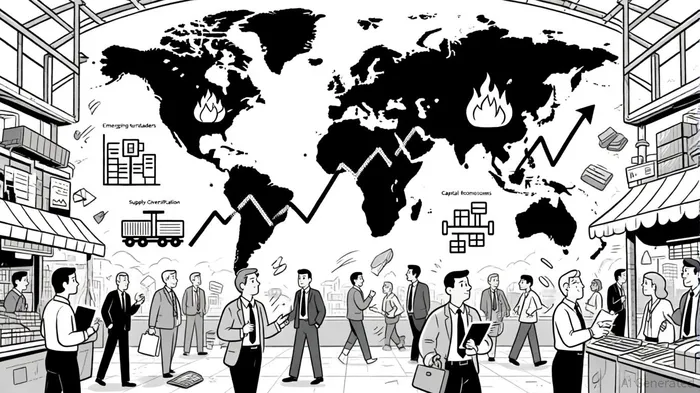
The Behavioral Shift: From Vulnerability to Proactive Adaptation
Geopolitical crises force traders and investors to confront uncertainty head-on. According to World Economic Forum's Resilience Leaders' Roundtable, businesses in emerging markets have increasingly adopted "bounce-forward" strategies, where adversity drives transformative learning rather than mere survival. For example, U.S. multinational subsidiaries in China have shifted from reactive stabilization to proactive adaptation, leveraging deep-level learning to restructure supply chains and align with regional regulatory frameworks, as shown in a ScienceDirect study. This behavioral shift underscores a critical insight: prolonged exposure to geopolitical risk compels firms to build resilience as a core competency.
Emerging market traders have also embraced diversification as a defensive and offensive tactic. As J.P. Morgan's analysis of 80+ years of geopolitical events reveals, while large-cap equity markets often recover quickly post-crisis, localized markets and sectors in emerging economies face prolonged volatility. To mitigate this, traders are now prioritizing cross-regional supply chains. Vietnam, Mexico, and Indonesia, for instance, have emerged as manufacturing hubs, attracting $23 billion in foreign direct investment in 2024 alone as firms seek to reduce China dependency, according to HSBC insights. This diversification isn't just a response to risk-it's a strategic reinvention.
Market Stability: Structural Reforms and Policy Innovation
Market stability in emerging economies hinges on structural factors that turn adversity into opportunity. Improved monetary policy frameworks and prudential regulations have been pivotal. As noted by the Bank for International Settlements' BIS bulletin, emerging markets with robust policy buffers-such as India's AI-driven agricultural reforms and Brazil's national AI strategy-have weathered monetary tightening in advanced economies without destabilizing. These policies create a "floor" for economic resilience, ensuring that external shocks don't cascade into systemic collapse.
Capital flow management further illustrates this point. The G20/OECD report highlights how "pull factors" like strong local debt markets and declining inflation have attracted capital inflows to Southeast Asia and the Gulf Cooperation Council (GCC) in 2025. For example, Indonesia's sovereign wealth fund and Saudi Arabia's Public Investment Fund have become anchors of stability, offsetting external volatility with domestic investor confidence. This shift reflects a broader trend: emerging markets are no longer passive recipients of global capital but active architects of their own financial ecosystems.
The Role of Technology and Multilateral Collaboration
Technological innovation has emerged as a linchpin of resilience. In sub-Saharan Africa, where geopolitical risk (GPR) impacts exchange rates differently across economies, predictive analytics and stress testing are now standard tools for managing systemic risks, as shown in a Future Business Journal study. Angola's crisis management frameworks, for instance, now integrate AI-driven forex models to mitigate GPR-induced volatility. Similarly, India's AI for Agriculture Innovation (AI4AI) program has boosted productivity by 18% in 2024, attracting agri-tech investments worth $4.5 billion, according to a FCLT Global resource.
Multilateral collaboration has amplified these efforts. The World Economic Forum emphasizes that private-sector partnerships with governments and institutions are critical for addressing structural barriers like supply chain bottlenecks. For example, HSBC's 2025 Emerging Markets Seminar notes that firms collaborating with local stakeholders in Vietnam and Mexico have reduced supply chain disruptions by 30% compared to peers relying on traditional models. This synergy between policy and private action is reshaping the risk-return profile of emerging markets.
Investment Implications: Patience and Precision in a Fragmented World
For investors, the resilience of emerging markets in 2025 demands a recalibration of strategies. Short-term volatility remains inevitable, but long-term gains are unlocked by identifying markets that combine structural reforms with technological agility. Key opportunities lie in:
1. Digital Infrastructure: Markets like India and Indonesia, where AI and 5G adoption is outpacing global averages.
2. Energy Transition: GCC and Southeast Asia's pivot to green hydrogen and solar energy amid fossil fuel uncertainty.
3. Local Debt Markets: High-yield, inflation-linked bonds in Brazil and Nigeria, supported by declining inflation and dollar weakness, as noted in the G20/OECD report.
However, risks persist. As UNCTAD warns, over-diversification can fragment global trade, creating new vulnerabilities for smaller economies (Global trade in 2025: Resilience under pressure). Investors must balance exposure to high-growth regions with hedging against policy shifts and currency swings.
Conclusion: Resilience as a Competitive Advantage
The resilience of emerging market traders in 2025 is not accidental-it is the product of behavioral adaptation, policy innovation, and technological foresight. Geopolitical crises, while disruptive, have accelerated the evolution of markets that once seemed vulnerable. For investors, the lesson is clear: adversity is the forge where long-term value is built. The question is no longer whether emerging markets can survive geopolitical turbulence, but how quickly we can align our strategies with their new reality.







Comentarios
Aún no hay comentarios