
The Resilience of China's AI Sector Amid Global Market Volatility: Strategic Investment Opportunities in the CSI AI Index
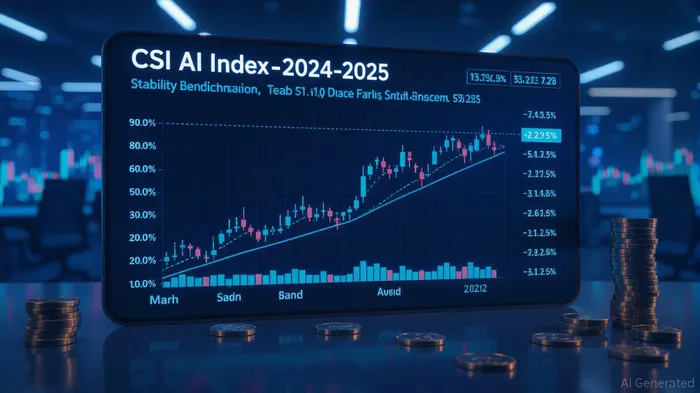
China’s AI sector has emerged as a beacon of resilience amid the turbulence gripping global markets in 2025. The CSI AI Index, a barometer of the country’s artificial intelligence-driven innovation, has defied broader economic headwinds, driven by a confluence of government policy support, domestic demand, and strategic corporate performance. For investors seeking to capitalize on long-term growth in a fragmented global landscape, the index offers a compelling case for strategic positioning.
Policy-Driven Momentum and Domestic Demand
The Chinese government’s aggressive push to localize AI chip production has been a cornerstone of the sector’s resilience. Beijing’s efforts to reduce reliance on U.S. suppliers—spurred by export restrictions on advanced semiconductors—have catalyzed a surge in domestic innovation. AlibabaBABA-- and Cambricon Technologies, two key constituents of the CSI AI Index, exemplify this trend. Alibaba’s Hong Kong-listed shares surged 19% in August 2025, fueled by a 100% year-on-year increase in AI-related revenues and state-backed R&D initiatives [1]. Similarly, Cambricon Technologies reported a 44-fold revenue jump in the first half of 2025, with a net profit nearing 1 billion RMB, underscoring robust demand for homegrown AI solutions [1].
This policy-driven momentum is not isolated. The broader CSI 300 Index, while not AI-specific, rose over 10% in August 2025, reflecting investor confidence in China’s tech-led recovery [2]. Fiscal stimulus measures, including tax cuts and consumption incentives, have further stabilized growth, creating a favorable environment for AI-focused equities [6].
Navigating Global Volatility
Despite these gains, the sector operates in a landscape of persistent geopolitical and trade uncertainties. U.S. tariff threats and Trump-era trade policies have historically triggered market selloffs, as seen in the S&P 500’s sharp decline in April 2025 [5]. However, Chinese markets have shown a unique ability to absorb such shocks. The CSI 300’s 11.2% year-to-date gain as of August 2025 highlights this resilience, even as global investors grew increasingly desensitized to tariff-related volatility [4].
This stability is partly attributable to the interplay between spot and futures markets. Research indicates that futures volume acts as a net transmitter of volatility spillovers, but China’s AI sector has insulated itself through strong domestic demand and regulatory interventions [3]. For instance, the government’s focus on AI infrastructure—such as data centers and cloud computing—has created a self-sustaining ecosystem less reliant on external trade flows [1].
Challenges and Strategic Considerations
Investors must remain cognizantCTSH-- of risks. The U.S. AI market’s slowdown, exemplified by C3.ai’s recent earnings warnings, has raised questions about global demand for AI tools [3]. Additionally, China’s broader economic challenges—such as a struggling real estate sector and high corporate debt—pose long-term headwinds [5]. However, these risks are partially offset by the CSI AI Index’s concentration in sectors with clear policy tailwinds.
A strategic approach to investing in the index would involve hedging against macroeconomic risks while leveraging its exposure to AI-driven growth. For example, pairing CSI AI holdings with defensive assets in healthcare or utilities could balance volatility. Moreover, the index’s performance during periods of U.S.-China trade friction—such as its outperformance relative to the MSCIMSCI-- Emerging Markets Index in Q2 2025—suggests its potential as a diversification tool [4].
Conclusion
The CSI AI Index’s resilience in 2025 underscores its role as a strategic asset for investors navigating a fractured global market. By aligning with China’s policy priorities and capitalizing on domestic demand, the index offers a unique blend of growth and stability. While external uncertainties persist, the sector’s ability to adapt to geopolitical and trade shocks positions it as a cornerstone of a forward-looking portfolio.
Source:
[1] China's AI Chip Push Sparks Stock Rally Amid Market Volatility [https://worldlytalk.com/chinas-ai-chip-push-sparks-stock-rally-amid-market-volatility/]
[2] Markets edge higher on AI momentum despite broader volatility [https://www.linkedin.com/pulse/markets-edge-higher-ai-momentum-despite-broader-volatility-mbgof]
[3] C3.ai (AI) Faces Challenges Amid AI Market Slowdown [https://www.gurufocus.com/news/3094639/c3ai-ai-faces-challenges-amid-ai-market-slowdown]
[4] Analysis of the international stock market situation (Summer 2025) [https://isdo.ch/analysis-of-the-international-stock-market-situation-summer-2025/]
[5] Global stock markets appear numb to Trump's 'reciprocal' ... [https://www.cnbc.com/2025/08/08/global-investors-become-numb-to-trump-amid-latest-trade-tariff-msci-stoxx-sp500-nifty-nikkei-salvos.html]
[6] Asia Mid-year Outlook [https://privatebank.jpmorganJPM--.com/latam/en/insights/markets-and-investing/asf/asia-mid-year-outlook]





Comentarios
Aún no hay comentarios