
The Reshaping of Market Leadership in 2025
The global financial landscape in 2025 is witnessing a seismic shift in market leadership, as AI-driven technology giants outpace traditional blue-chip companies in earnings, innovation, and market capitalization. This transformation is not merely a short-term trend but a structural realignment driven by the accelerating adoption of artificial intelligence (AI) and the strategic reinvention of core business models. For investors, understanding the forces behind this shift is critical to navigating the evolving investment landscape.
Market Performance: A Stark Divide
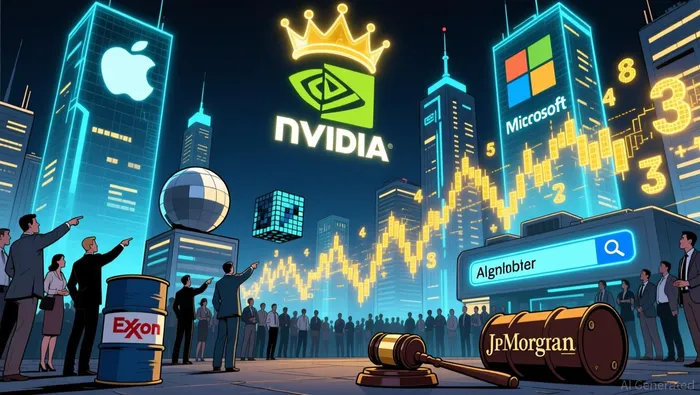
In Q3 2025, the five largest U.S. technology companies-Apple, MicrosoftMSFT--, Alphabet, NVIDIANVDA--, and Meta-collectively exceeded consensus EPS estimates by an average of 11.2%, with total revenue reaching $178.4 billion, a 18.6% year-over-year increase. NVIDIA, the poster child of the AI revolution, saw its data center revenue surge to $30.8 billion in Q3 2025, a 112% year-over-year jump, fueled by demand for its AI training and inference GPUs. By December 2025, NVIDIA's market capitalization had soared to $4.5 trillion, surpassing traditional blue-chip stalwarts like Exxon and JPMorgan. AppleAAPL-- followed with a $4.0 trillion valuation, while Microsoft and Alphabet held $3.6 trillion and $3.8 trillion, respectively. This dominance underscores a broader pattern: AI-driven innovation is now the primary engine of value creation in the global economy.
Drivers of Growth: R&D, AI Integration, and Strategic Vision
The outperformance of AI-driven tech giants is rooted in their aggressive R&D spending and early-stage adoption of AI technologies. According to a global survey by McKinsey, 62% of organizations are experimenting with AI agents, while 23% are scaling agentic AI within at least one business function. High-performing companies-particularly those in the tech sector-are leveraging AI not as a tool for incremental efficiency but as a catalyst for transformation. These firms are redesigning workflows, embedding AI into core operations, and aligning AI initiatives with growth and innovation objectives.
 For example, Microsoft's Azure and Google Cloud have capitalized on surging demand for AI infrastructure, with Microsoft reporting robust revenue growth driven by its investments in AI-powered cloud services. Similarly, NVIDIA's dominance in AI hardware has positioned it as the backbone of the AI revolution, supplying chips for everything from generative AI models to autonomous systems. In contrast, traditional blue-chip firms, while experimenting with AI, struggle to scale these initiatives enterprise-wide. Only one-third of organizations have begun widespread AI implementation, with smaller firms lagging even further behind.
Challenges for Traditional Blue-Chips
Traditional industries such as energy, finance, and consumer goods face structural challenges in keeping pace with AI-driven tech firms. While 88% of organizations report using AI in at least one business function, meaningful enterprise-wide impact remains elusive. Only 39% of respondents in the McKinsey survey reported any EBIT impact from AI, with most of those reporting less than 5%. This gap is exacerbated by the fact that high-performing tech companies are more likely to prioritize cross-functional collaboration, data governance, and workforce training-key enablers of AI success.
Moreover, the global AI market is projected to reach $254.5 billion in 2025, with generative AI alone contributing significantly to this growth. Traditional enterprises, however, often treat AI as a "plug-and-play" solution rather than a strategic transformation tool, limiting their ability to capture value. Sectors like technology, media, and healthcare are leading in AI adoption, while industries such as IT and knowledge management are only beginning to explore deep integration. This uneven progress ensures that AI-driven tech giants will continue to widen their lead.
Implications for Investors
For investors, the reshaping of market leadership in 2025 presents both opportunities and risks. AI-driven tech companies are not only outperforming traditional peers but also redefining entire industries. The next wave of AI adoption will likely focus on domain-specific applications and hybrid architectures that combine the broad reasoning of foundation models with specialized algorithms. Investors should prioritize firms with strong R&D pipelines, scalable AI infrastructure, and a culture of innovation.
Conversely, traditional blue-chips that fail to integrate AI into their core operations risk stagnation. While these companies may offer defensive qualities in a volatile market, their long-term growth potential is increasingly constrained by their inability to match the agility and technological momentum of AI-driven rivals.
Conclusion
The market leadership of 2025 is being reshaped by the relentless march of AI. As tech giants like NVIDIA, Microsoft, and Alphabet redefine the boundaries of innovation, traditional blue-chips face an existential challenge: adapt or be left behind. For investors, the lesson is clear: the future belongs to those who embrace AI not as a passing fad but as a fundamental force of economic transformation.







Comentarios
Aún no hay comentarios