
The Reshaping of Global Supply Chains: Assessing China's Export Vulnerabilities and Southeast Asia's Emerging Resilience
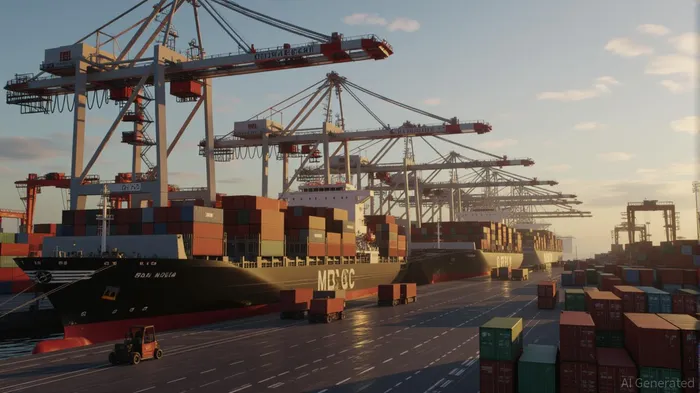
The U.S.-China trade war, now in its eleventh year, has evolved from a clash of tariffs to a high-stakes game of supply chain chess. Under President Trump's 2025 transshipment crackdowns, China's export-dependent sectors face a perfect storm: tariffs stacked to 145% on most goods, strict enforcement of transshipment rules, and a strategic push to displace Southeast Asia as a manufacturing haven. For investors, the question is no longer whether China's supply chains are vulnerable—but how to navigate the fallout.
The Trump Tariff Machine: A Precision Strike on Transshipment
The Trump administration's 2025 policies are a masterclass in tariff engineering. By imposing a 20% baseline tariff on Vietnamese exports and a punitive 40% surcharge on transshipped goods, the U.S. has weaponized trade rules to dismantle a key Chinese strategy: routing products through third-party countries to avoid U.S. duties. This move, formalized in the U.S.-Vietnam Trade Deal, forces Chinese manufacturers to either pay exorbitant tariffs or restructure their supply chains to meet stringent “rules of origin” (e.g., 35% regional value content or HS code classification changes).
For context, Vietnam's exports to the U.S. accounted for 30% of its GDP in 2024. A 40% tariff on transshipped goods effectively nullifies Vietnam's role as a low-cost assembly hub for Chinese goods. The result? A shift toward “value-added manufacturing” in Vietnam, where companies must invest in local production rather than simple re-exports. While this strengthens Vietnam's industrial base, it also raises costs for U.S. consumers and creates uncertainty for investors betting on Southeast Asia's growth.
China's Long-Term Risks: A Fractured Export Ecosystem
China's export model, built on low-cost labor and scale, is under siege. The 145% effective tariff on Chinese goods—combining IEEPA tariffs, fentanyl penalties, and border security surcharges—has already reduced U.S. GDP growth by 0.6% in 2025. For China, the pain is twofold: lost U.S. market share and a forced shift to higher-cost production bases.
The PwC Vietnam 2025 survey highlights the adaptive measures: 44% of firms are diversifying sourcing beyond China, while 40% are automating to offset rising costs. Yet, these strategies take time. Chinese manufacturers are adopting a “dual-base” model, with headquarters handling design and Vietnamese subsidiaries managing assembly. This hybrid approach mitigates U.S. tariff risks but requires significant capital reinvestment—a challenge for smaller firms.
Southeast Asia's Resilience: A New Frontier for Investors
Vietnam's 20% tariff in the U.S. trade deal, while a relief, is not a panacea. The country's manufacturing sector must now compete on value-added output, not just cost. However, this shift aligns with global trends toward “green manufacturing” and digital transformation. Vietnamese firms like FPT Corporation and Saigon Co-op are already investing in AI-driven logistics and carbon-efficient production.
For investors, Southeast Asia offers a compelling hedge. Vietnam's “critical manufacturing hub” designation under U.S. regional frameworks signals long-term strategic value. Indonesia and Malaysia are also emerging as alternatives, with incentives for semiconductor and EV battery production. However, risks remain: policy volatility in Southeast Asia, currency fluctuations, and the need for companies to navigate complex origin rules.
Strategic Hedging: Where to Invest in a Shifting Landscape
- Diversify into Southeast Asia's “Next-Gen” Sectors:
- Tech and Automation: Firms like FPT Corporation are leading Vietnam's digital transformation.
- Green Manufacturing: ETFs like the iShares MSCIMSCI-- Vietnam IMI ETF (VNM) offer exposure to companies aligning with ESG trends.
Regional Logistics: Ports and infrastructure play a key role in Southeast Asia's supply chain growth.
Monitor Policy Shifts in the U.S.:
Trump's 2025 policies are part of a broader “China + 1” strategy. Investors should track congressional debates on tariff reductions and regional trade pacts.
Balance Exposure to China:
- While Chinese exports face headwinds, sectors like renewable energy and domestic consumption remain resilient. A 30% allocation to China-focused ETFs (e.g., iShares China Large-Cap ETF) can mitigate overexposure to Southeast Asia.
Conclusion: A World of Fractured Chains, but Opportunities Remain
The U.S. transshipment crackdowns are not just reshaping supply chains—they're redefining global economic power. For China, the risks are clear: higher costs, reduced U.S. market access, and a forced pivot to high-value manufacturing. For Southeast Asia, the challenge is to avoid becoming a mere “tariff haven” and instead build sustainable industrial ecosystems.
Investors who act now—by hedging into Southeast Asia's resilient hubs and diversifying across sectors—stand to benefit from the next phase of global trade. The key is to balance caution with conviction, recognizing that while the U.S. trade machine is powerful, the future of manufacturing will be defined by adaptability, not just tariffs.







Comentarios
Aún no hay comentarios