
The Reshaping of Digital Asset Allocations in 2025: Why Altcoins Outperformed Bitcoin
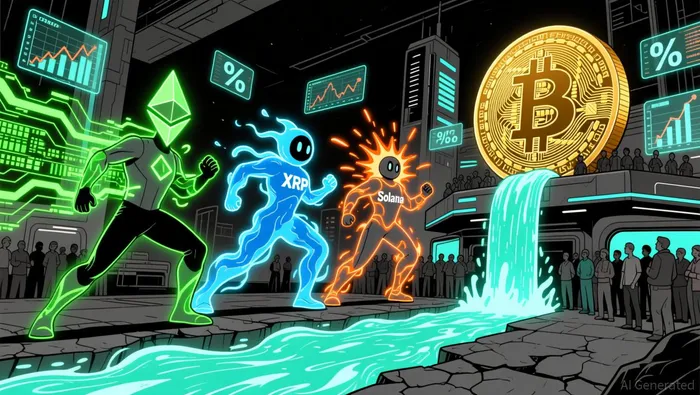
The digital asset landscape in 2025 has witnessed a seismic shift in investor behavior, with altcoins outpacing BitcoinBTC-- in terms of inflows and performance. While Bitcoin remains the dominant asset, its market share has eroded as institutional and retail investors pivot toward diversified portfolios and emerging use cases. This article unpacks the strategic rationale behind this reallocation, emphasizing how portfolio diversification and asset rotation have become central to navigating the evolving crypto ecosystem.
The Inflow Shift: Altcoins Gain Momentum
In 2025, global digital asset inflows surged to $47.2 billion, with EthereumETH--, XRPXRP--, and SolanaSOL-- leading the charge. Ethereum's inflows grew by 138% year-over-year to $12.7 billion, driven by its expanding ecosystem and upgrades like the Ethereum 2.0 transition. XRP attracted $3.7 billion in new capital, while Solana's inflows skyrocketed by 1,000% to $3.6 billion, reflecting renewed interest in high-throughput, utility-driven blockchains. Meanwhile, Bitcoin's inflows, though still substantial at $26.9 billion, accounted for a 35% smaller share of total inflows compared to 2024. The Altcoin Season Index, at 20, underscores Bitcoin's continued dominance but also highlights incremental altcoin momentum, with 80% of major altcoins underperforming Bitcoin.
Strategic Diversification: Beyond Bitcoin's Core
The shift toward altcoins is not a rejection of Bitcoin but a strategic move to optimize risk-adjusted returns. Institutional investors now allocate 60-70% of their portfolios to core assets like Bitcoin and Ethereum, while reserving 20-30% for altcoins with specialized use cases. This approach balances Bitcoin's store-of-value properties with the innovation and scalability of Layer-1 protocols (e.g., Solana), Layer-2 solutions, and DeFi tokens according to best practices. For instance, Ethereum's 65% surge in Q3 2025 and Solana's 1,000% inflow growth demonstrate the appeal of ecosystems with clear utility and active development as market reviews indicate.
Emerging use cases further justify this diversification. Altcoins are increasingly tied to real-world applications, such as AI-blockchain integration, metaverse infrastructure, and tokenized real-world assets (TRWAs). These innovations offer exposure to high-growth sectors while mitigating the volatility risks inherent in holding a single asset according to investment analysis. As one report notes, "Digital assets are now being considered alongside liquid alternatives and international equities to enhance diversification" as BlackRock's insights suggest.
Asset Rotation: Capitalizing on Market Cycles
Asset rotation has emerged as a critical strategy in 2025's dynamic market. Institutions actively shift capital between sectors like DeFi, NFTs, and cross-chain protocols based on market sentiment and macroeconomic conditions according to institutional research. For example, during periods of optimism, momentum trading favors high-performing altcoins, while contrarian strategies target undervalued assets during downturns as portfolio strategies show. Volatility targeting and dynamic rebalancing further ensure consistent risk exposure, particularly during market stress events.
Tokenized real-world assets have become a cornerstone of this rotation. With onchain value reaching $22.5 billion in 2025, TRWAs provide liquidity and yield while bridging traditional and digital markets as institutional reports state. Stablecoins, now holding $275 billion in AUM, also play a pivotal role as liquidity buffers and yield-generating tools as market reviews indicate. Regulatory clarity in the U.S. and Europe has further accelerated adoption, fostering institutional confidence in these emerging asset classes according to research findings.
The Road Ahead: Balancing Growth and Risk
While altcoins offer compelling opportunities, investors must remain vigilant. Active oversight, futures, and options are essential to managing crypto's inherent volatility as institutional guidelines recommend. A diversified approach-combining Bitcoin's stability with altcoins' innovation-ensures resilience against market shocks. As the Altcoin Season Index suggests, Bitcoin's dominance is far from obsolete, but its role is evolving from a sole store of value to a foundational pillar in a broader, more dynamic portfolio.
In conclusion, 2025 marks a pivotal year for digital asset allocations. The outperformance of altcoins reflects a maturing market where strategic diversification and asset rotation are no longer optional but imperative. By embracing these strategies, investors can harness the full potential of the crypto ecosystem while navigating its risks with precision.






Comentarios
Aún no hay comentarios