
The Reshaping of US-China Economic Diplomacy and Its Impact on Global Investment Alliances
The U.S.-China economic relationship in 2025 is defined by a delicate balancing act: high-level diplomatic breakthroughs coexist with unresolved strategic competition. Recent trade agreements, such as the November 2025 deal to reduce tariffs and address fentanyl precursor cooperation, signal a temporary de-escalation of tensions. However, the broader geopolitical landscape remains fraught, with unresolved disputes over Taiwan, the South China Sea and critical technology dominance. This duality-diplomatic pragmatism amid strategic rivalry-has profound implications for global investment alliances, particularly in emerging markets.
The 2025 Trade Deal: A Tactical Pause, Not a Paradigm Shift
The U.S.-China trade agreement of late 2025, while significant, reflects a tactical recalibration rather than a fundamental shift in their economic rivalry. By agreeing to relax rare earth export restrictions and potentially roll back tariffs on Chinese goods, both nations sought to stabilize trade flows amid inflationary pressures and supply chain fragility according to analysis. For investors, this deal offers short-term relief but does not eliminate the structural risks posed by U.S. strategic de-risking and China's push for self-reliance in semiconductors and other technologies according to research.
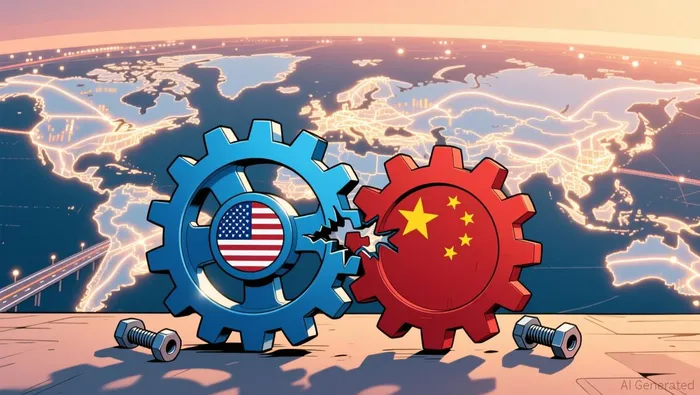
The Trump administration's emphasis on "strategic de-risking" underscores this nuance. While the U.S. has softened some tariffs, it continues to pressure China to limit Russian oil purchases and restrict access to critical technologies according to HSBC insights. Meanwhile, China's focus on domestic consumption and targeted reforms-such as its 2025 FDI inflow target of $86.38 billion-highlights its determination to reduce reliance on Western markets according to China Briefing. This dual-track approach ensures that while trade tensions may ease temporarily, the long-term realignment of global supply chains and investment flows remains intact.
Emerging Markets as the New Battleground for Investment Alliances
The U.S.-China realignment has accelerated the formation of new investment alliances, with emerging markets at the center. Chinese outbound investment is increasingly directed toward Southeast Asia, the Middle East, and Central Europe, focusing on sectors like electric vehicles. Countries such as Thailand, Malaysia, and Morocco are leveraging competitive tax policies and industrial expertise to attract Chinese capital, creating regional hubs for manufacturing and technology transfer.
Simultaneously, the U.S. is reshoring critical industries and redirecting investments to allies like Vietnam and India. A July 2025 trade agreement with Vietnam, for instance, imposed 20% tariffs on most Vietnamese exports but also spurred diversification efforts among local manufacturers. Similarly, India's strategic pivot to attract U.S. capital-bolstered by its $322 billion FDI stock as of 2024- reflects its growing role as a production hub. These shifts are not merely economic; they are geopolitical, as nations align with either the U.S. or China to secure access to capital, technology, and markets.
The Gulf's Strategic Rise and Its Impact on FDI Flows
Among the most striking developments is the deepening economic ties between China and Gulf Cooperation Council (GCC) nations. In 2025, Gulf sovereign wealth funds accounted for 62% of China's sovereign inflows, with investments concentrated in finance, energy. Saudi Arabia and the UAE, in particular, have become key partners in China's Belt and Road Initiative (BRI), funding port expansions, renewable energy projects. This alignment is driven by mutual strategic interests: the GCC seeks to diversify its oil-dependent economies, while China aims to secure energy supplies and counterbalance Western influence.
For emerging markets, this realignment has two key implications. First, it diversifies FDI sources, reducing reliance on traditional Western investors. Second, it accelerates regional integration, as seen in the GCC's growing role as a bridge between China and Europe. However, risks persist. Geopolitical flashpoints-such as U.S. sanctions on Gulf-China energy deals or U.S. pressure on India to align with its de-risking agenda-could disrupt these alliances.
Navigating the New Investment Landscape: Opportunities and Risks
Investors must navigate a landscape marked by both opportunity and volatility. Emerging markets with strong domestic fundamentals, such as Vietnam and the GCC, offer attractive returns but face challenges like regulatory uncertainty and exposure to U.S. tariff policies according to Reuters analysis. For example, Vietnam's reliance on Chinese inputs and weak legal enforcement remain vulnerabilities despite its $322 billion FDI stock according to UNCTAD. Similarly, while the GCC's structural reforms and low debt levels make it a resilient destination for capital, its alignment with China could strain relations with U.S. allies.
The broader lesson is clear: diversification and active management are essential. As U.S.-China tensions persist, investors should prioritize markets that can adapt to shifting trade policies and geopolitical currents. This includes Southeast Asian nations with flexible supply chains, Gulf states with strategic economic reforms, and India, which is leveraging its demographic dividend to attract U.S. and Chinese capital alike.
Conclusion
The 2025 U.S.-China trade deal is a temporary truce in a broader contest for economic and geopolitical influence. While it provides short-term stability, the long-term realignment of global investment alliances is irreversible. Emerging markets are both beneficiaries and battlegrounds of this shift, with new alliances forming around strategic priorities rather than purely economic ones. For investors, the path forward lies in agility-capitalizing on opportunities in resilient emerging markets while hedging against the risks of a fragmented global economy.







Comentarios
Aún no hay comentarios