
Replit's Meteoric Valuation Growth: A Deep Dive into Unit Economics and Market Capture in Developer Tools
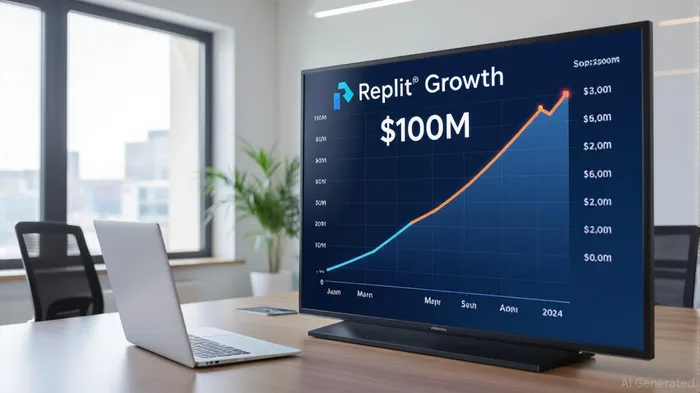
Replit's valuation has surged to over $3 billion in 2025, a staggering leap from its previous estimates, driven by a $250 million funding round and a dramatic increase in annual recurring revenue (ARR). The company's ARR ballooned from below $10 million to $100 million in just eight months following the September 2024 launch of its AI Agent[1]. This growth has sparked intense debate among investors: Is Replit's valuation a justified reflection of its unit economics and market capture potential, or is it a speculative overreach?
Unit Economics: Efficiency and AI-Driven Leverage
Replit's ARR per employee of $1.5 million dwarfs the typical $200,000–$400,000 range for SaaS companies[1]. This outlier performance suggests exceptional operational efficiency, likely amplified by its AI Agent. The tool enables users to build applications via natural language, reducing the need for extensive coding and accelerating product development cycles[3]. Such automation not only lowers customer acquisition costs (CAC) by streamlining onboarding but also enhances customer lifetime value (LTV) through sticky, self-serve workflows.
While Replit's specific CAC and LTV figures remain undisclosed, industry benchmarks for developer tools in 2025 offer a lens for inference. A healthy LTV:CAC ratio in this sector ranges between 3:1 and 8:1, with top performers exceeding 5:1[5]. Autonomous AI agents, as noted in recent research, could push this ratio to 5:1 by automating lead qualification and personalizing support[4]. Replit's AI Agent, functioning as an “AI app builder,” aligns with these trends, suggesting its unit economics may already approach or exceed industry-leading benchmarks.
Market Capture: Pricing Power and Developer Adoption
The developer tools market is undergoing a pricing revolution. Nearly 80% of tools now offer free tiers with usage limits, fostering bottom-up adoption[1]. Replit's freemium model, combined with its AI-driven ease of use, positions it to capture a significant share of this market. The median price for professional tiers has risen 27% since 2019, reflecting a shift toward value-based pricing[1]. Replit's AI Agent, which accelerates application development, likely justifies premium pricing by delivering tangible productivity gains—a critical factor in developer tools, where trial-to-paid conversion rates often exceed 15–25%[5].
Moreover, Replit's product-qualified lead (PQL) conversion rates—estimated at 15–30%—far outpace traditional marketing-qualified lead (MQL) rates of 2–5%[5]. This dynamic underscores the power of developer-driven adoption, where satisfied users become advocates, reducing CAC and accelerating growth.
Risks and Realities
Despite its strengths, ReplitREPL-- faces challenges. The developer tools market is highly competitive, with rivals like GitHub, AWS, and JetBrains investing heavily in AI-enhanced offerings. Sustaining its ARR per employee of $1.5 million will require continuous innovation and disciplined cost management. Additionally, the absence of public CAC and LTV data introduces uncertainty, as investors must rely on industry averages to gauge financial health.
Conclusion: A High-Stakes Bet on AI and Developer Productivity
Replit's valuation growth hinges on two pillars: its ability to maintain exceptional unit economics and its capacity to capture a meaningful portion of the developer tools market. The company's AI Agent, by democratizing app development and reducing friction, aligns with broader industry trends toward automation and value-based pricing. While risks persist, Replit's performance thus far suggests it has mastered the delicate balance between aggressive growth and operational efficiency—a rare feat in the SaaS world. For investors, the question is not whether Replit's valuation is justified today, but whether it can sustain its trajectory in a market where AI is rewriting the rules.







Comentarios
Aún no hay comentarios