
Repligen's Strategic Position in Bioprocessing Innovation and Its Implications for Long-Term Growth
In the rapidly evolving biotech manufacturing sector, companies that align with the twin forces of technological innovation and operational efficiency are poised to outperform. Repligen CorporationRGEN-- (RGEN) has emerged as a standout player, leveraging recent product launches, strategic acquisitions, and high-visibility industry engagements to solidify its leadership in bioprocessing. For investors seeking exposure to a sector projected to grow at 9% annually through 2030, Repligen's moves signal a compelling value proposition.
Product Innovation: Redefining Efficiency in Bioprocessing
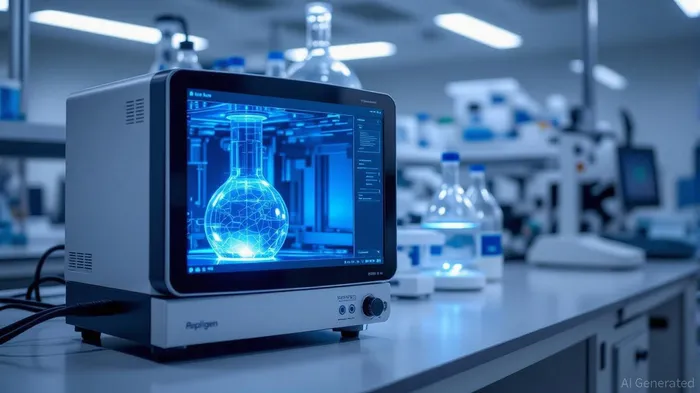
Repligen's January 2025 launch of the CTech™ SoloVPE® PLUS System underscores its commitment to solving critical pain points in biopharma manufacturing. This next-generation UV-Vis concentration measurement system reduces process steps by 70% and doubles data acquisition speed compared to prior models. By eliminating the need for dilution or background correction, the SoloVPE PLUS enables real-time decision-making for clients producing monoclonal antibodies, mRNA therapeutics, and nucleic acid-based drugs.
The system's integration of variable pathlength spectroscopy—a technology that adjusts light pathlength to optimize sensitivity—positions RepligenRGEN-- to capture market share in a segment where precision and speed are non-negotiable. For investors, this innovation aligns with the industry's shift toward Process Analytical Technology (PAT), a regulatory-endorsed framework that emphasizes real-time monitoring to enhance product quality and reduce costs.
Strategic Acquisitions: Expanding the PAT Portfolio
Repligen's March 2025 acquisition of 908 Devices for $70 million in cash further strengthens its PAT offerings. The four acquired devices—MAVERICK, MAVEN, REBEL, and ZipChip—provide real-time monitoring and high-resolution separations, addressing gaps in upstream and downstream bioprocessing workflows. This move not only diversifies Repligen's product suite but also accelerates its ability to serve a broader range of modalities, including cell and gene therapies.
The acquisition's financial structure—pure cash with no debt—demonstrates Repligen's confidence in its balance sheet and its willingness to invest in technologies that align with customer demand for digitization. By integrating 908's desktop analytics tools, Repligen now offers a comprehensive solution from lab to manufacturing scale, a critical differentiator in an industry where end-to-end visibility is increasingly valued.
Digital Partnerships: Pioneering Smart Manufacturing
Repligen's July 2025 partnership with Novasign, a leader in AI-powered bioprocessing, marks a pivotal step in its digitalization strategy. By embedding Novasign's machine learning and digital twin capabilities into its tangential flow filtration (TFF) systems, Repligen is enabling customers to predict process outcomes, optimize parameters, and reduce development timelines. This integration not only enhances the functionality of existing systems but also positions Repligen at the forefront of smart manufacturing, a trend expected to redefine biopharma in the 2030s.
The partnership's focus on predictive analytics and real-time control aligns with the industry's push for continuous manufacturing, a model that promises faster scale-up and lower costs. For investors, this signals Repligen's agility in adapting to regulatory and technological shifts, a trait that could drive long-term revenue growth.
Conference Engagements: Amplifying Industry Visibility
Repligen's aggressive participation in 2025 investor conferences—including the Wells Fargo Healthcare Conference, Deutsche Bank Healthcare Summit, and Bank of America Global Healthcare Conference—highlights its strategic emphasis on investor communication. These events provide a platform for CEO Olivier Loeillot and CFO Jason Garland to articulate the company's vision for leveraging AI, digital twins, and advanced analytics to transform bioprocessing.
The timing of these engagements, coinciding with recent product launches and acquisitions, is no coincidence. By showcasing its leadership in bioprocessing innovation, Repligen is likely to attract institutional interest and reinforce its narrative as a high-growth, low-risk play in a capital-intensive sector.
Investment Implications: A Compelling Long-Term Case
Repligen's strategic moves collectively address three key investor concerns: technological differentiation, market expansion, and financial resilience. The company's focus on digitization and AI integration positions it to benefit from the $12.3 billion bioprocessing analytics market, which is expected to grow at a CAGR of 11.2% through 2030. Meanwhile, its acquisition of 908 DevicesMASS-- and partnership with Novasign demonstrate a disciplined approach to scaling capabilities without overextending its balance sheet.
For long-term investors, Repligen's ability to innovate across its core segments—Filtration and Fluid Management, Chromatography, Process Analytics, and Proteins—creates a durable competitive moat. The company's global footprint, with manufacturing hubs in the U.S., Europe, and Asia, further insulates it from regional supply chain risks.
Conclusion: A Strategic Play for the Future of Biopharma
Repligen's 2025 trajectory—from launching cutting-edge systems to acquiring complementary technologies—reflects a company in sync with the biotech manufacturing sector's most pressing needs. As the industry shifts toward data-driven, continuous manufacturing, Repligen's investments in AI, digital twins, and end-to-end PAT solutions position it as a key enabler of this transformation.
For investors, the question is not whether bioprocessing innovation will matter in the coming decade, but whether Repligen can maintain its leadership in this space. With a robust pipeline, strategic agility, and a clear vision for digitalization, the answer appears increasingly affirmative. Now is the time to consider Repligen as a core holding in a portfolio targeting the next wave of biotech manufacturing disruption.







Comentarios
Aún no hay comentarios