
Reopening of Public Lands in Alaska's Interior Regions: A Strategic Analysis of Post-Fire Policy Shifts and Their Market Implications
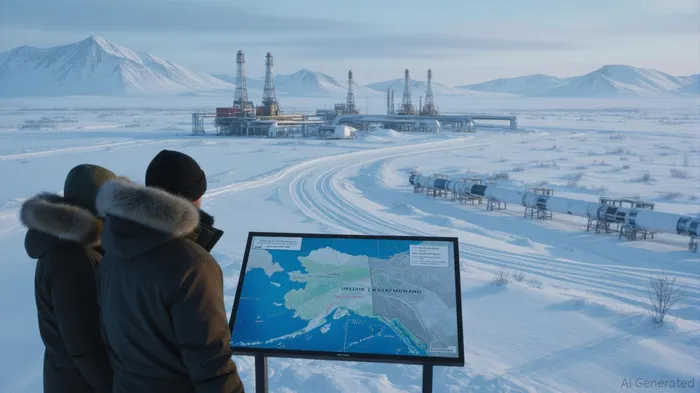
The reopening of public lands in Alaska's Interior regions represents a pivotal moment for U.S. energy policy and global market dynamics. Driven by a confluence of post-fire regulatory adjustments, executive orders, and a renewed focus on energy independence, these policy shifts are reshaping the economic and environmental calculus of natural resource extraction. For investors, the implications are profound, spanning energy infrastructure, commodity markets, and geopolitical energy strategies.
Policy Shifts: From Obstruction to Opportunity
The U.S. Department of the Interior, under Secretary Doug Burgum, has accelerated the reversal of Biden-era restrictions on oil and gas drilling in Alaska. A key move was the rescission of a 2021 rule that had banned drilling on 11 million acres of the National Petroleum Reserve-Alaska (NPR-A), a 23-million-acre expanse on the North Slope. This decision, formalized in the Federal Register, aligns with the Trump-era deregulatory agenda and seeks to unlock energy resources critical to U.S. energy security. The Interior Department emphasizes that these lands were originally designated in the 1970s to support domestic energy production, a rationale now amplified by the need to reduce reliance on foreign oil amid global supply chain volatility.
Complementing this, the January 2025 executive order titled “Unleashing Alaska's Extraordinary Opportunities” has further streamlined resource development. It mandates the cancellation of environmental impact statements and the reinstatement of permissive 2019-era policies, effectively rolling back protections for the Arctic National Wildlife Refuge and the NPR-A. The order also facilitates infrastructure projects like the Ambler Road and Alaska LNG Pipeline, which are projected to create thousands of jobs and stimulate local economies.
Economic and Market Implications
The immediate economic impact of these policies is twofold: short-term cost savings for energy firms and long-term structural shifts in global energy markets.
Energy Sector Reinvigoration: By removing regulatory hurdles, the Interior Department aims to expedite drilling permits and reduce the time-to-market for new projects. For instance, the Willow and Pikka oil fields in the NPR-A could see faster production ramp-ups, potentially adding 100,000 barrels of daily output within five years. This aligns with the U.S. Energy Information Administration's projection that Alaska's oil production could rebound to 2010 levels by 2030 if current policies persist.
LNG as a Strategic Lever: The executive order prioritizes Alaska's liquefied natural gas (LNG) potential, with plans to transport the resource to U.S. markets and allied nations in the Pacific. This positions Alaska as a key player in the global energy transition, where LNG is increasingly seen as a bridge fuel. The Alaska LNG Pipeline, if completed, could export 5.8 billion cubic feet of gas daily, bolstering U.S. energy exports and reducing Europe's dependence on Russian gas.
Infrastructure and Labor Gains: The Ambler Road project, a 214-mile highway connecting mineral-rich areas to the Trans-Alaska Pipeline, is expected to unlock over $10 billion in mining potential. This infrastructure will not only support resource extraction but also create a ripple effect in construction, logistics, and local services, with Anchorage and Fairbanks likely to see a surge in employment.
Risks and Rebalancing
While the policy shifts offer clear economic upside, investors must weigh several risks:
- Environmental and Regulatory Reversals: A potential return to a Biden-style administration in 2026 could halt these projects, creating regulatory uncertainty.
- Climate and Subsistence Concerns: Indigenous communities and environmental groups have raised alarms about the impact on permafrost, carbon sinks, and subsistence practices. Litigation risks remain high, particularly in the Arctic National Wildlife Refuge.
- Global Energy Demand Shifts: The rise of renewable energy and electric vehicles could dampen long-term demand for fossil fuels, making the economic viability of new projects contingent on market timelines.
Investment Strategy: Balancing Exposure and Resilience
For investors, the key is to diversify within the energy value chain while hedging against regulatory and environmental volatility.
Energy Infrastructure Plays: Companies involved in Alaska's LNG and pipeline projects, such as ConocoPhillips (COP) and Chevron (CVX), are likely to benefit from accelerated permitting. Additionally, infrastructure firms like Bechtel Group and Fluor Corporation could see increased contracts for construction and engineering work.
Mineral and Metal Producers: The Ambler Road project opens access to the Ring of Fire, a mineral-rich region with significant deposits of gold, copper, and critical minerals like rare earth elements. Firms like Noranda Aluminum and Nickel and Newmont Corporation (NEM) could see renewed interest.
Environmental and Energy Transition Firms: While the current policies favor fossil fuels, the long-term energy transition remains inevitable. Investors should consider dual-exposure companies like NextEra Energy (NEE), which balance traditional energy with renewable investments, or firms specializing in carbon capture and storage (CCS) technologies.
Geopolitical Hedges: Given the strategic importance of Alaska's LNG to U.S. allies in the Pacific, investors might explore regional energy infrastructure stocks in Japan, South Korea, and Australia, which are likely to import Alaskan gas.
Conclusion: A Calculated Bet on Energy Security
The reopening of Alaska's public lands is a calculated response to a world increasingly defined by energy insecurity and climate uncertainty. For investors, the opportunities lie in the immediate economic stimulus of resource extraction and the longer-term potential of Alaska's LNG and mineral assets. However, success will require a nuanced approach that balances short-term gains with the realities of environmental scrutiny and shifting global demand.
As the Interior Department's policies unfold, the market's reaction will hinge on the interplay of regulatory stability, project execution, and global energy dynamics. For those willing to navigate these complexities, Alaska's Interior offers a compelling blend of high-risk, high-reward opportunities—and a chance to participate in a pivotal chapter of U.S. energy history.





Comentarios
Aún no hay comentarios