
Rent the Runway's Financial Sustainability: A Deep Dive into Unit Economics and Cash Flow Dynamics
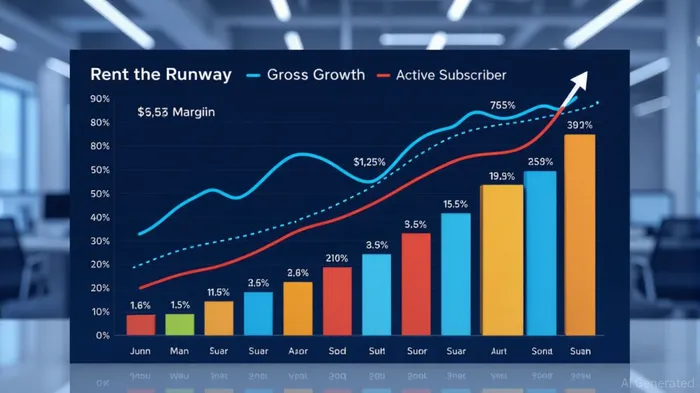
Rent the Runway, Inc. (RENT) has long been a bellwether for the viability of the fashion rental industry. As of Q2 2025, the company's financial sustainability remains a contentious topic, with mixed signals emerging from its unit economics and cash flow dynamics. This analysis evaluates RTR's path to profitability through the lens of customer acquisition costs (CAC), lifetime value (LTV), gross margins, and burn rates, while contextualizing its recent recapitalization plan.
Unit Economics: A Tale of Two Metrics
Rent the Runway's subscriber growth metrics are undeniably robust. The company reported a 13.4% year-over-year increase in active subscribers to 146,373 in Q2 2025, with Q1 2025 marking its highest-ever subscriber count at 147,157 [1]. This growth is driven by aggressive inventory expansion—Q2 2025 new receipts surged by over 420% YoY—and product innovations like personalized styling support, which reduced first-month churn by 27% [2]. However, these gains come at a cost.
Customer acquisition costs (CAC) remain a critical vulnerability. Publicly available data suggests RTR's CAC ranges between $150–$200 per subscriber [3], far exceeding the $55 blended CAC figure cited in a LinkedIn analysis that likely includes organic traffic [4]. This discrepancy highlights the company's reliance on paid marketing to sustain growth, a strategy that strains the LTV/CAC ratio. While LTV has improved from $1,932 in 2019 to $2,368 in 2023 [5], the high CAC implies a ratio closer to 1:1 in 2025—a far cry from the 3:1 benchmark required for long-term scalability.
Gross margins, another key unit economics metric, have deteriorated sharply. Q2 2025 gross margins fell to 30%, down from 41.1% in Q2 2024, primarily due to higher fulfillment costs (29.3% of revenue) and inventory expansion expenses [1]. This compression underscores the tension between investing in customer acquisition and maintaining profitability.
Cash Flow Dynamics: A High-Stakes Recapitalization
Rent the Runway's cash flow challenges are stark. The company reported a net loss of $26.4 million in Q2 2025, with adjusted EBITDA declining to $3.6 million from $13.7 million in the prior year [1]. Full-year 2025 free cash flow is projected to remain below -$40 million, driven by inventory investments and customer acquisition [6].
To address this, RTR announced a transformative recapitalization plan in partnership with Aranda Principal Strategies and STORY3 Capital Partners. The plan reduces debt from $340 million to $120 million, extends maturity to 2029, and injects $20 million in cash through debt-to-equity conversions [1]. While this provides short-term liquidity, the long-term implications are mixed. The extended debt maturity reduces immediate pressure but locks in higher interest costs, while the equity infusion dilutes existing shareholders.
The company's cash burn rate—projected at $30–$40 million for FY2025—remains a red flag. Despite a 2.5% revenue growth in Q2 2025, the $26.4 million net loss indicates that RTR is prioritizing growth over profitability. This strategy hinges on the assumption that increased subscriber engagement (e.g., 84% YoY growth in inventory views [1]) will eventually translate to higher LTV. However, with CAC and churn rates still elevated, this remains unproven.
Strategic Trade-Offs and Investor Implications
Rent the Runway's financial strategy reflects a classic growth-at-all-costs approach. The company's Q1 2025 results showed a 24% YoY increase in inventory volume and a 7.2% revenue decline, illustrating the trade-off between short-term profitability and long-term market share [7]. While these investments have improved customer retention (e.g., a 34% reduction in churn via the 60-day customer promise [2]), they also exacerbate cash flow pressures.
For investors, the key question is whether RTR's unit economics can improve to a point where the business becomes self-sustaining. The recent $2-per-item price hike aims to offset inflationary costs [1], but this may further strain customer retention. A more sustainable path would involve reducing CAC through organic growth (e.g., leveraging its 77% YoY increase in subscription net promoter scores [1]) and optimizing fulfillment costs.
Conclusion: A High-Risk, High-Reward Proposition
Rent the Runway's financial sustainability hinges on its ability to balance subscriber growth with margin preservation. While the company's inventory strategy and product innovations have driven engagement, the combination of high CAC, declining gross margins, and a cash-burning business model raises concerns. The recapitalization plan buys time but does not address structural inefficiencies.
Investors should monitor two metrics closely: (1) the LTV/CAC ratio, which must improve to at least 2:1 for profitability, and (2) gross margins, which need to stabilize above 35% to offset rising fulfillment costs. Until these metrics align with industry benchmarks, RTR remains a speculative bet rather than a sustainable investment.







Comentarios
Aún no hay comentarios