
Renewed Crypto Momentum and Institutional Adoption: Strategic Entry Points in a $3.91 Trillion Market Rebound
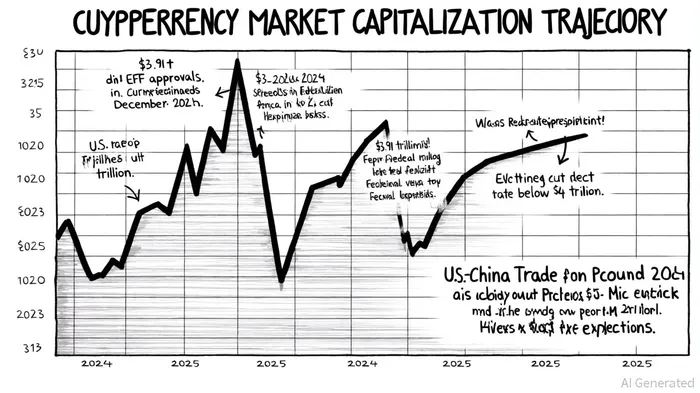
The cryptocurrency market's recent rebound to $3.91 trillion as of October 13, 2025, marks a pivotal inflection point for investors navigating a landscape reshaped by macroeconomic tailwinds and institutional adoption. This resurgence follows a 7% selloff driven by U.S.-China trade tensions but has since stabilized on the back of dovish Federal Reserve signals and renewed optimism around spot ETFs. For investors, the question is no longer if crypto can sustain this momentum but how to position for a market that now commands a valuation exceeding 40% of its 2021 peak.
Macroeconomic Catalysts: From Panic to Resilience
The October rebound was catalyzed by a confluence of factors. First, the U.S. Federal Reserve's 97.8% probability of a 25-basis-point rate cut in October, as reported by CryptoNews, rekindled risk-on sentiment, with crypto markets-historically sensitive to interest rates-responding swiftly. Second, de-escalating U.S.-China trade tensions, particularly Vice President J.D. Vance's openness to "rational negotiations," alleviated fears of a global economic slowdown, a development also noted by CryptoNews. This combination allowed BitcoinBTC-- to reclaim $110,000 and EthereumETH-- to surpass $4,000, while altcoins like Binance Coin (BNB) surged 13% in a single session.
Data from CoinGecko and Binance Research underscores the durability of this recovery: 97 of the top 100 cryptocurrencies appreciated in value during the rebound, according to Crowdfund Insider. This broad-based strength suggests a shift from speculative trading to deeper institutional participation, a trend accelerated by the approval of U.S. spot ETFs. CoinGecko's 2024 annual report shows Fidelity's Bitcoin ETFs alone attracted $3.2 billion in fresh inflows, signaling a structural shift as traditional asset managers allocate crypto alongside equities and bonds.
Institutional Adoption: From Hype to Infrastructure
The 2024-2025 cycle has seen institutional adoption evolve from hype to operational reality. By mid-December 2024, CoinGecko's 2024 report noted the market's $3.91 trillion peak was driven notNOT-- just by retail enthusiasm but by infrastructure-grade demand. Firms like BlackRockBLK-- and Grayscale now offer crypto products with custodial solutions, regulatory compliance, and liquidity mechanisms that mirror traditional markets. This has normalized crypto as a portfolio diversifier, particularly for investors seeking uncorrelated assets amid inflationary pressures.
A critical metric here is the decline in exchange balances. As of October 2025, major exchanges held 18% less Bitcoin than they did in early 2024, according to CoinGecko's analysis, indicating reduced selling pressure and increased long-term holding. This trend aligns with institutional strategies to lock in assets for hedging or staking, further decoupling crypto's price action from short-term volatility.
Strategic Entry Points: Navigating Volatility with Precision
For investors seeking entry into this $3.91 trillion market, the key lies in balancing opportunism with risk management. Three strategies emerge as particularly compelling:
Dollar-Cost Averaging (DCA) into Core Assets
Bitcoin and Ethereum remain the bedrock of any crypto portfolio. With Bitcoin trading near $110,000 and Ethereum above $4,000 (as reported by CryptoNews), DCA allows investors to mitigate volatility while capitalizing on the Fed's dovish pivot. Historical data shows that even during corrections, these assets have retained 70–80% of their gains over 12-month horizons, per CoinGecko's findings.Layering Altcoins with Fundamentals
While 97 of the top 100 cryptocurrencies rose in October, according to Crowdfund Insider, investors should prioritize projects with defensible use cases. Solana's 90% revenue decline in late 2024, per an FXStreet report, highlights the risks of speculative narratives, but chains like Ethereum (post-merge efficiency) and layer-2 solutions with institutional-grade throughput offer more durable upside.Hedging with Derivatives and Staking
The rise of crypto ETFs and staking products enables investors to hedge downside risk while generating yield. For instance, staking Ethereum yields 4–6% annually, according to CoinGecko, providing a buffer against potential drawdowns in equities or other volatile assets.
Risks and Realities: A Cautious Outlook
Despite the bullish case, risks persist. The Fed's rate-cut cycle remains untested in a crypto context, and geopolitical tensions could reignite. Additionally, the market's reliance on institutional inflows makes it vulnerable to regulatory shifts-particularly in the U.S. and China. Investors must also contend with the "rebound trap," where a $3.91 trillion valuation could attract short-term traders but deter long-term holders if macroeconomic conditions sour.
Conclusion: A New Baseline for Crypto Investing
The October 2025 rebound to $3.91 trillion represents more than a technical milestone-it signals a new baseline for crypto as a mainstream asset class. With institutional infrastructure in place and macroeconomic tailwinds aligning, strategic entry points now favor disciplined, long-term investors. However, success hinges on avoiding the pitfalls of overleveraging and speculative overreach. As the market matures, the winners will be those who treat crypto not as a fad but as a foundational component of a diversified portfolio.





Comentarios
Aún no hay comentarios