
The Renewable Energy Paradox: How Trump's AI Push Could Backfire Without Clean Power
The artificial intelligence revolution is reshaping global economies, but its success hinges on a critical, often overlooked factor: the ability to power the data centers that fuel it. As Donald Trump's administration pushes for an AI-driven industrial renaissance, the U.S. faces a stark reality: without a rapid, large-scale shift to renewable energy, the very infrastructure enabling AI could collapse under its own energy demands.
The AI-Driven Energy Tsunami
According to the International Energy Agency, AI is the fastest-growing driver of electricity consumption in data centers, with demand for accelerated servers-used for AI workloads-projected to rise by 30% annually between 2024 and 2030. Goldman SachsGS-- warns that global AI data centers could surge electricity consumption by 165% by 2030 compared to 2023, driven by hyperscale facilities that consume as much energy as millions of homes. A single AI server rack uses ten times the electricity of a traditional cloud server, reflecting a power density revolution that strains existing grids.
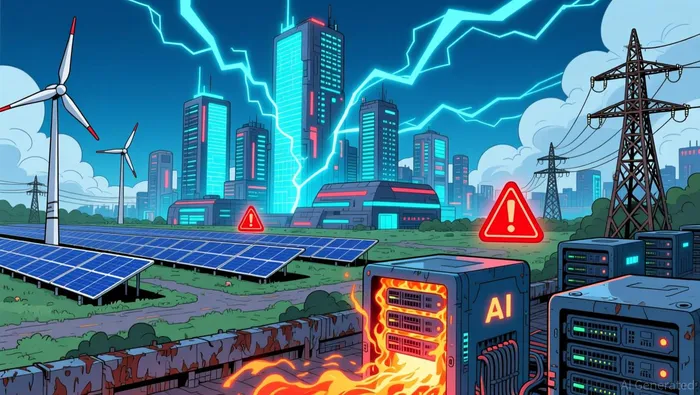 The U.S. Department of Energy (DOE) estimates that data centers could account for 6.7–12% of total U.S. electricity by 2028, up from 2% in 2023. This surge is not just a matter of scale but also of intensity: AI training alone requires 2.9 watt-hours per interaction, nearly ten times that of a Google search. Meeting this demand will require $720 billion in global infrastructure investments by 2030, with U.S. utilities alone needing $50 billion to build new generation capacity.
Fossil Fuels and Nuclear: Too Slow, Too Costly
Trump's emphasis on reviving fossil fuels and nuclear power as solutions to this crisis is misguided. While natural gas has temporarily filled gaps in the short term-utilities are adding twice as much gas capacity as initially planned- its scalability is limited by supply chain bottlenecks and environmental risks. Nuclear energy, though reliable, faces insurmountable challenges: high upfront costs, long construction timelines (often 10+ years), and public skepticism. Even with a 50% growth in nuclear investment since 2020, it remains a niche player, contributing just 21% of data center energy needs in 2025.
Fossil fuels, meanwhile, are increasingly uncompetitive. The cost of solar photovoltaic (PV) and wind energy has fallen by 85% and 60%, respectively, since 2010, making them cheaper than new coal or gas plants in most regions. By contrast, coal and gas prices have spiked due to geopolitical tensions and supply chain disruptions, with wholesale electricity costs in data center hubs rising by 267% over five years.
Renewables: The Only Scalable Path Forward
Renewable energy, particularly solar, wind, and battery storage, is the only viable solution to meet AI's insatiable appetite for electricity. Global investment in clean energy reached $2.2 trillion in 2025, with solar PVMAXN-- alone accounting for $450 billion-a stark contrast to the $1.1 trillion allocated to fossil fuels. Battery storage, projected to reach $66 billion in 2025, addresses intermittency concerns and enables data centers to operate as grid assets rather than burdens.
State-level case studies underscore renewables' scalability. In Idaho, Meta's 1-million-square-foot data center is powered by 100% renewable energy, including a new 200-MW solar project. Washington State leverages its hydroelectric resources to maintain affordable electricity (10.16¢/kWh), while South Dakota's 55% wind-powered grid demonstrates reliability (https://www.cnbc.com/2025/07/15/10-best-power-sources-us-grid-ai-data-center-top-states-for-business.html). Apple's 300-MW Texas solar farm further illustrates how tech giants are locking in clean energyCETY-- to power AI infrastructure.
### Policy Paralysis and the Need for Immediate Action
Despite these advantages, U.S. policymakers remain stuck in a "two-speed" transition. While tech firms like Microsoft and Google invest in long-term clean-power contracts, smaller players are priced out of renewable access. Deloitte's 2025 AI Infrastructure Survey reveals that 72% of respondents view grid capacity as a "very or extremely challenging" issue, with permitting delays and aging infrastructure exacerbating bottlenecks.
The paradox is clear: Trump's AI ambitions risk backfiring without a clean energy revolution. Fossil fuels and nuclear cannot scale fast enough to meet demand, while renewables offer a proven, cost-effective path. Immediate investment in solar, wind, and storage is not just an environmental imperative-it is an economic and strategic one.
Conclusion: A Call for Strategic Investment
The AI boom is here, but its future depends on energy infrastructure that can match its pace. Investors and policymakers must prioritize renewables over short-term fixes. As the DOE notes, leveraging federal tax credits, streamlining permitting, and adopting innovative tariffs can accelerate grid modernization. The alternative-a reliance on fossil fuels or underperforming nuclear projects-risks stalling the AI revolution before it can fully realize its potential.
The renewable energy paradox is simple: the cleanest power sources are also the most scalable. Ignoring this reality could leave Trump's AI push stranded in the dark.





Comentarios
Aún no hay comentarios