
Renewable Energy Infrastructure Resilience: A New Era of Investment Amid Geopolitical and Climate Risks
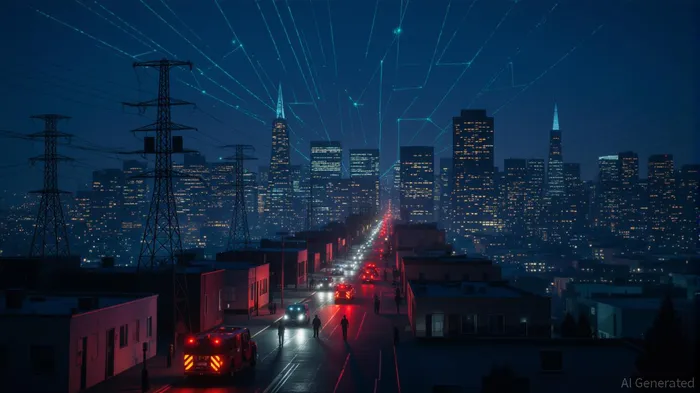
The December 2025 San Francisco power outage, which left 130,000 customers in darkness, serves as a stark reminder of the fragility of centralized energy systems in an era of escalating climate and geopolitical volatility. A fire at a PG&E substation in the South of Market neighborhood triggered the outage,
exposing vulnerabilities in grid infrastructure even as California's energy leaders tout progress in reliability. This incident, coupled with PG&E's
73 billion grid modernization plan to address AI-driven data center demand and wildfire risks, underscores a pivotal shift in investor priorities: capital is increasingly flowing toward decentralized energy solutions and battery storage as a hedge against systemic disruptions.
Climate and Geopolitical Risks as Catalysts for Change
California's grid has long been a battleground for climate adaptation.
Between 2020 and 2025, battery storage capacity in the state surged past 13,000 MW, a 1,700% increase, driven by the need to stabilize renewable energy integration and mitigate extreme weather impacts. This growth is not merely a response to environmental pressures but also a reaction to geopolitical uncertainties. China's dominance in the supply chain for solar panels and rare earth minerals, for instance, has prompted a reevaluation of sourcing strategies,
with U.S. firms pivoting to domestic production amid trade tensions. Meanwhile,
federal tax incentives under the Inflation Reduction Act have accelerated investments in energy storage, offering a lifeline to a sector grappling with rising costs from tariffs on Chinese batteries.
The interplay of these forces is reshaping investor priorities.
A 2025 report by the California Energy Commission highlights that battery storage is now cheaper, faster, and more reliable than gas-fired plants, while also reducing air pollution-a dual benefit that aligns with both climate goals and public health imperatives. For investors, the calculus is clear: decentralized systems, including virtual power plants and demand response programs, offer resilience against cascading failures,
a critical advantage in a world where climate disasters and geopolitical shocks are no longer outliers but regularities.
PG&E's $73 billion investment plan through 2030 reflects a broader industry trend. The utility aims to underground power lines, enhance vegetation management, and deploy advanced grid technologies to reduce fire risks and accommodate surging demand from AI-driven data centers
as outlined in its plan. Yet, even as PG&E modernizes its infrastructure, the December 2025 outage revealed the limitations of centralized systems. The substation fire-a localized event-disrupted a vast portion of San Francisco's grid, highlighting the need for distributed solutions that can isolate and contain failures without widespread impact.
Decentralized energy storage is emerging as a key solution. California's Strategic Reliability Reserve, which includes 4,000 MW of backup resources from battery storage and virtual power plants, has already
averted blackouts during peak demand periods. Investors are taking note:
global energy storage installations added 3.8 GW in Q3 2024 alone, with the U.S. leading the charge. The IRA's tax credits for storage deployment further amplify this momentum, creating a virtuous cycle of innovation and adoption.
The Investment Case: Resilience as a Competitive Advantage
For investors, the case for renewable energy infrastructure resilience is compelling. Battery storage firms, such as those developing next-generation lithium-ion and solid-state technologies, are positioned to benefit from both regulatory tailwinds and market demand. Similarly, companies specializing in microgrids and smart grid software-enablers of decentralized systems-are gaining traction as utilities seek to diversify their risk profiles.
However, challenges remain.
Federal tax incentives have introduced uncertainty, with shortened timelines for claiming credits potentially slowing project development. Tariffs on Chinese batteries, while spurring domestic manufacturing, have also
raised costs for consumers and manufacturers alike. These headwinds underscore the importance of strategic investment in firms with diversified supply chains and strong R&D pipelines.
Conclusion: A Call for Immediate Action
The December 2025 San Francisco outage is a microcosm of the broader challenges facing energy systems worldwide. As climate volatility and geopolitical risks converge, the era of centralized, fossil-fuel-dependent grids is waning. Investors who act now to capitalize on the transition to decentralized, resilient infrastructure will not only mitigate risk but also secure outsized returns in a rapidly evolving landscape. The question is no longer whether to invest in renewable energy resilience-it is how quickly one can position themselves to lead this transformation.







Comentarios
Aún no hay comentarios