
Renesas and the 800V DC Revolution: Semiconductor Innovation Driving AI Data Center Efficiency
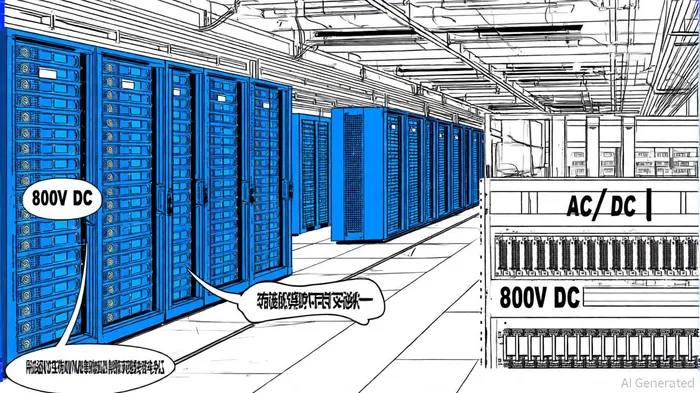
The global AI infrastructure market is undergoing a seismic shift, driven by the insatiable power demands of next-generation computing. As AI workloads scale to megawatt-level operations, traditional 48V AC/DC power architectures are proving inadequate, plagued by resistive losses, bulky cabling, and inefficiencies in high-density environments. Enter the 800V DC power revolution-a paradigm shift spearheaded by NVIDIA and enabled by semiconductor innovators like Renesas Electronics Corporation. For investors, this transition represents not just a technological leap but a strategic inflection point in the data center industry.
Semiconductor Innovation at the Core
Renesas' contribution to the 800V DC ecosystem hinges on its advanced Gallium Nitride (GaN) Field-Effect Transistor (FET) switches, which enable efficient power conversion from 48V to 800V through stacking capabilities. These GaN FETs, paired with Renesas' REXFET MOSFETs and power management controllers, address the critical bottlenecks of energy loss and thermal management in AI data centers. By eliminating redundant AC-to-DC conversions and reducing reliance on copper bus bars, Renesas' solutions cut distribution losses and physical infrastructure costs, enabling compact, high-density power systems.
The technical advantages are staggering. According to a report by NVIDIANVDA--, the 800V DC architecture achieves end-to-end power efficiency of up to 98%, a 5% improvement over traditional systems, while reducing copper usage by 45%. This is not merely incremental progress-it is a redefinition of power distribution for AI infrastructure. Renesas' GaN technology, with its high switching frequencies and low on-resistance, plays a pivotal role in achieving these metrics, enabling air-cooled operations and simplifying thermal management in high-power environments, as described in The 800-Volt Gorilla.
Energy Efficiency and Market Validation
Eaton, a key collaborator with NVIDIA, has developed reference architectures integrating 800V DC power with supercapacitors and advanced thermal solutions, reducing cooling costs and maintenance overhead by up to 70%. Similarly, STMicroelectronics has demonstrated 12 kW power delivery in a compact form factor using GaN and silicon carbide (SiC) technologies, achieving a power density exceeding 2,600 W/in³. These advancements underscore the scalability of 800V DC for AI clusters with over 100,000 GPUs, where per-rack power consumption can exceed 1 MW, as reported by Infineon and Nvidia.
For investors, the financial implications are clear. The 800V DC architecture reduces total cost of ownership (TCO) by minimizing energy waste, infrastructure complexity, and maintenance cycles. As NVIDIA states, this shift is critical for managing the volatility of AI workloads, which require rapid power adjustments and integrated energy storage solutions to maintain grid stability. Renesas' role in enabling these systems positions it as a linchpin in the transition to high-voltage DC infrastructure.
Industry Adoption and Strategic Partnerships
The 800V DC ecosystem is gaining momentum through strategic alliances. Renesas' collaboration with NVIDIA is complemented by partnerships with Infineon, STMicroelectronics, and Eaton, all of whom are developing complementary components for this architecture. For instance, Infineon's work on centralized 800V HVDC distribution consolidates power generation at the data center level, reducing conversion losses and infrastructure complexity, as explained in a Data Center Frontier article. Vertiv, another key player, is set to launch a 800V DC power portfolio in late 2026, aligning with NVIDIA's Kyber and Rubin Ultra platforms.
This collective effort reflects a broader industry consensus: 800V DC is not a niche experiment but a necessary evolution for AI infrastructure. As highlighted in a report by Data Insights Market, the 800V high-voltage systems market is projected to grow at a compound annual rate exceeding 20% through 2030, driven by the need for sustainable, high-density power solutions.
Investment Implications
For investors, Renesas' leadership in GaN technology and its alignment with NVIDIA's 800V DC vision present a compelling case. The company's semiconductor innovations directly address the scalability and efficiency challenges of AI data centers, positioning it to capture a significant share of the growing high-voltage DC market. Moreover, Renesas' partnerships with industry giants like NVIDIA and Eaton provide a robust validation of its technology, reducing the risk of obsolescence in a rapidly evolving sector.
Conclusion
The transition to 800V DC power architecture is not merely a technical upgrade-it is a foundational shift in how AI data centers are designed, operated, and scaled. Renesas' semiconductor innovations, particularly its GaN-based solutions, are at the forefront of this transformation, offering investors a unique opportunity to participate in the next phase of computing infrastructure. As AI workloads continue to redefine power demands, the companies that enable efficient, high-voltage solutions will dominate the market-and Renesas is already leading the charge.







Comentarios
Aún no hay comentarios