
Renault's Valuation and Strategic Outlook Post-Earnings Disappointment and Leadership Transition
Renault Group's recent earnings report and leadership transition have sparked significant investor concern, yet the company's long-term strategic initiatives and operational resilience present a nuanced picture for potential investors. This analysis evaluates Renault's valuation and strategic outlook, balancing short-term volatility with its ambitious transformation plans.
Earnings Disappointment and Leadership Uncertainty
Renault's Q3 2025 results revealed a 6.8% year-on-year revenue increase to €11.4 billion, driven by strong international sales growth and a 44% electrified vehicle mix. However, the company revised its full-year operating margin target downward to 6.5% from over 7%, citing deteriorating market trends, intensified competition, and exceptional losses tied to its Nissan partnership. First-half free cash flow of €47 million fell far short of expectations, with projections now ranging between €1 billion and €1.5 billion for 2025.
The leadership transition further compounded uncertainty. The abrupt departure of CEO Luca de Meo and appointment of CFO Duncan Minto as interim CEO triggered an 18% share price drop, the steepest decline since the pandemic. While de Meo's successor, François Provost, was named in late July 2025, the interim period has left investors questioning strategic continuity. Analysts at Goldman Sachs and Morningstar have highlighted risks from Chinese automakers, regulatory pressures, and the sustainability of high-single-digit margins for a mass-market player.
Strategic Initiatives: Electrification, Cost-Cutting, and Partnerships
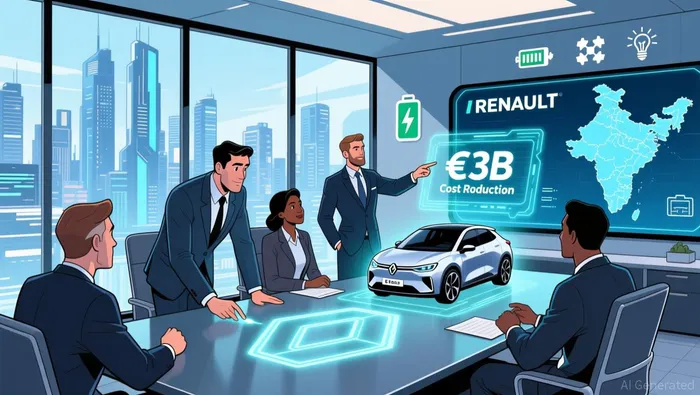
Renault's "Renaulution" roadmap remains central to its long-term vision. The company's 2025 strategic initiatives focus on three pillars: 1. Electrification: Electrified vehicles accounted for 44% of Q3 sales, with EVs contributing 13.5% and hybrid sales rising 25% year-on-year. The Renault 5 E-Tech and Scenic E-Tech models are driving this shift, while the Re-Factory in Flins underscores commitments to renewable energy and circular economy practices. 2. Cost-Cutting: Renault aims to reduce fixed costs by €3 billion by 2025 through platform rationalization, manufacturing footprint optimization, and SG&A expense reductions. CFO Duncan Minto emphasized maintaining capex and R&D at 8% of revenue to safeguard break-even points. 3. Partnerships: The alliance with Nissan includes a 2026 Twingo derivative for Nissan, reducing development costs. Additionally, Renault's acquisition of Nissan's 51% stake in RNAIPL in India strengthens its global footprint.
These initiatives align with Renault's ambition to derive over 20% of revenue from services, data, and energy trading by 2030, positioning the company as a "tech company working with cars".
Analyst Outlook and Long-Term Potential
Despite short-term challenges, Renault's strategic execution has earned cautious optimism. S&P Global Ratings upgraded the company to investment grade 'BBB-' in 2025, citing improved profitability and financial resilience. BNP Paribas Exane reinstated an Outperform rating with a €45 price target, praising Renault's cost discipline and product lineup.
However, risks persist. The European automotive market remains fragile, with U.S. tariffs and Chinese competition pressuring margins. Morningstar analysts caution that Renault's smaller scale and reliance on cost-cutting may limit long-term margin sustainability.
Conclusion: Balancing Volatility and Resilience
Renault's valuation reflects both its operational challenges and transformative potential. While the recent earnings disappointment and leadership transition have dented investor confidence, the company's focus on electrification, cost efficiency, and strategic partnerships offers a path to long-term growth. The success of these initiatives will hinge on execution under new leadership and the ability to navigate industry-wide headwinds. For investors with a multi-year horizon, Renault's discounted valuation and ambitious roadmap present an opportunity to capitalize on its transition to a tech-driven mobility leader.







Comentarios
Aún no hay comentarios