
Renault's Strategic Leadership Shift: A Catalyst for Accelerated Electrification and Operational Agility
Governance Reforms: From Rare-Earth Dependencies to Cobalt-Free Futures
Renault's governance strategy in 2025 has pivoted sharply toward reducing supply chain vulnerabilities. The company is now exploring in-house development of rare-earth-free motors and has tapped a Chinese supplier for stator components, a move that slashes costs and insulates it from export restrictions. This shift follows the termination of a project with Valeo, underscoring a hardening resolve to prioritize self-sufficiency.
Meanwhile, Renault's EV subsidiary, Ampere, has inked a joint development agreement with Stratus Materials to pioneer cobalt-free cathode technology. This isn't just a technical tweak-it's a seismic shift. Cobalt, a key ingredient in lithium-ion batteries, has long been plagued by ethical and geopolitical risks. By transitioning from nickel-manganese-cobalt (NMC) to lithium-iron-phosphate (LFP) and now to cobalt-free solutions, Renault is not only cutting costs but also aligning with ESG mandates that dominate investor sentiment.
Operational Agility: Geely Partnership and Global Market Expansion
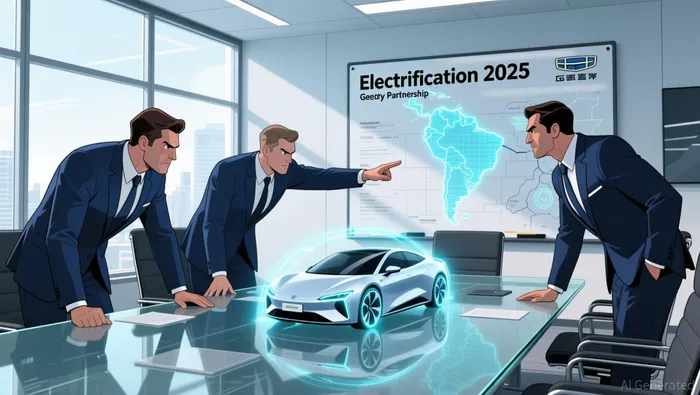
Renault's joint venture with Geely to manufacture cars for South America and the UK is a masterstroke of operational agility. By co-producing vehicles in Brazil-a market where EV adoption is accelerating-Renault avoids the pitfalls of over-investing in single-market infrastructure. This partnership allows it to scale production flexibly, adapting to regional demand swings without bearing the full brunt of capital expenditures.
The move also aligns with broader governance priorities: diversifying revenue streams and mitigating risks in volatile markets. Geely's expertise in cost-efficient manufacturing complements Renault's brand equity, creating a synergy that could redefine its competitive positioning.
Competitive Positioning: A $1.47 Trillion Opportunity
Renault's inclusion among the top 10 EV market players-controlling 77.48% of global market share in 2024-highlights its latent potential. With the EV sector projected to grow at a blistering pace, the company's focus on next-gen models, regional lineups, and strategic alliances positions it to capture a larger slice of this pie.
However, the path isn't without hurdles. Renault must balance innovation with profitability, ensuring that its pivot to EVs doesn't erode short-term margins. The company's governance reforms, particularly its supply chain overhauls, will be critical in this regard.
Investment Implications
For investors, Renault's 2025 strategy is a mixed bag of risk and reward. The governance-driven focus on electrification and operational agility is a positive, but the lack of transparency around leadership changes raises questions about continuity. That said, -with the vision to navigate the EV transition.
The key takeaway? Renault is no longer a bystander in the EV race. By marrying governance reforms with bold technological bets, it's building a foundation for long-term growth. For those willing to stomach near-term volatility, this could be a high-conviction play in a sector that's only just begun to accelerate.







Comentarios
Aún no hay comentarios