
Renault's Leadership Overhaul: Strategic Implications for Dacia's Electrification and Growth Trajectory
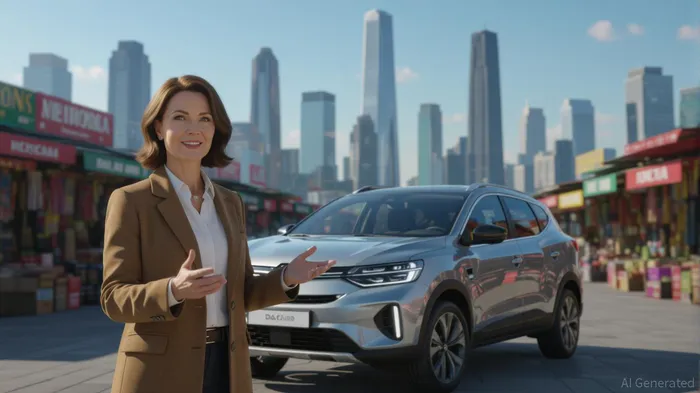
Renault Group’s recent leadership overhaul has positioned Katrin AdtADT--, the newly appointed CEO of Dacia, as a pivotal figure in the brand’s electrification and market expansion. Adt’s tenure at Mercedes-Benz, where she oversaw the transformation of Smart into a fully electric brand, and her focus on retail innovation, offer a compelling blueprint for Dacia’s future. This article examines how Adt’s strategic vision aligns with Renault’s broader goals and why Dacia represents a compelling long-term investment in the EV-driven automotive sector.
Adt’s Proven Track Record in Electrification
Adt’s leadership at Smart from 2018 to 2020 is a case study in rapid electrification. She spearheaded the brand’s shift to 100% electric vehicles, leveraging a joint venture with Geely to secure its future in China, a critical market for EVs [1]. This experience is directly transferable to Dacia, which is now accelerating its own electric roadmap. Under Adt, Dacia has announced plans for an electric Duster (with all-wheel drive) and an electric Sandero, both built on Renault’s modular platforms to reduce costs and expedite development [3]. These models target affordability—a core Dacia strength—while addressing EU regulations phasing out combustion engines by 2035.
Retail Transformation: A Mercedes-Benz Playbook for Dacia
Adt’s role at Mercedes-Benz as head of retail transformation emphasized digitalization, localization, and direct sales strategies. For example, Mercedes-Benz’s “local-for-local” approach in China—introducing seven region-specific models and enhancing R&D integration—mirrors Renault’s current strategy for Dacia [5]. Adt’s focus on streamlining operations and leveraging AI-driven customer service could similarly enhance Dacia’s retail experience in emerging markets. By adopting Mercedes-Benz’s Next Level Performance initiative—aimed at reducing production costs by 10% by 2027—Dacia could maintain its cost leadership while scaling EV production [4].
Electrification in Emerging Markets: A Strategic Sweet Spot
Dacia’s growth potential lies in its ability to capitalize on EV adoption in emerging markets like India and Latin America. While specific data on Dacia’s market share in these regions remains sparse, broader trends are promising. In Latin America, EV sales nearly tripled in 2024, driven by affordable Chinese imports and supportive policies [1]. Dacia’s upcoming electric Duster, priced competitively and built on the AmpR Small platform, is poised to capture this momentum. Similarly, India’s EV market is projected to reach 7% of total car sales by 2028, with government incentives accelerating infrastructure development [5]. Dacia’s Spring EV, already a top-five seller in France, could replicate this success in India if localized effectively.
Renault’s Global Ambitions and Dacia’s Role
Renault’s strategic reorganization under François Provost and Fabrice Cambolive underscores a unified approach to electrification and international growth. By 2027, the group aims to double international revenue per unit and achieve a 33% share of electrified vehicles outside Europe [3]. Dacia’s role is to provide affordable EVs in markets where electrification is still nascent. Adt’s leadership ensures this strategy aligns with Dacia’s brand identity—practical, accessible mobility—while leveraging Renault’s CMF-BEV and CMF-EV platforms for cost efficiency [5].
Investment Thesis: Why Dacia Stands Out
Dacia’s combination of affordability, modular platforms, and Adt’s leadership creates a unique value proposition. Unlike luxury-focused EV brands, Dacia targets price-sensitive consumers in emerging markets, where EV adoption is accelerating. With Renault’s financial backing and Adt’s proven ability to execute electrification, Dacia is well-positioned to outperform peers in these high-growth regions.
Conclusion
Katrin Adt’s appointment marks a strategic inflection point for Dacia. Her experience in electrification, retail transformation, and cost optimization positions the brand to capitalize on global EV trends while maintaining its core strengths. For investors, Dacia represents a high-conviction opportunity within Renault’s evolving strategy—a brand poised to redefine affordable electric mobility in the 2030s.
Source:
[1] Katrin Adt [https://en.wikipedia.org/wiki/Katrin_Adt]
[2] Dacia confirms upcoming electric offshoot for the Duster [https://www.electrive.com/2025/07/01/dacia-confirms-upcoming-electric-offshoot-for-the-duster/]
[3] Renault Group strengthens leadership and organisation to accelerate execution [https://media.renaultgroup.com/renault-group-strengthens-leadership-and-organisation-to-accelerate-execution/?lang=eng]
[4] Mercedes-Benz Accelerates Transformation Strategy [https://theevreport.com/mercedes-benz-accelerates-transformation-strategy]
[5] Trends in electric car markets – Global EV Outlook 2025 [https://www.iea.org/reports/global-ev-outlook-2025/trends-in-electric-car-markets-2]







Comentarios
Aún no hay comentarios