
Why Remittix (RTX) Outpaces XRP and Cardano as a 2026 Momentum Play
In the rapidly evolving crypto landscape of 2025, the race for real-world utility has intensified, with projects like XRPXRP--, CardanoADA--, and Remittix (RTX) vying for dominance. However, as the year draws to a close, one project stands out for its concrete, near-term catalysts and measurable adoption metrics: Remittix. This analysis examines why RTX is poised to outpace XRP and Cardano in 2026, leveraging its deflationary tokenomics, institutional credibility, and a utility-driven infrastructure that directly addresses the $19 trillion global remittance market.
RTX's Near-Term Catalysts: PayFi and Global Accessibility
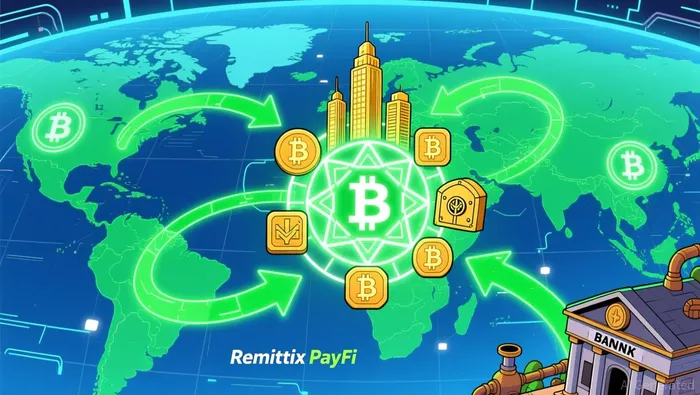
Remittix's PayFi protocol represents a paradigm shift in cross-border transactions. By enabling users to send fiat directly to bank accounts in over 30 countries from their crypto wallets, RTX bridges the gap between decentralized finance (DeFi) and traditional banking systems. The live beta of the Remittix Web3 Wallet, now available on the App Store for EthereumETH-- and SolanaSOL--, supports 40+ cryptocurrencies and 30+ fiat currencies, positioning it as a cross-chain DeFi platform with immediate utility. This functionality is not speculative-it is operational, with users already leveraging it for real-time foreign exchange (FX) conversions and low-cost remittances.
A critical catalyst for RTX is the full launch of PayFi in February 2026. This milestone will unlock institutional-grade liquidity and expand the project's geographic footprint, directly targeting underbanked populations and small-to-medium enterprises (SMEs) reliant on cross-border payments. Unlike XRP and Cardano, which remain partially dependent on speculative narratives, RTX's utility is tied to tangible use cases, including competitive transaction fees (0.1%) and direct bank integrations.
XRP's Institutional Push vs. RTX's On-Ramp to Mainstream Adoption
XRP has made strides in institutional adoption, particularly after Ripple's $125 million SEC settlement in August 2025. The acquisition of Hidden Road to form Ripple Prime-a global prime brokerage-has integrated XRP into institutional trading workflows, while partnerships with Mastercard, WebBank, and Gemini highlight its role in on-chain settlements via RLUSD according to market analysis. However, XRP's utility remains largely confined to cross-border remittances and on-demand liquidity, with daily transaction volumes still lagging behind RTX's direct user base.
Mike Novogratz, CEO of Galaxy, has warned that XRP must demonstrate sustained growth in "genuine payment transactions" to avoid a valuation decline. While Ripple's institutional moves are significant, they do not address the core inefficiencies in global remittances as directly as RTX's PayFi protocol. For example,
RTX's 0.1% fee model is explicitly designed to undercut traditional remittance providers, whereas XRP's utility is often abstracted through intermediaries.
Cardano's Ambitious Roadmap vs. RTX's Deflationary Edge
Cardano's Q4 2025 progress is impressive, with the Cardano Summit 2025 in Berlin attracting 1,000 in-person attendees and 25,000 online viewers. The ecosystem has also expanded through enterprise partnerships (e.g., Petrobras) and on-chain metrics like 2.5 million active addresses and $10 billion in daily transaction volumes. However, Cardano's utility remains fragmented, with debates persisting over its on-chain value proposition.
RTX, by contrast, benefits from a deflationary tokenomics model that aligns with its real-world adoption. The presale has already raised $27 million, with 681 million tokens sold at $0.1166, and the 200% presale bonus set to expire in early 2026. This creates urgency among investors while ensuring token scarcity as adoption scales. Cardano's whale concentration-where the top 100 addresses control 40% of ADA-also raises concerns about market manipulation, a risk RTX mitigates through its institutional-grade audits (e.g., CertiK) and BitMart/LBank listings.
Conclusion: RTX as the 2026 Momentum Play
As 2026 approaches, the crypto market will increasingly reward projects that deliver measurable utility and adoption. Remittix's PayFi protocol, deflationary model, and institutional credibility position it as a clear leader in the remittance sector, outpacing XRP's institutional focus and Cardano's fragmented utility. With the full PayFi launch in February 2026 and a growing user base leveraging its cross-chain capabilities, RTX is not just a speculative play-it is a structural solution to a $19 trillion problem. For investors seeking momentum in 2026, RTX's near-term catalysts and real-world adoption metrics make it an undeniable choice.






Comentarios
Aún no hay comentarios