
Reliance's Strategic Restructuring in Energy and Global Markets: Assessing Operational Synergies and Growth Potential Post-Amalgamation
In 2025, Reliance Industries Limited (RIL) has emerged as a global energy and consumer goods powerhouse, driven by a series of strategic amalgamations, demergers, and capital-intensive investments. The company's restructuring efforts—spanning its energy portfolio, FMCG operations, and international subsidiaries—have positioned it to capitalize on India's energy transition and global sustainability trends while unlocking operational efficiencies. This analysis evaluates the operational synergies and growth potential arising from these moves, supported by recent financial disclosures and expert insights.
Energy Sector Restructuring: A New Energy Paradigm
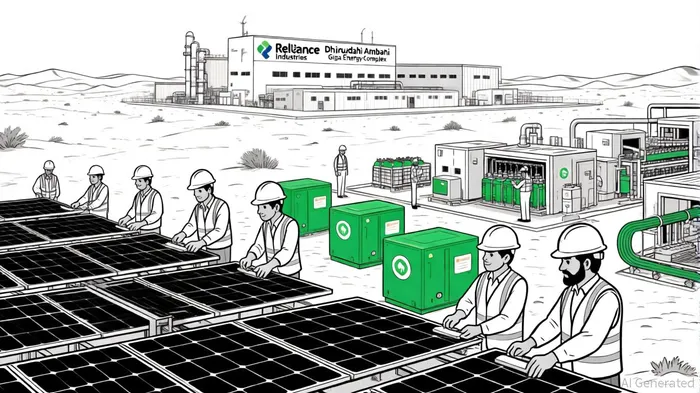
Reliance's pivot to clean energy has been nothing short of transformative. The company's Dhirubhai Ambani Giga Energy Complex in Jamnagar is now a cornerstone of its new energy strategy, with plans to produce green ammonia, e-methanol, and sustainable aviation fuel [4]. By 2025, Reliance had invested ₹75,000 crore ($9 billion) in new projects across Nagothane, Dahej, and Palghar, targeting India's surging energy demand [1]. These initiatives are complemented by a 20 GW solar PV manufacturing capacity and a battery giga factory with 40 GWh annual output, expandable to 100 GWh [4].
The Exploration & Production (E&P) segment, contributing nearly 30% of India's natural gas output, delivered a record EBITDA of ₹21,188 crore ($2.5 billion) in FY25, despite global market volatility [1]. Reliance's Hazira carbon fibre facility, set to become one of the world's largest, underscores its ambition to serve high-margin aerospace and defense markets [1]. Meanwhile, the Jio-bp joint venture is accelerating India's electric mobility ecosystem, with EV charging infrastructure and green fuel adoption [3].
Operational Synergies from Middle East Subsidiary Amalgamation
On September 16, 2025, Reliance completed the amalgamation of two wholly owned Middle East subsidiaries—Reliance Exploration & Production DMCC and Reliance Industries (Middle East) DMCC—streamlining its international energy operations [2]. This move, certified effective the following day, aims to reduce administrative overhead and enhance operational efficiency in exploration, production, and petrochemicals [2]. While specific cost savings figures remain undisclosed, such consolidations typically eliminate redundancies and optimize resource allocation [4].
The amalgamation aligns with Reliance's broader strategy to strengthen its global footprint. By centralizing operations in the Middle East—a region critical to global energy trade—the company is poised to leverage lower logistics costs and regional supply chain advantages. Analysts note that such structural simplifications often lead to revenue synergies through expanded market reach and cost synergies via shared infrastructure [4].
FMCG Demerger: A Path to Focused Growth
Reliance's demerger of its Fast-Moving Consumer Goods (FMCG) business into New Reliance Consumer Products Ltd (New RCPL) is another strategic milestone. This standalone entity, now a direct subsidiary of RIL, is designed to attract sector-specific investors and streamline operations for rapid growth [5]. The FMCG segment, which reported ₹4,400 crore in Q1 FY25 revenues (a 2x YoY increase), is expanding its distribution to 4–5 million outlets, targeting tier-2 and tier-3 cities [5].
The demerger's three-stage plan—including a slump sale transfer and regulatory approvals—has already received National Company Law Tribunal (NCLT) clearance [5]. By offering distributors 6–8% margins (vs. industry averages of 3–5%) and pricing products 20–40% lower than competitors, Reliance is disrupting traditional retail channels [5]. This strategy has forced rivals like Coca-ColaKO-- and PepsiCoPEP-- to enhance trade promotions in competitive regions [5].
Growth Catalysts and Risks
Reliance's $75 billion New Energy division—focused on green hydrogen, solar, and storage—positions it to meet global decarbonization goals while diversifying revenue streams [4]. The company's 3 MT green hydrogen target and 5,500-acre solar project in Kutch could meet 10% of India's electricity needs [4]. However, risks include execution challenges in unproven technologies and capital intensity.
The potential IPO of Reliance Retail by 2027, valued at $200 billion, hinges on the FMCG demerger's success [5]. A successful listing could unlock shareholder value and attract sector-specific capital, but depends on maintaining operational discipline and investor confidence.
Conclusion
Reliance's strategic restructuring—spanning energy, FMCG, and global operations—has created a multi-engine growth model. By leveraging operational synergies from subsidiary amalgamations and demergers, the company is optimizing costs, enhancing focus, and aligning with global sustainability trends. While challenges remain, Reliance's financial strength, innovation in new energy, and aggressive market strategies position it as a leader in India's energy transition and a formidable player in global markets.





Comentarios
Aún no hay comentarios