
Reitmans' Q2 2025 Performance: A Barometer for Retail Resilience Amid Inflation and Shifting Consumer Behavior
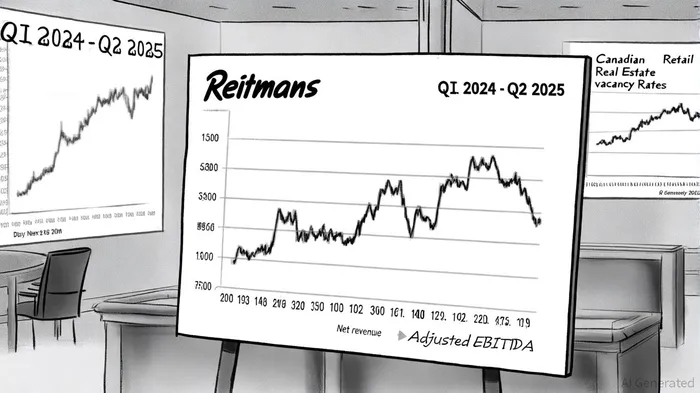
Reitmans (Canada) Limited's fiscal second-quarter 2025 results reflect the broader challenges and opportunities facing the retail sector in an era of inflationary pressures and evolving consumer behavior. While the company reported a modest revenue increase of 0.4% to $215.9 million, its performance was tempered by a 1.3% decline in comparable sales and a 220-basis-point drop in gross profit margin to 56.9% [1]. These figures contrast with a separate report indicating a 17.2% surge in net earnings to $15.7 million for Q2 FY25, attributed to reduced promotions and strategic store renovations [3]. This apparent discrepancy underscores the complexity of interpreting financial results in a volatile market, where fiscal calendars and reporting standards can vary.
Retail Real Estate Resilience: A Double-Edged Sword
The Canadian retail real estate market remains a critical factor in Reitmans' long-term strategy. Vacancy rates have held steady at 1.5% in early 2025, with landlords leveraging strong demand to secure favorable terms for tenants [5]. This stability benefits Reitmans, which has reduced SG&A costs by $2.7 million through operational efficiency while investing in store modernization [1]. However, the sector's resilience is not without risks. CBRECBRE-- notes that landlords are increasingly adopting creative rent structures, such as revenue-sharing models, to retain tenants in non-essential categories like apparel [6]. For Reitmans, this could mean higher fixed costs if lease renegotiations favor landlords in a tightening market.
Apparel Sector Challenges: Navigating Consumer Cautiousness
The apparel sector faces a dual challenge: inflationary pressures and shifting consumer priorities. While Canadian retailers reported an 80% year-over-year sales gain in spring 2025, non-essential categories like apparel saw softer demand, particularly among mid-tier brands [3]. Reitmans' Q2 results align with this trend, as its gross margin contraction—driven by increased promotions—mirrors industry-wide discounting to attract budget-conscious shoppers [1]. Meanwhile, the second-hand apparel market is growing at a faster rate than traditional retail, driven by sustainability concerns and economic uncertainty [4]. This shift could erode Reitmans' market share unless the company accelerates its focus on value-driven offerings or circular business models.
Strategic Initiatives: A Path to Long-Term Resilience
Reitmans' management has emphasized strategic investments to counter these headwinds. Andrea Limbardi, President and CEO, highlighted plans to optimize the store footprint and modernize digital infrastructure, signaling a pivot toward hybrid retail models [3]. These initiatives align with broader sector trends, as 74% of Canadian shoppers plan to prioritize in-person experiences during the holiday season [5]. By integrating online and in-store services—such as buy-online-pickup-in-store (BOPIS)—Reitmans can mitigate e-commerce stagnation while leveraging the enduring appeal of physical retail.
Long-Term Outlook: Balancing Risks and Opportunities
Despite near-term volatility, the Canadian retail sector remains cautiously optimistic. The Retail Council of Canada projects growth in experiential and service-based retail, areas where Reitmans could differentiate itself through curated in-store experiences [3]. However, the company must navigate macroeconomic risks, including potential U.S. tariffs and supply chain disruptions, which could further compress margins. For investors, Reitmans' ability to balance cost discipline with innovation will be key. Its Q2 results suggest a company in transition, leveraging operational efficiency to offset sector-wide challenges while investing in long-term resilience.
In conclusion, Reitmans' performance offers a microcosm of the retail sector's broader dynamics. While inflation and shifting consumer behavior pose significant risks, strategic agility and a resilient real estate market provide a foundation for recovery. Investors should monitor the company's progress in executing its digital and store modernization plans, as these initiatives will likely determine its ability to thrive in an increasingly competitive landscape.







Comentarios
Aún no hay comentarios