
Regulatory Winds Shift: The Case for Strategic Crypto Buying in 2025
The cryptocurrency market has long been a battlefield for regulatory uncertainty, but recent developments at the Securities and Exchange Commission (SEC) suggest a pivotal turning point. The departure of Gary Gensler, the 33rd SEC Chair, on January 20, 2025, marks the end of an era defined by aggressive enforcement actions against digital assets according to the SEC press release. His exit, coupled with the appointment of Paul Atkins as the new SEC Chair, signals a potential recalibration of regulatory priorities-a shift that investors may now view as a strategic inflection point for digital asset allocations.
The Gensler Era and Its Legacy
Gensler's tenure, which began in April 2021, was characterized by a broad application of existing securities laws to crypto projects, often through enforcement actions rather than rulemaking. This approach created a climate of ambiguity for market participants, as projects faced unpredictable scrutiny without clear guidelines. For instance, the SEC's focus on retroactive enforcement-such as lawsuits against major exchanges and token issuers-prioritized punitive measures over proactive clarity. While this strategy may have served short-term political goals, it stifled innovation and deterred institutional capital from entering the space.
A New Regulatory Paradigm Under Paul Atkins
The transition to Paul Atkins as SEC Chair, effective April 21, 2025, introduces a stark contrast. Although direct statements from Atkins on crypto remain limited, the broader regulatory agenda under his leadership emphasizes structured rulemaking over enforcement. This shift is evident in the formation of the SEC's Crypto Task Force, led by Commissioner Hester Peirce-a long-time advocate for balanced crypto regulation according to Gibson Dunn. Peirce's role in steering the task force toward a framework that distinguishes between securities and non-securities tokens could provide much-needed clarity for developers and investors alike.
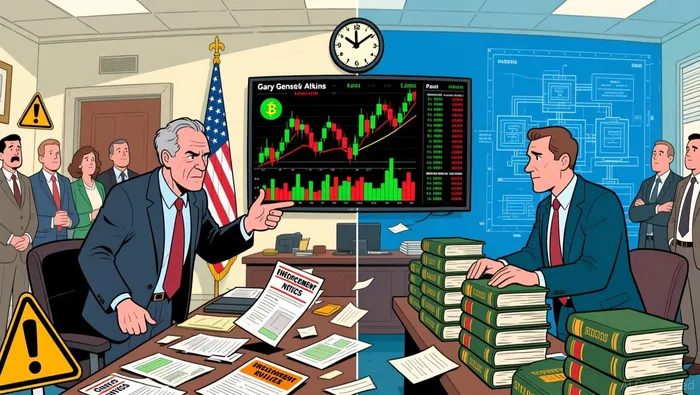
The new administration's focus on "proactive regulatory frameworks" rather than "retroactive enforcement" suggests a willingness to engage with industry stakeholders according to industry analysis. This approach aligns with broader trends in financial policy, where regulators increasingly recognize the need to foster innovation while protecting investors. For example, the European Union's MiCA framework, which entered into force in June 2024, demonstrates how structured regulation can coexist with market growth.
Strategic Implications for Investors
The regulatory environment's evolution presents a compelling case for re-evaluating crypto exposure. Historically, enforcement-driven uncertainty has suppressed valuations, creating undervalued opportunities for long-term investors. With the SEC's pivot toward rulemaking, the risk of arbitrary crackdowns diminishes, reducing a key headwind for the sector.
Consider Bitcoin's performance in 2024: despite macroeconomic volatility, the asset outperformed traditional equities during periods of regulatory clarity, such as the approval of spot ETFs in January 2024. A similar dynamic could unfold in 2025, particularly if the SEC's new framework facilitates clearer compliance pathways for exchanges and custodians.
Moreover, the departure of Gensler-a figure synonymous with anti-crypto enforcement-removes a symbolic barrier to institutional adoption. Asset managers and pension funds, which have historically hesitated to allocate capital to crypto due to regulatory risks, may now reassess their strategies. This could catalyze a surge in demand for liquid crypto assets, particularly BitcoinBTC-- and EthereumETH--, which have already demonstrated resilience in bear markets.
Risks and Considerations
While the regulatory outlook appears favorable, investors must remain cautious. The SEC's new framework is still in its infancy, and political shifts-such as the potential for a Biden administration in 2026-could reintroduce uncertainty. Additionally, global regulatory divergence remains a challenge; jurisdictions like China and Russia continue to impose restrictive policies.
However, the immediate-term risks are arguably outweighed by the sector's structural advantages. Blockchain technology's utility in cross-border payments, decentralized finance (DeFi), and tokenized assets is gaining traction, independent of regulatory cycles. For investors with a 3–5 year horizon, the current environment offers a rare combination of undervaluation and regulatory tailwinds.
Conclusion
The SEC's transition from enforcement to structured regulation represents a foundational shift in the crypto landscape. While the departure of Gary Gensler does not guarantee a utopian regulatory environment, it does signal a departure from the punitive approach that has historically hindered the sector. For investors, this shift-from regulatory hostility to measured oversight-creates a compelling case for strategic entry into digital assets. As the SEC's Crypto Task Force moves to define a coherent framework, the time to act may be now.






Comentarios
Aún no hay comentarios