
Regulatory Uncertainty and Growth Potential in the Prediction Markets Sector
The prediction markets sector has emerged as a high-growth, high-risk investment opportunity in 2025, with platforms like Kalshi and Polymarket at the forefront of a legal and regulatory revolution. These platforms, which allow users to trade contracts based on the outcomes of political, economic, and sports events, have attracted billions in funding and trading volume despite-or perhaps because of-the escalating legal battles with state regulators. As the sector navigates a fragmented regulatory landscape, investors must weigh the potential for transformative growth against the risks of state-level enforcement actions and unresolved federal preemption questions.
Legal Battles and the Federal vs. State Regulatory Divide
Kalshi, a federally regulated derivatives exchange under the Commodity Futures Trading Commission (CFTC), has faced aggressive pushback from states like Tennessee, New Jersey, and Maryland, which argue that its sports-event contracts constitute unlicensed gambling. Tennessee's Sports Wagering Council, for instance, issued a cease-and-desist order in late 2025, demanding Kalshi halt operations and refund deposits by January 2026 under threat of criminal charges. Kalshi and its peers counter that the Commodity Exchange Act (CEA) grants the CFTC exclusive jurisdiction over derivatives markets, preempting state laws.
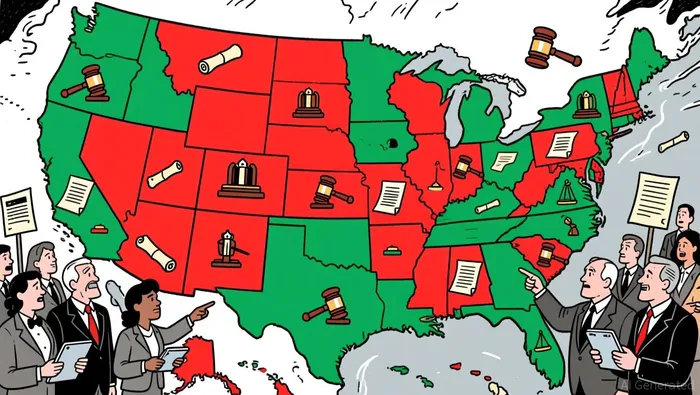
This tension has led to a circuit split in federal courts. A Maryland court denied Kalshi's preliminary injunction in December 2025, ruling that the CEA does not clearly preempt state gambling laws. Conversely, courts in Nevada and New Jersey initially sided with Kalshi, though the Nevada court later reversed its decision. These conflicting rulings have created a legal gray area, with 38 states filing an amicus brief in support of Maryland's case, signaling a broader political alignment against federal preemption.
The Role of the Supreme Court and Scenario-Based Projections
The ultimate resolution of these disputes may hinge on the Supreme Court. Legal experts predict that a case involving Kalshi or Polymarket could reach the high court by 2027 or 2028, given the circuit split and the lack of a clear congressional mandate on federal preemption. A ruling favoring federal preemption would likely streamline compliance for prediction markets, enabling platforms to operate nationwide without state-specific restrictions. Conversely, a decision affirming state authority would force Kalshi and Polymarket to navigate a patchwork of regulations, potentially limiting their scalability.
Scenario-based investment models suggest stark divergences in outcomes. If federal preemption is upheld, Kalshi and Polymarket could achieve annualized trading volumes exceeding $50 billion by 2026, with valuations reaching $15–20 billion. Partnerships with institutions like Intercontinental Exchange (owner of the NYSE) and media giants like CNN and Yahoo Finance further position these platforms as foundational data infrastructure for financial and AI-driven decision-making. However, a fragmented regulatory environment could lead to operational costs rising by 30–50%, eroding margins and delaying expansion into new markets.
Financial Performance and Institutional Confidence
Despite regulatory uncertainty, Kalshi and Polymarket have demonstrated robust financial performance. Kalshi secured $1.6 billion in funding by late 2025, including a $1 billion round led by Sequoia and CapitalG, while Polymarket raised $2 billion from ICE and other investors. Their combined notional trading volume surpassed $2 billion in a single month, driven largely by sports-related contracts. Institutional adoption has also surged, with Kalshi partnering with the NHL and Google Finance, and Polymarket integrating its data into AI models and financial terminals according to reports.
This institutional backing has insulated the platforms from immediate regulatory shutdowns. For example, Tennessee's cease-and-desist order against Polymarket has not yet led to enforcement, as regulators await clearer legal precedents. Similarly, Kalshi's preliminary injunctions in New Jersey and Nevada allowed it to continue operations while litigation proceeds according to legal analysis. These dynamics suggest that regulatory risks, while significant, are not yet existential for the sector.
Investment Implications and Risk Mitigation Strategies
For long-term investors, the key is to balance the sector's growth potential with its regulatory risks. A federal preemption victory would likely unlock exponential growth, with prediction markets becoming a core component of financial infrastructure. However, a state-led regulatory framework could fragment the market, requiring platforms to invest heavily in compliance and lobbying.
Investors should also monitor the CFTC's capacity to provide guidance. The agency's delayed actions and leadership changes post-2025 presidential transition have left market participants in limbo. A proactive CFTC could clarify the legal boundaries of event contracts, reducing uncertainty. Conversely, regulatory inaction may prolong litigation and deter institutional investment.
Conclusion
The prediction markets sector represents a unique intersection of financial innovation and regulatory conflict. Kalshi and Polymarket have demonstrated the power of event-based trading to aggregate real-time probability signals, outperforming traditional forecasting methods. However, their long-term viability depends on resolving the federal preemption question-a task that may require a Supreme Court ruling. For investors willing to navigate the legal volatility, the sector offers a high-reward opportunity to capitalize on a market poised to redefine risk management, data infrastructure, and institutional finance.







Comentarios
Aún no hay comentarios