
Regulatory Uncertainty in DeFi: The MEV Prosecution and Its Impact on Blockchain Innovation
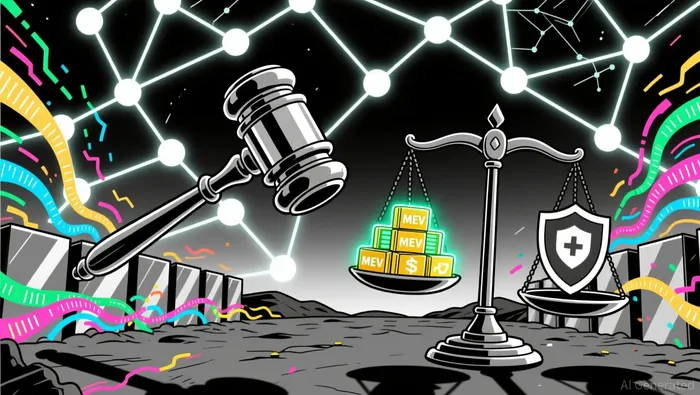
The U.S. Department of Justice's (DOJ) prosecution of Anton and James Peraire-Bueno for exploiting Ethereum's Maximal Extractable Value (MEV) system has become a flashpoint in the broader debate over DeFi regulation. The case, which ended in a mistrial in late 2025, underscores the tension between innovation and enforcement in blockchain ecosystems. As the DOJ grapples with how to apply traditional financial regulations to decentralized systems, investors must assess the long-term risks and opportunities in DeFi infrastructure and projects that demonstrate regulatory resilience.
The Peraire-Bueno Case: A Legal and Technical Quagmire
The Peraire-Bueno brothers were charged with conspiracy to commit wire fraud, wire fraud, and money laundering after allegedly exploiting Ethereum's validator layer to manipulate transaction ordering and siphon $25 million from traders according to reports. Prosecutors framed their actions as a novel form of financial misconduct, arguing that MEV-based "sandwich attacks" constituted fraud under existing laws according to Justice Department statements. The defense, however, contended that their activities were within the bounds of Ethereum's protocol rules, highlighting the ambiguity of applying traditional legal frameworks to decentralized systems as reported by industry analysts.
The mistrial, declared after a jury reportedly overwhelmed by technical and legal complexities failed to reach a consensus according to financial news outlets, leaves the DOJ with options: retry the case, negotiate a plea, or drop charges. This outcome reflects a broader challenge for regulators: how to enforce accountability without stifling innovation in a space where code and consensus often replace centralized governance.
U.S. Regulatory Overreach and Developer Sentiment
The DOJ's aggressive stance on MEV has raised concerns among DeFi developers and entrepreneurs. While the U.S. passed the GENIUS Act in 2025 to provide a stablecoin framework according to market analysis, enforcement actions like the Peraire-Bueno case risk creating a chilling effect on innovation. Developers are increasingly wary of being targeted under Section 1960 of the Bank Secrecy Act, which has been misapplied to noncustodial software developers according to industry reports. This uncertainty has prompted some to migrate to jurisdictions with clearer regulatory guardrails, such as Singapore or the EU.
Meanwhile, the DOJ's internal guidance-reflected in the "Ending Regulation by Prosecution" memo-suggests a shift toward curbing overly aggressive enforcement according to regulatory commentary. However, the lack of a coherent regulatory framework for MEV and other DeFi-native risks remains a liability for U.S. competitiveness.
Global Regulatory Divergence and Capital Flows
The U.S. is not the only player in the DeFi regulatory arena. The EU's Markets in Crypto-Assets (MiCA) regulation, fully implemented in 2025, has created a harmonized but rigid framework that prioritizes investor protection over innovation according to industry analysis. In contrast, Singapore's Digital Token Service Provider (DTSP) rules under the Monetary Authority of Singapore (MAS) have positioned the city-state as a hub for experimentation, with rapid adoption of real-world asset tokenization and Bitcoin-native DeFi projects according to Chainalysis reports.
This divergence has reshaped capital flows. U.S. institutional investors are increasingly allocating to stablecoin-integrated DeFi protocols like AaveAAVE-- and CompoundCOMP--, which benefit from the GENIUS Act's clarity according to DeFi market data. Meanwhile, Singapore's innovation-friendly environment has attracted projects like Lido and EtherETH--.fi, which have scaled liquid staking solutions while adhering to MAS's DTSP requirements according to market analysis. The EU, despite MiCA's regulatory certainty, faces implementation challenges that create uneven compliance costs across member states according to Chainalysis reports.
Regulatory Resilient Projects: Where to Invest
Investors seeking risk-adjusted returns in DeFi should focus on projects that have navigated regulatory complexity while maintaining user growth. Key examples include:
- Aave and Compound: These lending protocols have rebounded with record TVL, driven by institutional adoption and integration with stablecoins compliant with the GENIUS Act according to DeFi market reports.
- Lido and Ether.fi: Liquid staking platforms have thrived by balancing yield generation with compliance in jurisdictions like Singapore according to market analysis.
- Bitcoin-native DeFi: Projects leveraging Bitcoin's ecosystem-such as lending and stablecoin platforms-have seen TVL surge from $307 million in 2024 to $6.36 billion in 2025, reflecting growing demand for Bitcoin-based financial tools according to market data.
- Real-World Asset (RWA) Tokenization: Platforms bridging DeFi with traditional finance, such as those tokenizing real estate or corporate debt, have seen TVL grow by over 25% in Q3 2025 according to market analysis.
These projects demonstrate adaptability to regulatory environments, whether by aligning with U.S. stablecoin rules, EU MiCA compliance, or Singapore's DTSP framework.
Strategic Investment Recommendations
Given the regulatory uncertainty in the U.S., investors should adopt a diversified approach:
- Prioritize Infrastructure: Allocate to DeFi protocols with modular architectures that can adapt to jurisdictional changes. For example, projects like Aave and Lido are building compliance layers to operate across the U.S., EU, and Singapore according to market analysis.
- Focus on Stablecoin Integration: The GENIUS Act's emphasis on stablecoins creates opportunities for protocols that facilitate cross-chain and institutional-grade stablecoin usage according to market commentary.
- Hedge Against U.S. Overreach: Consider exposure to EU and Singapore-based projects, which offer regulatory clarity and innovation-friendly environments. For instance, MiCA-compliant stablecoins and Singapore's DTSP-licensed platforms are attracting capital as alternatives to U.S.-centric solutions according to Chainalysis reports.
- Monitor Enforcement Trends: The DOJ's next move in the Peraire-Bueno case could signal broader enforcement priorities. If retried, the case may set a precedent for how MEV is treated under U.S. law, potentially reshaping the DeFi landscape.
Conclusion
The Peraire-Bueno case is a microcosm of the broader struggle between regulatory oversight and blockchain innovation. While U.S. enforcement actions create near-term uncertainty, the global DeFi ecosystem is evolving to mitigate these risks through jurisdictional agility and compliance-driven design. For investors, the key is to balance exposure to U.S. infrastructure with opportunities in regulatory resilient projects across the EU and Singapore. In a world where code and law increasingly collide, the most durable DeFi protocols will be those that navigate both technical and regulatory complexity with equal dexterity.







Comentarios
Aún no hay comentarios