
Regulatory and Technological Catalysts Powering the Onchain Economy's Institutional Takeoff
U.S. Regulatory Framework: A Blueprint for Institutional Adoption
The U.S. is on the cusp of a crypto regulatory breakthrough. With bipartisan support, lawmakers are targeting year-end 2025 for passing comprehensive crypto market structure legislation, a move that would standardize rules for digital assets while protecting investors, according to a Coinpedia report. This framework is critical for institutional adoption, as it addresses long-standing ambiguities around custody, stablecoin oversight, and DeFi compliance.
A landmark development in this space is Crypto.com's application for a U.S. National Trust Bank Charter with the Office of the Comptroller of the Currency (OCC). By seeking federal regulation, the company aims to offer institutional-grade staking and custody services, bypassing the fragmented state-by-state compliance maze, as reported by a Wral article. This mirrors similar moves by CoinbaseCOIN-- and Ripple, signaling a broader industry shift toward integration with traditional finance.
President Trump's January 2025 executive order further accelerated progress. The creation of a Presidential Working Group on Digital Asset Markets, led by White House AI and Crypto Czar David Sacks, underscores the administration's commitment to balancing innovation with accountability, as detailed in a Financefeeds report. The group's mandate includes establishing a Strategic BitcoinBTC-- Reserve and a Digital Asset Stockpile, recognizing Bitcoin as a strategic asset. These steps notNOT-- only legitimize crypto but also create infrastructure for institutional participation.
Technological Catalysts: Scaling the Onchain Economy
While regulatory clarity is foundational, technological advancements are the engines of growth. Ethereum's institutional hub, launched by the EthereumETH-- Foundation, is a prime example. This platform equips banks, asset managers, and corporations with tools to tokenize assets, manage onchain portfolios, and integrate blockchain into existing workflows, as reported by a CryptoFrontNews article. Institutions like BlackRock and Visa are already leveraging Ethereum to process trillions in transactions.
Layer 2 (L2) scaling solutions have been equally transformative. Networks like ArbitrumARB--, Polygon, and StarknetSTRK-- now secure over $50 billion in total value locked (TVL), enabling low-cost, high-speed transactions that meet institutional demands for scalability, according to a CryptoFrontNews article. These L2s are not just technical upgrades-they're gateways to a future where blockchain can handle global financial infrastructure.
Privacy-preserving technologies like zero-knowledge proofs (ZKPs) and trusted execution environments (TEEs) are also gaining traction. These innovations allow institutions to comply with KYC/AML regulations while maintaining data confidentiality-a critical requirement for onboarding traditional finance players, as noted in a CryptoFrontNews article.
Beyond Ethereum, cross-chain interoperability is unlocking new possibilities. Stellar's partnership with Chainlink has created a bridge for institutions to access cross-chain data feeds and move assets seamlessly between blockchains, as described in a Blockonomi article. This collaboration extends Chainlink's $100 billion DeFi TVL infrastructure to StellarXLM--, further solidifying the onchain economy's institutional-grade capabilities.
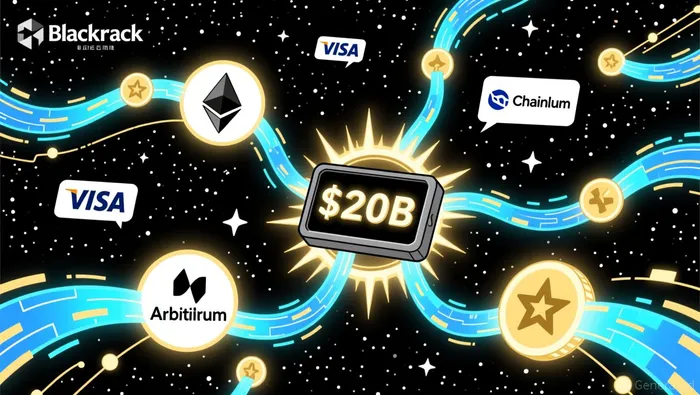
The Onchain Economy's $20B Milestone: Real Demand, Not Speculation
The onchain economy's value has surged to $20 billion, driven by real-world demand rather than speculative hype, according to a Yahoo Finance report. DeFi protocols now account for 63% of onchain fees, while emerging categories like decentralized physical infrastructure networks (DePIN) and institutional-grade wallets are gaining traction. This shift is evident in rising transaction fees and the tokenization of real-world assets-from real estate to carbon credits.
A report by 1kx highlights that onchain fees are outpacing speculative trading volumes, indicating a maturing ecosystem where value creation, not speculation, drives growth, according to a Yahoo Finance report. For institutions, this means a transition from "crypto as a bet" to "crypto as infrastructure."
The Road Ahead: Institutional-Grade Onchain Finance
The onchain economy is no longer a parallel financial system-it's a complementary layer to traditional markets. With U.S. legislation nearing finalization, Ethereum's institutional tools, and cross-chain interoperability solutions, the barriers to institutional adoption are dissolving.
For investors, the implications are clear:
1. Regulatory clarity reduces counterparty risk and opens doors to crypto-backed ETFs and insurance products.
2. Scalable infrastructure (L2s, ZKPs) ensures the onchain economy can handle institutional volumes.
3. Real-world asset tokenization creates new liquidity pools and diversification opportunities.
As the onchain economy converges with traditional finance, early adopters-those who allocate capital to regulated crypto infrastructure and DeFi protocols-will reap outsized rewards. The question isn't whether institutions will enter this space, but how quickly they'll act.







Comentarios
Aún no hay comentarios