
Regulatory Tailwinds for U.S. Crypto Firms in 2026
The U.S. cryptocurrency sector in 2026 is navigating a transformed regulatory landscape, shaped by the Trump administration's deliberate retreat from aggressive enforcement and its embrace of pro-innovation policies. For investors, this shift represents both an opportunity and a challenge: a clearer, more predictable environment for capital deployment, but also the need to navigate lingering structural risks in a market still grappling with systemic vulnerabilities.
The SEC's Enforcement Retreat: A Paradigm Shift
The Securities and Exchange Commission's (SEC) enforcement strategy under the Trump administration marked a stark departure from its Biden-era approach. By 2025, the agency had dropped over 60% of its crypto-related cases, including the outright dismissal of seven investigations, five of which involved firms with ties to the Trump camp according to reports. This retreat was not merely political but framed as a response to legal uncertainties, with the SEC citing doubts about its authority to regulate digital assets under existing frameworks. By 2026, the agency had ceased filing new crypto enforcement actions entirely, a move that signaled a broader prioritization of regulatory clarity over punitive measures.
This shift has had immediate market implications. According to a report by The New York Times, the SEC's disbanding of the U.S. Department of Justice's crypto enforcement division in 2025 further underscored the administration's hands-off approach. For investors, this has reduced the risk of sudden regulatory overreach, creating a more stable environment for long-term capital allocation.
Policy Frameworks: From Chaos to Clarity
The Trump administration's 2026 regulatory agenda has centered on institutionalizing crypto as a mainstream asset class while avoiding the pitfalls of overregulation. Key legislative milestones include the passage of the GENIUS Act, which established reserve requirements and monthly audits for stablecoins, and the Strengthening American Leadership in Digital Financial Technology Executive Order, which explicitly prohibited the development of a U.S. central bank digital currency (CBDC) according to policy analysis.
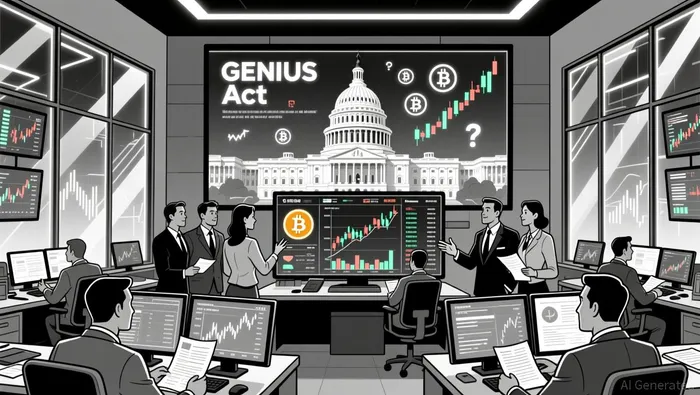
These policies have catalyzed institutional adoption. By August 2025, 76 spot BitcoinBTC-- exchange-traded funds (ETFs) had been listed in the U.S., with cumulative assets under management (AUM) reaching $140 billion by early November 2025. The administration's emphasis on innovation-friendly regulation has also spurred global competition, with 70% of jurisdictions reviewed in 2025 advancing new stablecoin frameworks.
However, the administration's focus on Wall Street integration has left gaps in support for domestic Bitcoin miners, who faced economic headwinds post-halving and high network difficulty in 2025. This divergence between policy rhetoric and on-the-ground realities highlights the need for investors to critically assess where capital can be most effectively deployed.
Market Reactions and Investor Strategies
The market's response to Trump-era policies has been mixed but largely positive. A study published on SSRN found that Trump-related crypto policy events in 2025 and 2026 generated a collective positive abnormal return of 2.22% over a three-day window, with symbolic actions (e.g., the announcement of a Strategic Bitcoin Reserve) eliciting the strongest reactions.
For investors, the key to capitalizing on this environment lies in strategic positioning. The SEC's 2026 examination priorities no longer list crypto as a standalone focus, signaling a normalization of the asset class. This shift aligns with the administration's broader goal of integrating crypto into traditional finance, as evidenced by the SEC's formation of a Crypto Task Force and the CFTC's expanded jurisdiction over decentralized assets under the proposed CLARITY Act according to industry reports.
Investors should prioritize jurisdictions with clear regulatory guardrails, such as the U.S., EU, and parts of Asia, where financial institutions have announced digital asset initiatives at a rate of 80% in 2025. Opportunities in stablecoins, institutional-grade digital asset platforms, and decentralized finance (DeFi) infrastructure are particularly compelling, given the GENIUS Act's emphasis on reserve transparency and anti-money laundering compliance according to policy analysis.
Risks and Considerations
While the regulatory tailwinds are undeniable, investors must remain cautious. The Atlantic warned in November 2025 that the Trump administration's reliance on self-regulation for stablecoins could exacerbate systemic risks, particularly in the event of a reserve collapse. Additionally, the administration's neglect of domestic Bitcoin mining infrastructure-despite its public championing of the asset-raises questions about long-term sustainability.
The Basel Committee's 2025 reassessment of prudential rules for banks' crypto exposures further complicates the landscape, as it may reintroduce capital requirements that dampen institutional participation. Investors should monitor these developments closely and diversify their portfolios to mitigate sector-specific risks.
Conclusion
The Trump administration's 2026 regulatory framework has created a fertile ground for U.S. crypto firms to thrive, but success will depend on investors' ability to navigate both the opportunities and the inherent risks. By leveraging policy clarity, prioritizing innovation-friendly jurisdictions, and hedging against systemic vulnerabilities, investors can position themselves to capitalize on the next phase of the crypto market's evolution.







Comentarios
Aún no hay comentarios